Start in high school to strengthen the accounting profession
A practitioner-led initiative to spark high school students’ interest in an accounting career is showing promising results.

Editor’s note: This is the first of two parts. Part 2, running in August and titled “How to Set Up an Effective Internship Program,” examines the critical role of college-level accounting internships.
The accounting profession’s workforce and talent development issue starts with students never even considering accounting in the first place.
Today’s high school students likely have never met one of the many accountants who truly love what they do. They probably don’t understand the wide variety of roles accountants play and the myriad ways accountants make an impact in the economy and their communities. And they almost certainly are unaware of all the career paths offered by an accounting degree.
A practitioner-led initiative developed through a university-based collaboration offers a strategy to engage high school students and reshape perceptions of accounting careers.
In 2022, faculty of the School of Accounting (SoA) at the University of Nebraska at Omaha (UNO) and practitioners from a variety of firms and companies in the region came together to forge the Four-Stage High School Initiative, a partnership among the faculty, the professionals, and the local high schools.
It started with the SoA’s accounting advisory board, composed of accounting community members representing a wide variety of firms, companies, nonprofits, and government functions. The board was keen to see the SoA become more involved in the Nebraska community. From these discussions, the initiative began with the creation of a standing advisory board (SAB) to develop focused strategies for spurring the accounting profession’s growth and success. Since then, 28 professionals and 12 SoA faculty have been involved in the initiative.
The initiative’s goal is to inspire students to pursue the accounting profession, regardless of which university or college they ultimately attend.
Our initiative starts early. High school is where career dreams are formed (or dismissed). And accounting isn’t on most teens’ radar. Their first real brush with the profession may not come until they take their first introduction to accounting course, perhaps as late as their sophomore year in college. That is too late.
Practitioners need to be in classrooms telling a different story: that accounting is strategic, global, people-centered, and tech-integrated and that it offers a seat at the leadership table (see the June 2026 JofA article, “What It Takes for a CFO to Lead Operations and Tech“). But storytelling during a school’s career day isn’t enough. We also need structure, follow-through, and scalability.
The Four-Stage High School Initiative is a full-scale, practitioner-academic partnership that unfolds in interconnected stages. Each stage builds credibility, connection, and career curiosity.
STAGE 1: A STANDING ADVISORY BOARD WITH PURPOSE
The SAB is the initiative’s engine. SAB members are early-career professionals who have graduated with an accounting degree in the past four to 10 years. They bring the energy and proximity to connect with students. SAB members also serve as a strong pipeline to the accounting advisory board.
SAB members cold-email teachers, plan classroom visits, organize educator roundtables, and partner with student groups to amplify their reach. They serve as career myth busters who break the “boring” narrative with personality, honesty, and relatability. They:
- Debunk the myths: It’s not all math, and no, you don’t need to love spreadsheets.
- Provide real talk about salaries, job stability, flexibility, and career variety.
- Serve as role models who show what it’s like to be an early-career professional in today’s world.
In just a few years, we have reached more than 500 students face to face, teachers are asking us back, and students are engaging with real questions.
STAGE 2: WHERE FUN MEETS THE FUTURE
Students need something immersive. To make them feel what it’s like to be part of the accounting world, we launched a multiday camp called Accounting Adventures — a name we have trademarked — that is designed to be immersive, fun, and future-focused.
Over five days, students experience:
- Field trips to public companies and private firms.
- Fraud games and case-solving competitions.
- Q&A panels with early-career CPAs.
- College prep guidance.
- Team-building games with actual prizes.
The camp is equal parts inspiration and information. We start with a theme such as fraud, ethics, forensic accounting, or artificial intelligence (AI) in accounting. We recruit four to five speakers from diverse career paths; use breakout games, group projects, and mock investigations to make it interactive; and let students drive the conversation during the Q&A panel. Following the camp, we conduct a survey and use the feedback to improve the camp experience.
The camp is affordable ($20 per student), and attendance is capped at 20 students for personalized interaction. We offer a hardship waiver for students who are unable to pay the camp registration fee.
In 2025, the camp offering moved from a day format to an overnight format. Demand for the camp, which was offered in summer 2025, exceeded capacity, and registration was full. Feedback from students and practitioners was overwhelmingly positive. The summer 2026 overnight camp is being offered in July 2026, with an increased seat cap of 25.
STAGE 3: BIANNUAL MINI CAMPS
The demand for the summer camp and feedback from participants encouraged us to develop mini camps, held in the fall and spring semesters. With a capacity of 180, these half-day programs provide even more high school students a glimpse into the college experience. The mini camps offer a taste of the summer camp experience, showcasing popular activities from the summer camp (e.g., an Accounting Jeopardy game and fraud case study activities) and also allowing students to explore the diverse and dynamic career opportunities in the accounting profession.
We have held three mini camps with 50 students attending in fall 2024, 30 in spring 2025, and 80 in fall 2025. Interest continues to grow, with 110 students in attendance at our spring 2026 mini camp. We gathered feedback from these attendees about their college interests and mini-camp experience. We received strong and encouraging feedback with highly positive responses overall regarding both learning outcomes and exposure to the accounting profession. As shown in the table “Attendees’ Experience at the Mini Camp,” we received 109 responses from 110 participants, which reflects outstanding engagement and enthusiasm.
The results are especially encouraging with regard to students’ educational interests, as shown in the table “Mini Camp Attendees’ Interests After High School.” Students indicated strong interest in pursuing a bachelor’s degree, and over half reported an interest in pursuing an accounting degree. Three-fifths reported an interest in learning more about accounting and the profession.
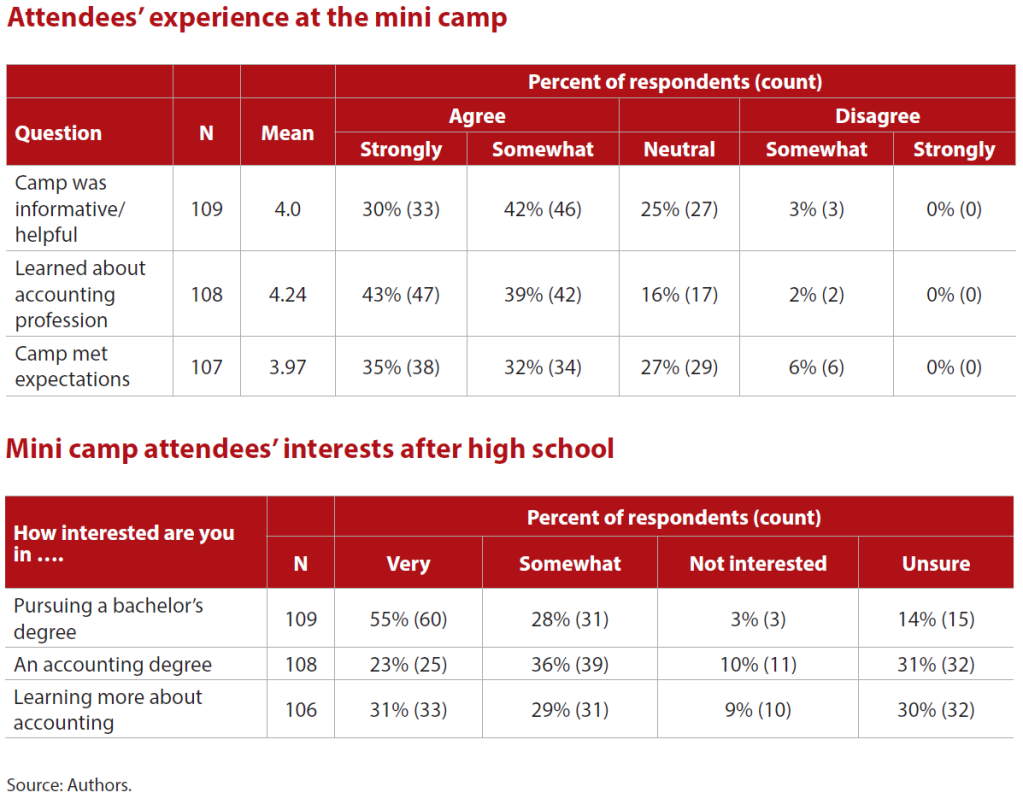
These results demonstrate the camp’s meaningful impact in increasing awareness about the value of higher education and generating an interest in the field of accounting.
Students still unsure about accounting (approximately one-third) present a significant and promising opportunity to encourage undecided students to consider pursuing an accounting degree and the profession. This makes our efforts in high school outreach even more critical. We can make quite a significant impact if roughly 30% of high school students are ready to be convinced. We believe, and our feedback supports, that our mini camp is an extremely effective method for doing precisely that.
Finally, we asked students an open-ended question: What can we do to improve? Student suggestions clustered around a few clear themes. (See the table “Attendees’ Suggestions for the Mini Camp.”) Nearly 100 students responded to this question, demonstrating strong engagement and participation. The most common response was “no change,” indicating many participants were satisfied with the overall experience. Among actionable suggestions, students most frequently requested greater interactivity and more hands-on activities, such as reducing time spent sitting and incorporating more movement, tours, or interactive components.
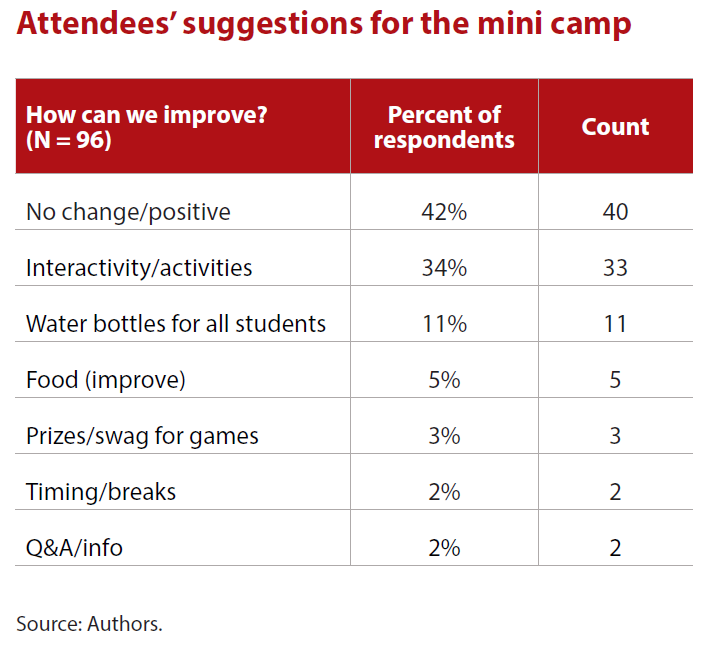
Across all feedback, the results present a consistently positive picture of the mini-camp experience. On the scaled items, students reported high satisfaction and strong perceived learning, particularly in gaining a better understanding of the accounting profession, and agreed that the camp was informative and met expectations.
The open-ended responses reinforce these patterns: Many students reported that no changes were needed, and when suggestions were offered, they were largely incremental and actionable (e.g., adding even more interactive and hands-on activities). Overall, the combined quantitative and qualitative feedback indicates the outreach format is resonating with participants and offers clear direction for refining future camps.
STAGE 4: CLASS OFFERINGS TO MAKE IT SUSTAINABLE
One of the earliest points of introduction to accounting occurs in high school accounting courses. We realized that these courses, when they exist, often reinforce the “bookkeeping for administrative assistants” narrative. They are vocational, outdated, and disconnected from the dynamic realities of the profession.
For decades, math and science advanced placement (AP) courses have provided an opportunity to teach those fields as skill sets, but no such AP course exists for accounting. We needed to develop a comparable course on our own. This resulted in a dual-credit accounting course at UNO for high school students with full college credit.
The dual-credit course, offering three college credit hours, would not be just a bookkeeping course. We designed a course that teaches decision-making, business impact, and ethical judgment, which are the same content we teach to nonbusiness majors at the university.
We train teachers and assign a faculty liaison to support course instruction. As a result, students get a real taste of accounting’s value early.
One high school enrolled 30 students in the first semester and is now thinking about expanding to two sections. We have added another high school and are actively recruiting more. This creates a talent stream of students who already feel connected to accounting and who have already passed college-level material. One of the high school teachers is now teaching the same course at UNO as an adjunct. Thus, this stage of our Four-Stage High School Initiative not only introduces students to the knowledge of accounting but also provides professional development opportunities to high school instructors.
Finally, to protect the initiative from petering out should one champion move away, we adopted several sustainability actions. We document everything, e.g., presentation templates, camp agendas, and outreach strategies, to make it easy to pass the baton, and we track engagement and student outcomes for reporting. This documentation is then used to develop practical materials for sustaining momentum, including:
- Templates for school visits: Agendas and presentation decks for practitioner volunteers to quickly adapt in preparation for their event.
- Camp program folders: Digital and hard-copy road maps that lay out the process and activities conducted during camp events.
- Handoff manuals for SAB members: A training guide to easily transfer knowledge from one member to another, and guidelines for the structure and processes of the SAB itself.
- Standing funding requests with partners: Documents including detailed feedback and updates, supported by positive reports on student engagement and outcomes.
THE PROFESSIONAL ROLE IN CHANGING MINDS
Practitioners are the accounting profession’s brand ambassadors. Whether you are a sole practitioner or a Big Four partner, a new managerial accountant or a CFO, your story matters. Every student you reach changes their perception of accounting. Every parent you talk to reconsiders what they tell their kids. Every teacher you support becomes a stronger advocate.
Here is what you can do right now:
- Be an active accounting or standing advisory board member for your local university.
- Volunteer for high school presentations or panels.
- Offer a field trip or host a lunch-and-learn for students at your office.
- Sponsor a student’s camp fee or travel costs.
- Mentor a high-schooler curious about the profession.
- Work with your alma mater to launch a dual-credit course.
- Get your firm involved — the return on investment is long-term talent supply.
THIS IS OUR MOMENT
We need to show up. We need to remind people what this profession has always been about: ethics, trust, clarity, and strategic leadership and that these continue in this age of AI, other advancing technology, and globalization.
This is about the future of the accounting profession. The goal isn’t to push students into one university, one firm, or one credential. It’s to show them that accounting is a profession worth exploring and worth sticking with. If we want a future with trusted advisers, ethical leaders, strategic thinkers, and business influencers, we need to invest in them now.
This is just the beginning. The work doesn’t end at high school graduation. Sustaining students’ interest in accounting through college and into the profession requires ongoing commitment. Early exposure in high school can spark intent, but moving students through the college curriculum and into meaningful careers demands deeper engagement from educators and employers alike.
For more information about starting your own SAB and high school initiative, please contact us at rvenkatesh@unomaha.edu.
The authors would like to thank the following current and past members of the UNO School of Accounting’s advisory and standing advisory boards for their support of the Four-Stage High School Initiative: Leonard Sommer, Dan Kinsella, Doug Ewald, Dan Koraleski, Kailey Riskowski, Jenny Mickeliunas, Jerry O’Doherty, Nicole Cooper, Patrick Hodson, Adam Stahlecker, Colin Siert, and Cecilia London.
About the authors
Roopa Venkatesh, Ph.D., CMA, is director of the University of Nebraska at Omaha School of Accounting and a member of the Institute of Certified Management Accountants Board of Regents. She also serves on the International Panel on Accountancy Education at the International Federation of Accountants. Jennifer Riley, CPA, Ph.D., and Xiaoyan Cheng, Ph.D., are professors at the University of Nebraska at Omaha School of Accounting. Lori Simonsen, CPA, is a lecturer at the University of Nebraska at Omaha School of Accounting. To comment on this article or to suggest an idea for another article, contact Jeff Drew at Jeff.Drew@aicpa-cima.com.
MEMBER RESOURCES
Articles
“Accounting Opportunities Experience: Inspiring the Next Gen,” AICPA and CIMA, March 24, 2026
“Teen CPA: Caleb Byers Earns His License Before Age 20,” JofA, Jan. 27, 2026
“What Does an Accountant Do? Exploring Key Tasks, Career Paths, and Earning Potential,” AICPA and CIMA, Nov. 7, 2025
“High School Outreach to Boost the Accounting Pipeline,” JofA, Aug. 1, 2025
“Pipeline Update: Perceptions of Accounting Brighten Among Students,” JofA, April 30, 2025
Podcast episode
“Accelerating Accounting Outreach, a CPA Leader’s Campus Return,” JofA, Nov. 20, 2025
Websites
Accounting Profession Education
Professional initiative
Pipeline Pledge: A self-paced pledge to take action to improve workforce and talent development and change the narrative about accounting.