How to set up an effective internship program
Learn what practitioners can do to attract stronger internship candidates and build a robust on-ramp for long-term accounting careers.

Editor’s note: This is the second of two parts. Part 1, titled “Start in High School to Strengthen the Accounting Profession,” describes a practitioner-led initiative that sparks high school students’ interest in an accounting career.
Internships are important on-ramps into the accounting profession, but they’re not working equally well for everyone.
Students are eager for experience. Many firms are eager for talent. And yet, a surprising number of qualified accounting students can’t land internships, while employers continue to report gaps in skills, communication, and readiness.
To better understand how accounting internships are working and where they’re falling short, we surveyed two key groups: 100 undergraduate and graduate accounting majors and representatives of 22 employers from local firms to regional offices of national companies actively hiring and managing interns. The survey was conducted over several months beginning in late 2024 into 2025. Students were enrolled at a large, public university, and employers ranged in size from local to international firms and companies.
INTERNSHIPS ARE COVETED, BUT ACCESS IS UNEVEN
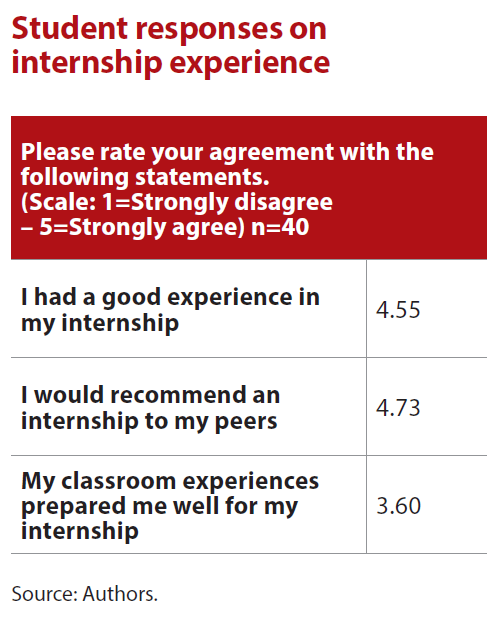
Students reported strongly positive internship experiences and overwhelmingly recommended internships to their peers. (See the table “Student Responses on Internship Experience.”) For them, internships offer a chance to apply classroom learning, build confidence, and earn a fast track to full-time employment.
For employers, internships function as extended interviews and essential components of the recruitment process. (See the table “Employer Responses on Internship Motivation.”)
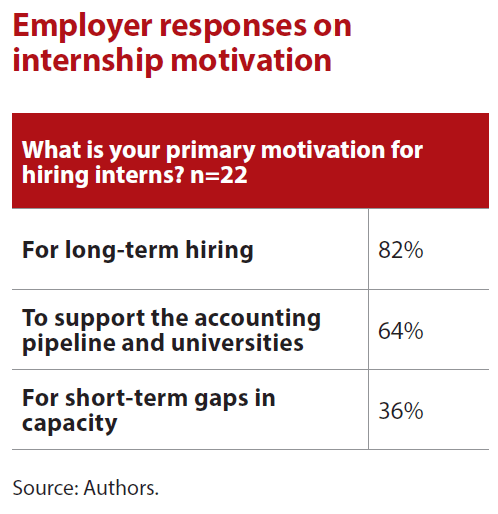
In our regional survey of internship employers, hiring and supporting workforce and talent development are the main reasons for hosting interns. And it works — 60% of students with internship experience received job offers, and most intended to accept.
Despite broad agreement about their value, access to internships remains uneven. In our survey, only 42% of students had completed an internship, and only another 6% had one lined up. Among the remaining students, 87% said they wanted one, but 60% reported hitting barriers, including lack of experience, unclear application timelines, or simply not knowing how to get started. Several students pointed to a perceived “insider track,” with one remarking, “It’s all about who you know.”
Students who had secured internships described strong support systems such as family connections, faculty referrals, and involvement in professional student organizations like Beta Alpha Psi. These informal advantages played a critical role in access. When firms rely on “who you know” processes, they may unintentionally overlook capable candidates who just need a foot in the door.
Employers emphasized intern performance and attitude over credentials. One firm noted they extend job offers to interns who “improve on feedback, show strong communication, and demonstrate a desire to learn.”
Still, firms expressed concern about gaps in preparation, especially in soft skills and Excel. Interns were described as bright but sometimes uncertain, hesitant to ask questions, unsure of workplace expectations, or lacking polish in communication. A 2023 survey of 800 U.S. companies by Intelligent.com, an online research site devoted to higher education and early professionals, found that these concerns have only intensified post-pandemic, when virtual learning disrupted students’ chances to build confidence in professional environments.
HOW TO SET UP AN EFFECTIVE INTERNSHIP
Gen Z students are navigating career decisions in a world of rising costs, shifting credentials, and evolving definitions of professional success. They are looking for clarity, support, and a sense that they’re being developed, not just used.
When you recruit matters
Many students reported frustration with how early internship recruiting begins, especially among large firms. Some commented that interviews and offers take place in the fall of junior year or even earlier, long before they’ve completed upper-level accounting courses.
At the same time, employers expressed concern that interns lack exposure to Excel, tax software, or accounting systems. These two issues are connected. Students are being hired before they’ve had the chance to develop technical readiness.
Still, many interns performed well despite their initial inexperience. Employers praised their adaptability and quick learning. One noted that interns “learn tax software very quickly and get up to speed in just a few weeks.”
Practitioner takeaway: If your firm recruits early, calibrate expectations accordingly. Provide foundational training in the first few weeks and consider targeting juniors who’ve completed more coursework. You may also explore “early access” programs for underclassmen that focus on exposure, not execution. (See “Adding Externships to Attract More Talent” in this issue.)
Support makes the difference
Of students without internships, 60% said they encountered obstacles from unclear application processes to lacking the right contacts. Among students who had internships or offers, 68% said they encountered no barriers at all.
What made the difference?Support. Students who landed internships consistently mentioned faculty referrals, family connections, and Beta Alpha Psi events. In short, they had someone in their corner and someone showing them the path. These informal networks played a pivotal role, and they aren’t equally available to all students. This inequity limits the profession’s talent pool.
Talented candidates may be overlooked simply because they didn’t have access to insider knowledge or support navigating the process.
Practitioner takeaway: Expand your recruitment funnel beyond the usual suspects. Partner with career centers, speak in classes, or host résumé and application workshops for students new to the field. Better yet, make your application process more transparent and accessible so that “who you know” doesn’t define who gets a chance.
Emphasize what you value in recruiting
The average employer rating for GPA importance was 3.73 out of 5, falling between “neutral” and “some emphasis.” What mattered more? Professional presentation. With an average rating of 4.18, how a student carries themselves, and how they communicate, dress, and engage were rated as more important than academic metrics.
In fact, many employers said they rarely screen out candidates by GPA as long as they come across as professional, adaptable, and eager to learn. Recommendations from professors or previous supervisors carried more weight than a transcript.
Practitioner takeaway: Don’t overemphasize GPA in recruiting language and hiring decisions, and make sure students know what matters. Consider sharing evaluation rubrics or offering mock interviews to help candidates understand what you are looking for.
Offer nontraditional internships
A surprising number of students didn’t know internships existed in nontraditional areas such as IT assurance, consulting, business analytics, or internal audit until it was too late to pursue them.
Practitioner takeaway: Students are more engaged and committed when they understand the full range of career paths available to them. Interns who find a good fit are more likely to return and bring others with them. Practitioners can increase awareness of nontraditional accounting internships by being explicit about them. Firms should label and promote internships in areas by name, such as internal audit, forensic accounting, analytics, sustainability reporting, and technology, when speaking in classrooms or at Beta Alpha Psi events, hosting office visits, and posting opportunities widely online.
Provide structured guidance
Many students don’t understand how demanding the busy season or part-time internships can be, especially when paired with full course loads. Clearer guidance on scheduling, workload, and expectations helps prevent burnout and sets interns up to succeed. Similarly, inconsistent or informal feedback can leave even strong interns unsure of how they’re doing.
The frequency of intern evaluations varied widely, from formalized weekly meetings to informal, “as needed” check-ins to no evaluations at all. Students generally place value on responsive, supportive mentoring.
Structured check-ins and mentorship, however light, can dramatically improve intern performance, confidence, and conversion to full-time roles. Interns who receive consistent mentorship are more productive, more accountable, and more likely to return as confident, capable hires.
Practitioner takeaway: Meeting students where they are and being clear about what you offer isn’t just good practice. It’s good business. Interns who feel supported perform better, stay longer, and return stronger.
Connect internships to long-term career growth
While 64% of employers said interest in CPA licensure was important or very important in hiring, students rarely mentioned credentials unless prompted. The result? A missed opportunity to connect internships to long-term career growth.
At the same time, some students may not be sold on the pursuit of a CPA career, concerned about cost and the extra credit hours some licensing jurisdictions require. Visible and flexible support can help ease these worries.
Practitioner takeaway: Promote CPA licensure support during recruiting — not after hiring. Highlight bonuses, paid study hours, or access to materials in internship job descriptions and information sessions. Doing so may boost application rates and signal long-term investment in students’ careers. (Also see, “How One Firm Helps Recruits Pass the CPA Exam,” JofA, Aug. 1, 2025.)
People skills are essential
Employers are clear about what separates a good intern from a great one. It’s communication, professionalism, and teachability. (See also “People Skills: You Are a Human Being, Not a Human Doing,” JofA, May 1, 2026.)
When interns struggled to ask questions, gave up too easily when confused, or missed the tone of professional emails, employers flagged these gaps as persistent and problematic even when interns had strong technical skills.
Among the most valued competencies, employers highlighted verbal and written communication (95%), willingness to learn (86%), time management (68%), and overall professionalism (68%). While these competencies may be developed to some extent during an in-person internship, they are especially crucial to already exist in hybrid or remote settings, where interns may not get informal coaching.
Practitioner takeaway: If you want stronger interns, invest in early feedback and explicit communication training. Encourage managers to normalize asking questions and model professional behavior. Build people skill assessments into performance reviews.
RECOMMENDATIONS FOR PRACTITIONERS
To ensure internships lead to stronger talent, more inclusive access, and long-term career commitment, firms should consider the following tactics:
Clarify and communicate expectations
- Be explicit about what matters. Let students know early that professionalism, communication, and adaptability are top priorities.
- Simplify your recruiting process. Clear job descriptions, timelines, and expectations reduce confusion and encourage a wider pool of applicants.
- Share what interns can expect. Include typical duties, team structure, and how performance will be evaluated. Students value transparency and perform better when they understand the rules of the game.
Invest in intern development from day one
- Offer structured onboarding. A short training plan on tools, systems, and communication norms makes interns more productive and less overwhelmed.
- Assign mentors. Pair interns with staff who can offer guidance, model professionalism, and answer questions.
- Give regular feedback. Don’t wait until the end. Brief weekly check–ins or informal reviews make a big difference, especially for students new to the workplace.
- Allow client interaction. Let interns observe selected client meetings or calls to see professional communication and client service in action.
Promote CPA licensure pathways and other accounting certifications upfront
- Advertise your CPA support. Many firms already offer great benefits, including study time, exam fee reimbursement, and completion bonuses, but students often don’t hear about them until after they have accepted the internship.
- Frame internships as a CPA launchpad. When firms connect internship roles to a longer career path, they send a message: “We are investing in you.”
Broaden workforce and talent development
- Reach beyond traditional recruiting pools. Consider working with universities to engage students who may not be involved in Beta Alpha Psi or other professional networks.
- Support first–generation and underrepresented students. Offer résumé reviews, application workshops, or early–exposure site visits.
- Offer flexibility. Consider hybrid schedules, extensions beyond busy season, or part–time roles for students balancing coursework and family responsibilities.
- Communicate the broad variety of career pathways, not just audit and tax.
Stay connected with educators
- Collaborate with faculty. Offer guest lectures, share feedback on student preparation, and co–design assignments that reflect real–world tasks.
- Help align curriculum with practice. Your input on Excel, accounting systems, and communication expectations helps schools close the preparation gap.
- Advocate for credit and compensation. Work with universities to ensure internships count for academic credit, and push for fair pay to eliminate financial barriers.
RECOMMENDATIONS FOR EDUCATORS AND INTERNSHIP COORDINATORS
- Embed real–world simulations into coursework that mirror internship duties such as mock audits, client memos, and financial reports, not just textbook exercises.
- Partner with employers to align course modules with current tools (e.g., Excel, QuickBooks, and tax software).
- Advocate for internship credit and help students navigate application strategies and credentialing pathways.
- Identify and coach students who lack professional networks, especially first–generation, transfer, or nontraditional students.
- Host early–exposure opportunities like site visits, guest panels, and résumé workshops.
- Standardize recruiting timelines and reduce confusion by aligning with employer expectations.
About the authors
Roopa Venkatesh, Ph.D., CMA, is director of the University of Nebraska at Omaha School of Accounting and a member of the Institute of Certified Management Accountants Board of Regents. She serves on the International Panel on Accountancy Education at the International Federation of Accountants. Jennifer Riley, CPA, Ph.D., and Xiaoyan Cheng, Ph.D., are professors at the University of Nebraska at Omaha School of Accounting. Lori Simonsen, CPA, is a lecturer at the University of Nebraska at Omaha School of Accounting. To comment on this article or to suggest an idea for another article, contact Jeff Drew at Jeff.Drew@aicpa-cima.com.
MEMBER RESOURCES
Articles
“Accounting Opportunities Experience: Inspiring the Next Gen,” AICPA and CIMA, March 24, 2026
“What Does an Accountant Do? Exploring Key Tasks, Career Paths, and Earning Potential,” AICPA and CIMA, Nov. 7, 2025
“High School Outreach to Boost the Accounting Pipeline,” JofA, Aug. 1, 2025
Podcast episode
“Accelerating Accounting Outreach, a CPA Leader’s Campus Return,” JofA, Nov. 20, 2025
Websites
Accounting Profession Education
For more information or to make a purchase, go to aicpa-cima.com/cpe-learning or call 888-777-7077.