- podcast
- NEWS
Telling a better CPA story, one T-shirt and LinkedIn post at a time
Sponsored by Practising Law Institute
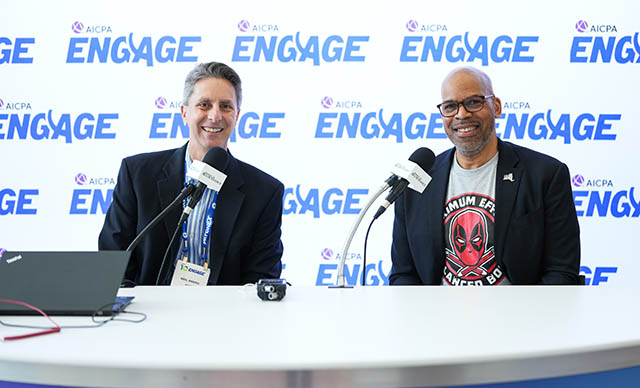
Calvin Harris, CPA, the CEO of the New York State Society of CPAs, returned to the JofA podcast to discuss why storytelling, humor, and personal connection are essential to the profession’s future.
In an episode recorded in June at ENGAGE, Harris shared how everything from T-shirt jokes and LinkedIn posts to podcast interviews can help strengthen accounting’s relevance and keep students and professionals engaged. He also discussed progress on the talent pipeline, lessons from hosting his state society’s podcast, and the value of bringing accountants together through conferences and networking.
What you’ll learn from this episode:
- Why Harris wore a Deadpool-themed shirt the day of the episode’s recording.
- How selfies featuring his accounting-themed T-shirts began showing up on LinkedIn and how those posts have sparked conversations about the profession.
- His insights on the accounting talent pipeline opportunities and trends in CPA licensure pathways.
- The unexpected lessons Harris has learned from hosting the New York State Society of CPAs’ podcast.
- How conferences in general, particularly ENGAGE, provide a “chance to connect.”
- How telling better stories about CPA career paths can grow the profession’s relevance.
Play the episode below or read the edited transcript:
— To comment on this episode or to suggest an idea for another episode, contact Neil Amato at Neil.Amato@aicpa-cima.com.
Transcript
Neil Amato: This is Neil Amato. Welcome back to the Journal of Accountancy podcast, recording from ENGAGE. This episode is set to air in summer of 2026. Our guest is the CEO of the New York state society, Calvin Harris. You’ll hear our conversation coming up right after this brief sponsor message.
[Sponsor message]
Amato: Welcome back to the show. As I said, our guest is Calvin Harris, the CEO of the New York State Society of CPAs. He’s a guy who’s run one of the world’s major marathons several times. He’s the wearer of T-shirts with accounting puns. He even calls them bad accounting puns. And he’s a podcast host himself. Calvin, welcome back to the JofA podcast.
Calvin Harris: Neil, I’m really glad to be here again. So good to see you. So good to talk with you. I’m chuckling because none of those things you said were the case when we first talked. So it’s like, you know, life comes at you fast.
Amato: Yeah. That was, I believe, back in late 2021. Was it Nashville, Tennessee?
Harris: Wow, good memory. You’re right. It sure was. I did not remember that until this moment. Yeah, it was Nashville, Future of Finance, I think, with the AICPA. You know, very much appreciate what they’re doing. In fact, we’re trying to do a modified version in New York. So, you know, full circle.
Amato: Let’s talk some about the New York state society. First, tell people, how long have you been the CEO of that state society?
Harris: Yeah, I’ve been the CEO for just over four years. I would say they are four of the fastest years of my life. It seems like I just got to New York, but it’s been more than seven years at this point. So yeah, four years as a CEO in New York. And really loving it.
Amato: Yep. And before that, CFO of the National Urban League?
Harris: Right. Yep. Three years there. That’s the job that had me go from Maryland to New York.
Amato: Tell me first — we’re at ENGAGE. This is not going to air in ENGAGE Week, but it’s going to air close to it. Why do you like coming to conferences such as this?
Harris: Yeah, well, I would say first that ENGAGE is a one-of-one sort of deal. And I’m not saying that because I’m on your podcast. It’s because I’ve seen it and I’m convinced. Really, my idea of coming, because this is just my second year, came from my fellow state society CEOs. Even though there are 50 states, four territories, and just as many CEOs or executive directors, we actually maintain very, very close contact with each other.
And more than a few of my colleagues told me for the two years prior to that, that you really need to get to ENGAGE. You’ve got a lot of your New York members here. There are a lot of partners that would like to work with New York, so it just makes sense. And I came last year, and it was hard to not be overwhelmed by how many great conversations. I mean, the sessions alone are fantastic. I often don’t have much time to go to those sessions, frankly, because I end up finding the highest and best use of my time as CEO is really getting around and talking to potential partners. I can get my CPE elsewhere if I need to. But yeah, the conversations are amazing.
Amato: What are some of the conversations? We’re just kicking off this year, but I assume there’s going to be at least one word, or one two-letter thing, that’s going to come up in some of the conversations this year: AI.
Harris: For sure. That’ll be in there all the time. And funny, as we were just chatting about this before I got on mic, this game, and I want to emphasize the word “game,” will be over by then. But we have, you know, created, with my friend and colleague, Byron Patrick —
Amato: Partner in crime Byron Patrick.
Harris: An ENGAGE bingo game, which by the time this airs, we’ll know if it was successful or if it was just a stupid idea. Either one is possible.
But it’s based on AI. So how many AI terms you can hear or see at ENGAGE, and you say, bingo. Now, the prize is, there is no prize. You just take a selfie with me or Byron. Both should get double credit, which is still nothing. But to that point, he was making a joke in a post I saw saying, “Hey, I’m headed to ENGAGE. AI will probably be the topic of the week.” I’m like, “Hey, let’s make a game out of it.” So, you know, I like to have fun.
But AI will absolutely be one of the words. Change will be the word. The word pipeline will still come up. Those issues, I’m making fun of them, make light of them, but they’re all serious, serious issues that are affecting the accounting profession in ways we’ve literally never seen before, so it’s an exciting time.
Amato: Yeah, the prize is getting a selfie with your Byron and then getting in one of your LinkedIn posts.
Harris: Yeah, that’s the thing. You’ll end up in there. I will say that I will freely admit that my approach to social media is probably a little different than some would expect from a state society CEO. But I figure that you can be serious about your work and serious about the issues and still try to have fun at the same time.
I mean, look, next year will mark my, which is mind-boggling as I say this, but next year will be my 30th year of being licensed as a CPA. That is wild to me because I remember how hard it was to pass the exam and I’m about to hit my 30th. And look, I had a 30-year career in accounting before I even took the job of CEO. So I’m certainly someone that understands the profession.
And I’m like, well, hey, the issues that we’re dealing with are really heady issues. And frankly, sometimes just having some fun or wearing a fun T-shirt or having a fun LinkedIn post or a silly game is a way to blow off steam, but it’s also a way to bring attention to some of the issues.
I do realize that the things that I seem to be recognized for the most are the things like the T-shirt, like I have a T-shirt on right now that will undoubtedly be funny for some people. But what I always try to do is sneak in a lot of information in there.
If you look at my social posts, particularly on LinkedIn, on Wednesday, I like to talk about some current issue happening in the profession. On Thursday, I like talking about someone I do a tribute to. I admittedly love history, and I could bore you to tears about some of the things that are just so amazing about the accounting profession in New York and how many things began in New York state. So I am a student of history, but I believe that history is something we can absolutely learn from to help make sure we don’t make the same mistakes in the future.
Amato: I don’t think you’d bore us to tears at all. We’ll save that for another conversation. We will mention you do have a Ryan Reynolds-themed shirt on. But I will ask about the T-shirts.
Harris: Yeah. So every Tuesday I post a T-shirt, and it began as a joke. It literally was a joke. So New York is the home of Peloton, the Peloton studios, the bike and the treadmill and all those things. And when I first came to New York, I would go there all the time. I don’t go there as much. The CEO job is kind of busy, so I don’t get there as much as I used to.
But one of the things that I did near Christmas one year is I had on a T-shirt that said “Santa’s favorite accountant.” I just thought it was funny to wear to the studio, and someone thought it was funny. They took a picture of me in front of the Peloton sign. And I don’t remember what colleague, but one of my colleagues saw it and said, you know, you should post that on LinkedIn. I said, that doesn’t even belong on LinkedIn. They said, why not? And I posted it, and it was all this response. I was like, oh.
So every once in a while I posted, and after a while, it just came to be a thing. So now I just post a T-shirt almost every Tuesday. The one I have today is admittedly Ryan Reynolds-themed because at the time of us recording, Ryan Reynolds will be giving a keynote later today.
So I have an absolutely questionable in terms of copyright infringement [shirt], considering it’s got a Deadpool head on it. But yeah, I love making funny accounting jokes to show that, hey, you can be serious about your job, you can be serious about the profession, and still have fun at the same time.
Amato: Yeah, you can be. It does help. It does add to the engagement, and it brings attention to those serious issues. I mean, the state of talent in the accounting profession, what are these trends that are kind of bubbling up right now as we’re in the middle of 2026?
Harris: Yeah, I think, Neil, what’s so interesting now is that the issues you’ve been talking about with the pipeline and when we had the National Pipeline Advisory Group and all those issues still remain, but we’re seeing a lot of movement.
We’ve absolutely seen where accounting majors have increased. I happen to believe that the addition of the 120-credit-hour as an additional pathway, at the time of us recording, we’ve got 41, if my math is right. So you’re getting almost all the way there.
Amato: That’s 41 states.
Harris: It’s 41 states with it in there. Not all of them are effective. New York is technically effective in November of 2026. You know, just an implementation period, but we’re included in that 41.
But I think we’re seeing that the things are going to expand. Where I think we have something that we cannot forget to look at, though, is the middle. You think of any, we use the word pipeline, so you think about it as a pipe. I’m no plumber, but I know this much: Water goes in on one end, water goes out on the other end. But if your pipe has holes in it, there’ll be no water either way.
So I think as important and critical as it is for us to pay attention to the front end of that pipeline, I certainly do. We have to make sure that we’re not forgetting to do the things that will make the profession relevant. You know, something like ENGAGE, I think, is right in there, of showing, of allowing accountants and CPAs to gather as many ways as we can, but those issues are still the same.
And I am excited. I know that the AICPA is about to launch a branding on CPA Trust. Funny enough, my next T-shirt Tuesday, by the time this airs, it would have already happened, is I’m one of the people doing a T-shirt on that [CPA Trust] campaign. But I think it’s critical because for all the things we’re looking at technically, we also have to think about the relevancy of the profession.
Is the profession interesting? Can we prevent people from really meaning it when they say, “I think accounting is boring?” Perish the thought. I don’t think there’s anything boring about it. But I do think we have a long way to go in communicating it and making it interesting. So for me, I try to do my little part of adding some levity to it all.
Amato: I think you’re definitely in the “I’m gonna tell a better story” camp. That’s one of the key things.
Harris: No doubt.
Amato: And you do it. And I’m not trying to say no one does it better, but you have to be one of the best.
Harris: Oh, thank you. I try. Look, I borrow and steal a lot of ideas, I will admit. But hey, I think it all helps.
Amato: As long as you admit that, then you’re good. You’re sourcing your info. Tell me about the podcast. When did you decide that you were going to host a podcast?
Harris: Yeah, thanks for asking about that. So NYSSCPA, the New York State Society of CPAs, has a podcast. Right now it’s monthly. We’re thinking about whether we can do it more frequently, but we pulled back to monthly, called The Trusted Professional Podcast. I’m the host, and I like to acknowledge, even though I’m the CEO and I realize I get to make the call on this sort of thing, it wasn’t really my idea to be the host.
I’m not sure who on the staff said they thought I should do it. And I’m not saying I pushed against it. I didn’t push against very hard. But at my prior employer, the Urban League has a podcast, and the CEO was never there. I mean, I shouldn’t say it that way, but by design, there’s someone else that does the podcast.
Amato: So, you meant “never on the podcast.”
Harris: Never on the podcast, right. He’s always there, but he was never on the podcast. So I’m like, to me, a good podcast would not involve the chief executive. I was like, you know, maybe to do an interview, maybe to talk about this or that, but heaven knows there’s got to be other people.
They said I should do it. I was like, all right, I’ll do it. And then I will admit, I very much enjoy doing it now. It’s interview style. Truth be told, I stole the interview part from you, Neil, because I thought the interviewing would be a good way. And, as I’m very much into “tell better stories,” we bring people on to just talk about where they are in the accounting profession.
We’ve had everywhere from very seasoned and established CPAs to students, everything in between. I just want to hear them talk about how they got into accounting and why they think accounting is such a great profession.
Amato: So those were the reasons you got into it. Now that you are into it, have there been any sort of, I don’t know, unexpected benefits, surprises, anything like that?
Harris: You know, I think the unexpected part was how much it compelled me to believe even more how important it is to tell a better story. I would say I probably wouldn’t be on some social media platforms the way I am if it wasn’t for the podcast, because once I got on the podcast, I would hear people talk about it. And our stats are modest. We’re still new in it, and I’m sure we’ll adjust here and there.
But I would have, particularly, students saying, hey, we don’t get to hear this, we don’t get to see that. So we really need to see people here. We need to see people there. So what it’s actually done is I expected that most of my feedback on the podcast would come from more seasoned individuals, but a lot of it’s actually come from younger people, you know, students even saying, I heard this, we would like to see that.
So it’s because of them that I really stay engaged, no pun intended, because that’s really been the one unforeseen thing. Also, it seems obvious as I say it, but I didn’t expect the stories to be so varied in terms of people.
So, I have four standard questions I ask, and the last question I ask, sometimes it expands, follow-ups, whatnot. But my last question is always, what did I forget to ask you? What did I miss? And one of my favorite stories was from, you know, last year’s Elijah Sells winner. So that award is for the highest CPA Exam scores. There were two in New York that year. And I asked them both, hey, do you want to come on the podcast? I said, no pressure. So one declined. Again, no pressure. That might seem a little intimidating to have a conversation. So no problem.
But another student, another one, not student, I’m sorry, another professional, accepted. And he had a great story, and we had a really great conversation. We got toward the end and I asked, “What did I forget?” He said, “Well, it’s probably important to note that English isn’t my first language.” I said, “OK, it is New York.” No big deal, of course. And “I came to the country when I was 13, and that’s when I learned to speak English.”
And then that’s when I paused and said, “Wait, so you’re telling me that you had one of the highest CPA Exam scores in the country and less than a decade ago, you couldn’t speak English.” He said, “Yes.” I said, that is mind-boggling to me. And I feel like I’ve failed in some sort of way, comparatively.
I hear these amazing stories. So that’s really been my thing is that it just really has made me more convinced about getting good stories out there. I mean, we can talk about the serious things and still make sure that people know that we’re not just bean counters.
Amato: Yeah, I think that’s excellent. It’s kind of what I strive to do on this show because I am not an accountant, but if we can bring those issues to light, bring them to light in a fun and I hope informative way, that’s kind of the goal.
Harris: Well, you know, one of the things it also does, Neil, is that it helps bring people together. So I will admit, through your podcast, I’ve met many people, including, like Janice, that I saw that have done all these things —
Amato: Janice Stucke.
Harris: Right. Whether it’s a triathlete like her or people doing other hard things or difficult things, I’ve met so many people that are CPAs and this type of athlete or whatever. I don’t like calling myself an athlete. I think that seems a little silly. Now, Janice is an athlete.
Amato: You’ve run the New York marathon. You’re an athlete.
Harris: Yeah, well, either that or I’m just a glutton. Maybe both. But I’ve been able to actually connect to people because I end up hearing stories of people that are doing things in the profession that hadn’t occurred to me before. I think it all feeds into it. It just is a good thing for the profession as a whole.
Amato: We’re recording, as I said, from ENGAGE, this episode to air later in the summer of 2026. I know we could talk forever, but we want to respect the listeners’ time. Anything as a closing thought, either related to conference attendance or networking or anything else on your mind as we close this episode?
Harris: First, again, thanks for having me. If I’m not mistaken, it’s either my fourth or the fifth time. So on [Saturday Night Live], when you get a certain number of episodes, you get a vest or a robe. So I’m wondering, I’m hoping I can get one in the future. But in all seriousness, what really occurs to me here at ENGAGE is —
Amato: I’m looking at my backpack to see what I have to give you.
Harris: As I’m here at ENGAGE, I think this ends up being like such a great example on how even when we have different things we do in the profession or different areas of focus or whatnot, that it still can all very comfortably fit under one umbrella. ENGAGE itself, at the risk of sounding like a commercial, but actually, I really do believe this. One of the great things about this particular conference is that you’ve got CPAs who might not otherwise meet each other, and they get a chance to connect with each other, whether it’s business development or just a colleague or a friend to relieve stress with and, you know, let someone hear where you are.
So I think that’s one of the biggest things. One of the ironies to me about accounting is that it often brings in people who are quiet or reserved or shy or just want to work in a corner. Believe it or not, I literally was that person, but ENGAGE changes that. So I think one of the most important things within the profession is that we need to keep communications going, keep finding ways to be more connected to each other, and that’s part of what will help us stay relevant as a profession.
Amato: Excellent way to end. Calvin Harris, thank you very much.
Harris: Thanks, Neil.