Skip to content
AICPA-CIMA
  • AICPA & CIMA:
  • Home
  • Engage 365 Communities
  • CPE & Learning
  • My Account
Journal of Accountancy
  • TECH & AI
    • All articles
    • Artificial Intelligence (AI)
    • Microsoft Excel
    • Information Security & Privacy

    Latest Stories

    • Drafting an AI policy that actually works
    • What AI agents mean for CPA firms
    • A guide to fighting AI-fueled AP/AR fraud

  • TAX
    • All articles
    • Corporations
    • Employee benefits
    • Individuals
    • IRS procedure

    Latest Stories

    • Corporation’s officer held personally liable for its taxes under Federal Priority Statute
    • District court upholds final microcaptive reporting regulations
    • Cannabis dispensary denied ERC
  • PRACTICE MANAGEMENT
    • All articles
    • Diversity, equity & inclusion
    • Human capital
    • Firm operations
    • Practice growth & client service

    Latest Stories

    • FASB seeks comment on fair value reporting proposal
    • Start in high school to strengthen the accounting profession
    • Drafting an AI policy that actually works
  • FINANCIAL REPORTING
    • All articles
    • FASB reporting
    • IFRS
    • Private company reporting
    • SEC compliance and reporting

    Latest Stories

    • SEC shares 3 goals in proposed 2026–2030 strategic plan
    • SEC proposes rescission of climate disclosure rules
    • SEC proposes semiannual reporting option for public companies
  • AUDIT
    • All articles
    • Attestation
    • Audit
    • Compilation and review
    • Peer review
    • Quality Management

    Latest Stories

    • Standardization of sustainability reporting improves, but obstacles remain
    • How to monitor a firm’s system of quality management
    • AICPA guides peer reviewers to address SOC 2 risks
  • MANAGEMENT ACCOUNTING
    • All articles
    • Business planning
    • Human resources
    • Risk management
    • Strategy

    Latest Stories

    • How to handle increased enforcement of unclaimed property notices
    • Standardization of sustainability reporting improves, but obstacles remain
    •  What it takes for a CFO to lead operations and tech
  • Home
  • News
  • Magazine
  • Podcast
  • Topics
Advertisement
  1. newsletter
  2. Cpa Insider
CPA INSIDER

Financial planning for clients who have suffered traumatic brain injuries

These types of injuries can be among the most difficult to plan around.

By Julie Papievis and James Sullivan, CPA/PFS
September 3, 2019

Please note: This item is from our archives and was published in 2019. It is provided for historical reference. The content may be out of date and links may no longer function.

Related

June 17, 2019

Prepare clients for a sudden elder health care crisis

June 10, 2019

What to say to grieving clients

TOPICS

  • Personal Financial Planning
    • Elder, Special Needs & Chronic Illness Planning

Each chronic disease or serious injury presents its own set of financial challenges. For that reason, it’s helpful for CPA financial planners to spend time getting to know the health history of affected clients and the prognosis of the condition they suffer from.

One type of trauma CPAs need to be aware of is traumatic brain injury (TBI). It’s likely that CPA financial planners will have a client, or a client with a family member, who has suffered a TBI. The Centers for Disease Control and Prevention (CDC) estimates that each year there are over 2.5 million TBI-related visits to emergency departments and over 50,000 deaths. Adults age 75 and older have the highest rates of TBI-related hospitalizations and deaths.

A lifetime of careful financial planning can become irrelevant in seconds due to head trauma suffered in a fall or accident. In this situation, as in any sudden health care event or new diagnosis of a serious illness, CPAs need to be prepared to assist clients and their families facing new financial problems due to changing health care needs.

TBI symptoms aren’t always apparent at first glance

Acquired brain injury (ABI) is any injury to the brain that is not hereditary, congenital, degenerative, or caused by birth. Causes include stroke, tumor, and oxygen deprivation. A TBI is a type of ABI. It is caused by trauma to the brain from external force. The CDC defines a TBI as “an injury that disrupts the normal function of the brain.”

A TBI can occur without warning, and at any point in a person’s life. At age 29, Julie Papievis (a co-author of this article) was in a car accident. She suffered a severe brain stem injury. Only 4% of those suffering such an injury survive. And many of those who do survive spend the remainder of their life in a nursing home.

TBI is often seen by many as an “event” that, once treated, requires little ongoing treatment. The impact of a TBI, however, can be lifelong. (Although Papievis, for instance, recovered to the extent where she can walk and compete in triathlons, she still suffers from vertigo and fatigue 26 years after her accident.)

The effects of a TBI are not always evident to the casual observer. Papievis, for example, has sustained permanent damage to her eyesight and nervous system that has made it impossible for her to work full time. Because sufferers often have no obvious symptoms, TBI is often referred to as the “silent epidemic.”

Advertisement

A CPA financial planner will need to know an affected client’s health history to properly plan. Specifically, CPAs must understand the characteristics of their client’s TBI, especially those that aren’t immediately evident, their ongoing care needs, and the impact on their finances.

The impact of TBI on a client’s financial plan

When clients are diagnosed with TBI, they will need a new or revised financial plan, which must consider their prognosis. Each instance of TBI has its own prognosis and the condition impacts everyone differently. A “cookie-cutter” approach is inadequate.

The chart below shows some of the issues that must be considered for a client with a TBI:
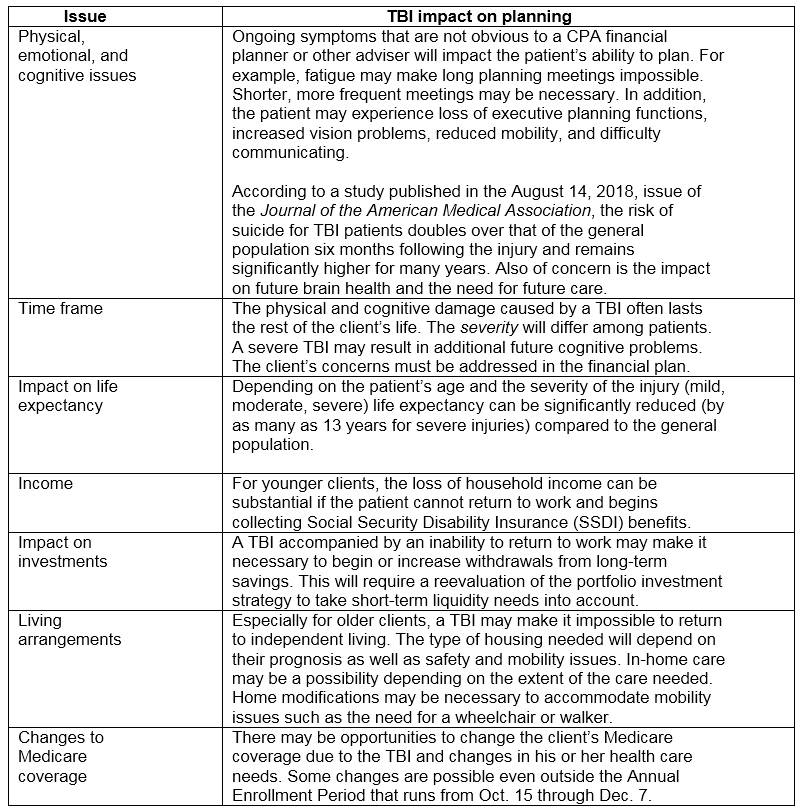
tbi-imact-planning

Address clients’ cognitive health concerns

The CPA should also ask the client about future health concerns. Many TBI patients are concerned that they have a greater chance of developing dementia later in life. A dementia, such as Alzheimer’s, can cause the patient’s executive planning functions to deteriorate — making them susceptible to costly financial errors and financial abuse.

Knowing this, the CPA can work on a financial plan to address clients’ fears about cognitive health and the proper management of finances should their fears be realized. For example, does the client have a support network of family and friends nearby? Should the client consider a move closer to their support network? How can the client’s finances be simplified to make them easier to manage should cognitive problems increase?

It can be difficult to put together a financial plan for a client with a TBI, as each TBI patient presents differently even if their underlying injuries are similar. Recovery is very individualized and patients’ financial plans need to take into account those differences.

Julie Papievis is a national speaker on the physical, emotional, and financial impact of TBI. She tells her story in her book Go Back and Be Happy. She can be reached at jp@gobackandbehappy.com. James Sullivan, CPA/PFS, is a financial planner in Wheaton, Ill. He specializes in working with clients suffering from chronic illness. To comment on this article or to suggest an idea for another article, contact senior editor Courtney Vien at Courtney.Vien@aicpa-cima.com.


Advertisement
Advertisement

latest news

July 2, 2026

FASB seeks comment on fair value reporting proposal

June 30, 2026

IRS seeks examples of incorrect CP53E notices

June 29, 2026

IRS offers gift tax safe harbor for contributions to Trump accounts

June 29, 2026

Standardization of sustainability reporting improves, but obstacles remain

June 26, 2026

IRS outlines AI risks, Circular 230 duties for tax practitioners

Advertisement

Most Read

HSA inflation-adjusted maximum contribution amounts for 2027 announced
Profession Ready Initiative targets gaps in early-career CPA readiness
How to build reusable Skills in Anthropic's Claude AI
4 ways sole practitioners can set themselves apart
Using Excel to identify financial statement red flags
Advertisement

Podcast

July 2, 2026

The AICPA’s CEO on trust, AI, and the profession’s future

June 25, 2026

Midyear advocacy update: STEM, BOI, taxes and licensure

June 18, 2026

Why mindset may matter more than technology adoption

Features

Start in high school to strengthen the accounting profession

Start in high school to strengthen the accounting profession

Accountancy in America: Meeting the moment for 250 years

Accountancy in America: Meeting the moment for 250 years

A guide to fighting AI-fueled AP/AR fraud

A guide to fighting AI-fueled AP/AR fraud

How to handle increased enforcement of unclaimed property notices

How to handle increased enforcement of unclaimed property notices

How to tame funding volatility in not-for-profits

How to tame funding volatility in not-for-profits

What AI agents mean for CPA firms
Accordance

What AI agents mean for CPA firms

FROM THIS MONTH'S ISSUE

Accountancy in America: Meeting the moment for 250 years

As the United States celebrates its semiquincentennial, explore the history of the accountancy profession’s essential role in the U.S. economy.

From The Tax Adviser

June 30, 2026

Condo casualty losses: Deductions for common-interest property

May 31, 2026

Trust distributions: Timing, tax, and practical considerations

May 31, 2026

Current developments in taxation of individuals: Part 3

April 30, 2026

Current developments in taxation of individuals: Part 2

MAGAZINE

July 2026

July 2026

July 2026
June 2026

June 2026

June 2026
May 2026

May 2026

May 2026
April 2026

April 2026

April 2026
March 2026

March 2026

March 2026
February 2026

February 2026

February 2026
January 2026

January 2026

January 2026
December 2025

December 2025

December 2025
November 2025

November 2025

November 2025
October 2025

October 2025

October 2025
September 2025

September 2025

September 2025
August 2025

August 2025

August 2025
view all

View All

http://JofA_Default_Mag_cover_small_official_blue

PUSH NOTIFICATIONS

Learn about important news

This quick guide walks you through the process of enabling and troubleshooting push notifications from the JofA on your computer or phone.

CPA LETTER DAILY EMAIL

CPA Letter Logo

Subscribe to the daily CPA Letter

Stay on top of the biggest news affecting the profession every business day. Follow this link to your marketing preferences on aicpa-cima.com to subscribe. If you don't already have an aicpa-cima.com account, create one for free and then navigate to your marketing preferences.

Connect

  • X Logo JofA on X
  • facebook JofA on Facebook

HOME

  • News
  • Monthly issues
  • Podcast
  • A&A Focus
  • PFP Digest
  • Academic Update
  • Topics
  • RSS feed rss feed
  • Site map

ABOUT

  • Contact us
  • Advertise
  • Submit an article
  • Editorial calendar
  • Privacy policy
  • Terms & conditions

SUBSCRIBE

  • Academic Update
  • CPE Express

AICPA & CIMA SITES

  • AICPA-CIMA.com
  • Global Engagement Center
  • Financial Management (FM)
  • The Tax Adviser
  • AICPA Insights
  • Global Career Hub
AICPA & CIMA

© 2026 Association of International Certified Professional Accountants. All rights reserved.

Reliable. Resourceful. Respected.