Skip to content
AICPA-CIMA
  • AICPA & CIMA:
  • Home
  • CPE & Learning
  • My Account
Journal of Accountancy
  • TECH & AI
    • All articles
    • Artificial Intelligence (AI)
    • Microsoft Excel
    • Information Security & Privacy

    Latest Stories

    • AI for CPAs: From efficiency tool to decision engine
    • 9 tips to write more effective AI prompts
    • People skills: You are a human being, not a human doing
  • TAX
    • All articles
    • Corporations
    • Employee benefits
    • Individuals
    • IRS procedure

    Latest Stories

    • Final regs. modify reporting obligations for Form 8308, Part IV
    • AICPA submits nearly 200 recommendations for IRS guidance plan
    • Taxpayers advised they can ignore CP53E notice — after verifying error
  • PRACTICE MANAGEMENT
    • All articles
    • Diversity, equity & inclusion
    • Human capital
    • Firm operations
    • Practice growth & client service

    Latest Stories

    • FASB issues standard for clarifying environmental credit disclosures
    • Final regs. modify reporting obligations for Form 8308, Part IV
    • AICPA submits nearly 200 recommendations for IRS guidance plan
  • FINANCIAL REPORTING
    • All articles
    • FASB reporting
    • IFRS
    • Private company reporting
    • SEC compliance and reporting

    Latest Stories

    • SEC proposes semiannual reporting option for public companies
    • SEC proposes amendments to small entity definitions
    • Key signals from the SEC-PCAOB conference point to a busy new year
  • AUDIT
    • All articles
    • Attestation
    • Audit
    • Compilation and review
    • Peer review
    • Quality Management

    Latest Stories

    • How to monitor a firm’s system of quality management
    • AICPA guides peer reviewers to address SOC 2 risks
    • Proposed new sustainability information AT-C sections
  • MANAGEMENT ACCOUNTING
    • All articles
    • Business planning
    • Human resources
    • Risk management
    • Strategy

    Latest Stories

    • AI for CPAs: From efficiency tool to decision engine
    • Audit report card: More internal audit teams suffered cuts in 2025
    • Optimism, while tempered, is up among finance leaders
  • Home
  • News
  • Magazine
  • Podcast
  • Topics
Advertisement
  1. newsletter
  2. Academic Update
academic-update-header

Best way to teach adults? Scenario-based learning

By Mark F. Hobson, Ph.D.
October 4, 2024

Related

April 29, 2024

Adapting teaching methods for Gen Z learners

September 13, 2023

Preparing accounting students for professional success

December 6, 2023

Expand the accounting pipeline with a mentorship circle

TOPICS

  • Professional Development
    • Career Development
  • Accounting Education

Scenario-based learning is in line with strategies for teaching adults known as andragogy, a term popularized in contemporary higher education by Malcolm Knowles (1913–1997), a central figure in U.S. adult education.

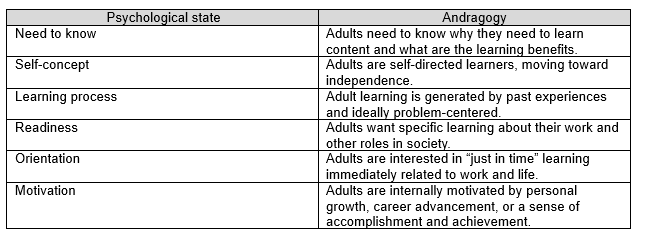
Knowles professed that teaching adults is fundamentally different from teaching children due to adults’ life experiences that formed their experiences, minds, and brains. His work is based on six principles or psychological states of adult learners. (See the chart, “Knowles’ 6 Psychological States of Andragogy.”)

Knowles’ 6 psychological states of andragogy
psychological-states-andragogy-1

Source: Author.

The main premise of Knowles’ andragogy theory is that adults are “self-directed” in their learning of material. They apply content to their work and life and want immediate relevancy. The instructor’s role is to lead and engage the learner toward understanding and applying the content and solving problems rather than transmitting facts.

Scenario-based learning strategies

In a business learning environment, scenario-based learning (SBL) teaches content within an environment of solving problems in real-life situations. Students learn content by engaging with the entire problem-solving process in a scaffolded or incremental fashion, with appropriate feedback and guidance from the instructor.

As a result of the COVID-19 pandemic and an explosion of e-learning, SBL became a mainstream tool in online business programs.     

Advertisement

SBL example: A 3-week accounting course lesson

In week one, the instructor provides the “big picture” of the course to help students understand and analyze a firm’s financial performance by examining the financial statements of a publicly traded company. Students are taught, with examples, the purpose of the “big three financial statements”: the income statement, the balance sheet, and the cash flow statement.

In the first lesson, students are shown how the statements are linked to one another and how they are used in a typical business financial model. Assessments for this week include a quiz on the content, along with a discussion board where the learners discuss the definitions and purpose of the statements based on their research of the reports of a publicly traded company.

The quiz is a tool to reinforce learning and memory for students, and the discussion board provides a vehicle to display their knowledge and share ideas with other learners. The instructor’s role is to reinforce what the learners did well and where they need to improve, with suggestions on how to improve their work products. The learning objective of this work is to prepare students to understand the big picture of a publicly traded firm’s financial performance.

In week two, students examine a case study of that publicly traded company and then evaluate financial success by understanding the company’s key financial performance indicators (KFPIs). Examples of KFPIs may include gross profit margin, net profit margin, and working capital. The assessments for this week include a quiz on the content, along with a presentation to a management team, with recommendations on improving one or two KFPIs.

Again, the quiz reinforces the need to learn definitions and commit KFPI terms to memory, and the presentation provides an outlet for critical and creative thinking for the learners. A presentation to management is a typical task of leaders in real life. The instructor’s feedback on the assessments follows the path of explaining what the learners did well and advising on areas for improvement, with guidance for how to improve their work. This week’s lesson builds on the first week, leading students to a final assessment regarding the big picture of financial performance.

In week three, adult students employ the information they learned in the previous weeks. Students are introduced to new content about how to apply the learning of strategic business tools like the Balanced Scorecard (BSC) or Michael Porter’s Five Forces to a firm’s strategic and financial reporting. The BSC focuses on reporting metrics of financial, customer service, internal processes, and organizational capacity. Porter’s Five Forces is a framework for understanding competitive forces in business that drive economic value. The learning of new content (known as novelty), along with material from the prior two lessons, will assist learners in combining financial reporting with organizational effectiveness.

Introducing new material, blended with current content, is an excellent way to improve adults’ learning and memory.

Advertisement

Final assessments

For the final assessment of the three-week lesson, students apply this new strategic content with previously learned tactical and operational information in a report and presentation to the leaders of their organization. The report should use the financial statements, financial benchmarks, and KFPIs applied to one of the strategic business tools. Students use simple technology, such as Microsoft Word, Excel, and PowerPoint, in this assessment. The learners also display their knowledge of the definition of terms and how the material is applied and explained in the report.

In addition to the report, students participate in a discussion board to share and explain the highlights of their work with other learners to elicit an exchange of ideas and peer feedback. These two assessments — the discussion board and the report — capture the learning objective of the three-week lesson. The assessments will also provide an opportunity for the instructor to supply feedback to the students on how well they learned the objective.

— Mark F. Hobson, Ph.D., CAGS, is a retired senior associate dean of Southern New Hampshire University who now teaches part time in business for Great Bay Community College in Portsmouth, N.H. He will speak on this topic at the AICPA Faculty Hour on Jan. 31, 2025. Register here.

To comment on this article or to suggest an idea for another article, contact Jeff Drew at Jeff.Drew@aicpa-cima.com.  

Advertisement

latest news

May 19, 2026

FASB issues standard for clarifying environmental credit disclosures

May 19, 2026

Final regs. modify reporting obligations for Form 8308, Part IV

May 15, 2026

AICPA submits nearly 200 recommendations for IRS guidance plan

May 14, 2026

Taxpayers advised they can ignore CP53E notice — after verifying error

May 13, 2026

IRS announces terms of new conservation easement settlement opportunity

Advertisement

Most Read

Taxpayers advised they can ignore CP53E notice — after verifying error
CP53E notice tied to paper-check transition causes confusion
AICPA ENGAGE networking tips: How to make meaningful connections
House panel backs repeal of BOI reporting by domestic companies
Optimize Windows 11 with these 8 settings tweaks
Advertisement

Podcast

May 19, 2026

How CPAs can show their value on National Accounting Day

May 14, 2026

Worrying about what’s next? Take a minute and focus on the present

May 7, 2026

The Auditing Standards Board’s priorities for 2026 and beyond

Features

5 human competencies CPAs need in the AI age

5 human competencies CPAs need in the AI age

People skills: You are a human being, not a human doing

People skills: You are a human being, not a human doing

Avoiding a big tax bill on inherited IRAs

Avoiding a big tax bill on inherited IRAs

Are you making the most of LinkedIn?

Are you making the most of LinkedIn?

SPONSORED REPORT

Tools for finding CAS clients

How to find the right CAS clients

The key to success with CAS is selecting the best clients. Tools like ideal client profiles (ICPs), buyer personas, and even artificial intelligence can help identify the businesses that best fit each CAS practice.

From The Tax Adviser

April 30, 2026

Current developments in taxation of individuals: Part 2

April 30, 2026

Hedge funds: Tax structuring, planning, and compliance

March 31, 2026

Current developments in taxation of individuals: Part 1

March 31, 2026

Current Developments in Taxation of Individuals: Part 1

MAGAZINE

May 2026

May 2026

May 2026
April 2026

April 2026

April 2026
March 2026

March 2026

March 2026
February 2026

February 2026

February 2026
January 2026

January 2026

January 2026
December 2025

December 2025

December 2025
November 2025

November 2025

November 2025
October 2025

October 2025

October 2025
September 2025

September 2025

September 2025
August 2025

August 2025

August 2025
July 2025

July 2025

July 2025
June 2025

June 2025

June 2025
view all

View All

http://JofA_Default_Mag_cover_small_official_blue

PUSH NOTIFICATIONS

Learn about important news

This quick guide walks you through the process of enabling and troubleshooting push notifications from the JofA on your computer or phone.

CPA LETTER DAILY EMAIL

CPA Letter Logo

Subscribe to the daily CPA Letter

Stay on top of the biggest news affecting the profession every business day. Follow this link to your marketing preferences on aicpa-cima.com to subscribe. If you don't already have an aicpa-cima.com account, create one for free and then navigate to your marketing preferences.

Connect

  • X Logo JofA on X
  • facebook JofA on Facebook

HOME

  • News
  • Monthly issues
  • Podcast
  • A&A Focus
  • PFP Digest
  • Academic Update
  • Topics
  • RSS feed rss feed
  • Site map

ABOUT

  • Contact us
  • Advertise
  • Submit an article
  • Editorial calendar
  • Privacy policy
  • Terms & conditions

SUBSCRIBE

  • Academic Update
  • CPE Express

AICPA & CIMA SITES

  • AICPA-CIMA.com
  • Global Engagement Center
  • Financial Management (FM)
  • The Tax Adviser
  • AICPA Insights
  • Global Career Hub
AICPA & CIMA

© 2026 Association of International Certified Professional Accountants. All rights reserved.

Reliable. Resourceful. Respected.