Skip to content
AICPA-CIMA
  • AICPA & CIMA:
  • Home
  • Engage 365 Communities
  • CPE & Learning
  • My Account
Journal of Accountancy
  • TECH & AI
    • All articles
    • Artificial Intelligence (AI)
    • Microsoft Excel
    • Information Security & Privacy

    Latest Stories

    • Drafting an AI policy that actually works
    • What AI agents mean for CPA firms
    • A guide to fighting AI-fueled AP/AR fraud

  • TAX
    • All articles
    • Corporations
    • Employee benefits
    • Individuals
    • IRS procedure

    Latest Stories

    • IRS raises standard mileage rates for remainder of 2026
    • PEEC finalizes revisions to tax services independence guidance
    • IRS designates certain CRAT arrangements as listed transactions
  • PRACTICE MANAGEMENT
    • All articles
    • Diversity, equity & inclusion
    • Human capital
    • Firm operations
    • Practice growth & client service

    Latest Stories

    • IRS raises standard mileage rates for remainder of 2026
    • PEEC finalizes revisions to tax services independence guidance
    • AICPA updates audit standards related to external confirmations
  • FINANCIAL REPORTING
    • All articles
    • FASB reporting
    • IFRS
    • Private company reporting
    • SEC compliance and reporting

    Latest Stories

    • SEC shares 3 goals in proposed 2026–2030 strategic plan
    • SEC proposes rescission of climate disclosure rules
    • SEC proposes semiannual reporting option for public companies
  • AUDIT
    • All articles
    • Attestation
    • Audit
    • Compilation and review
    • Peer review
    • Quality Management

    Latest Stories

    • AICPA updates audit standards related to external confirmations
    • PCAOB consultation process offers new options for firms seeking guidance
    • Standardization of sustainability reporting improves, but obstacles remain
  • MANAGEMENT ACCOUNTING
    • All articles
    • Business planning
    • Human resources
    • Risk management
    • Strategy

    Latest Stories

    • How to handle increased enforcement of unclaimed property notices
    • Standardization of sustainability reporting improves, but obstacles remain
    •  What it takes for a CFO to lead operations and tech
  • Home
  • News
  • Magazine
  • Podcast
  • Topics
Advertisement
  1. newsletter
  2. Cpa Insider
CPA INSIDER

The cities and states with the most robots

Manufacturing centers see the biggest impact from automation.

by Anslee Wolfe
November 13, 2017

Please note: This item is from our archives and was published in 2017. It is provided for historical reference. The content may be out of date and links may no longer function.

Related

October 10, 2017

How artificial intelligence is changing accounting

September 25, 2017

How Industry 4.0 will change accounting

September 11, 2017

The countries most likely to be affected by automation

TOPICS

  • Firm Practice Management
    • Practice Growth & Client Service

There’s plenty of anxiety over the potential for automation to eliminate jobs, but amid all the hand-wringing, industrial robots are already here. More than 233,300 of them are already in place across the United States, but they are more prevalent in some areas than others. Knowing where automation is happening—and what it’s doing—can help financial executives gain a competitive edge in their industries.

The largest clusters of robots are concentrated in the Midwestern and Southern manufacturing states, especially the upper Midwest, according to new analysis by the Brookings Institution, a Washington think tank.

“With that said, industrial robots are at work all across the country. Clusters of them exist on the coasts, especially where they help build Teslas in the Bay Area, make semiconductors in Oregon, and produce chemical and rubber products in Texas,” said Mark Muro, a senior fellow with the Metropolitan Policy Program at Brookings.

Brookings looked at where automation may actually displace employees—and where it may not—by examining 2015 data from the International Federation of Robotics that measured the infiltration of robots into U.S. industries and then into metropolitan areas. Brookings defines industrial robots as “automatically controlled, reprogrammable machines” that can replace human labor.

The data, according to Brookings, may help calm widespread fears that robots are infiltrating the U.S. economy on the whole. The numbers show that automation is concentrated only in some areas of the nation, and only in some sectors.

The following states have the largest number of robots:

  • Michigan: 27,600, 12% of the nation’s total.
  • Ohio: 20,400, 8.7% of the nation’s total.
  • Indiana: 19,400, 8.3% of the nation’s total.

The entire West, however, accounts for only 13% of the nation’s total of robots.

Advertisement

It’s no surprise the largest clusters are in states heavy in manufacturing, one of the industries most susceptible to automation, according to a recent report by McKinsey Global Institute. That’s because jobs that have the highest automation potential are physical ones in highly structured and predictable environments.

In fact, the Brookings Institution found that more than half of the nation’s industrial robots are in the auto industry. The bots are doing jobs such as painting cars, assembling products, handling materials, and packaging things in 10 Midwestern and Southern states.

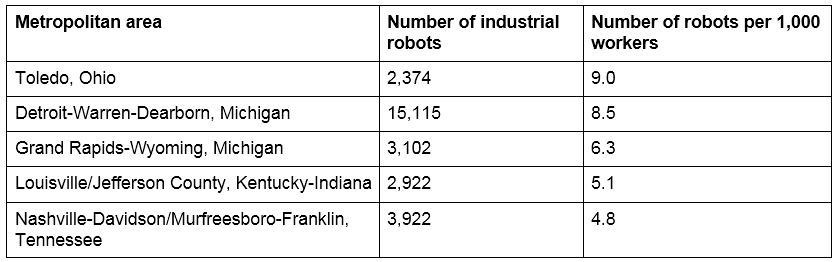
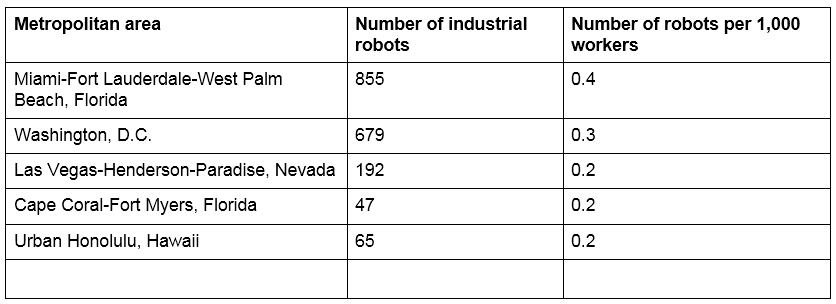
Metro areas are ranked based on the number of robots and the number of bots per 1,000 workers. Here is where the highest and lowest concentrations of industrial robots are among the largest 100 U.S. metropolitan areas, followed by the number of bots in 2015 and the number per 1,000 workers:

Areas with the highest concentration of robots
Source: The Brookings Institution.

Areas with the lowest concentration of industrial robots
Source: The Brookings Institution.

Source: The Brookings Institution.

“The least affected states are those with intensely service-oriented economies, such as Florida or Hawaii,” Muro said.

The Detroit area not only leads in the number of robots, but also has seen some of the largest growth, according to Brookings. In 2010, the area had 5,753 bots; that number jumped to 15,115 in 2015.

While the Brookings analysis shows the majority of robots are in high manufacturing areas, the industry itself is an example of how new jobs can be created even amid heavy losses.

Advertisement

Between 2004 and 2014, more than 2.1 million U.S. manufacturing jobs were cut, largely due to increased automation, according to the U.S. Department of Labor’s Bureau of Labor Statistics (BLS). But as manufacturing jobs became more computer-based than assembly line-based, workers needed more technical skills. This created new jobs for computer programmers and coders, for example, as well as for workers to design and run the machines, according to the BLS.

Although the industry has suffered extensive job loss over the decades, manufacturing as a whole remains a key part of the U.S. economy, said Tatiana Bailey, director of the University of Colorado at Colorado Springs Economic Forum, a research organization in the school’s College of Business.

“The number of jobs has gone down, but it doesn’t mean the industry has gone down,” she said. “Just because we have more automation doesn’t necessarily mean it’s a negative thing for the industry as a whole.”

Anslee Wolfe is a freelance writer in Colorado Springs, Colo. To comment on this article, contact Chris Baysden, senior manager of newsletters at the AICPA.

Advertisement

latest news

July 15, 2026

IRS raises standard mileage rates for remainder of 2026

July 15, 2026

PEEC finalizes revisions to tax services independence guidance

July 14, 2026

AICPA updates audit standards related to external confirmations

July 9, 2026

IRS designates certain CRAT arrangements as listed transactions

July 8, 2026

Eligible taxpayers to get automatic IRS penalty relief

Advertisement

Most Read

Eligible taxpayers to get automatic IRS penalty relief
IRS adds online option, details for Kwong-related refund claims
Self-directed IRAs: A tax compliance black hole
IRS seeks examples of incorrect CP53E notices
How to build reusable Skills in Anthropic's Claude AI
Advertisement

Podcast

July 9, 2026

From estate planning to AI: Managing CPA liability

July 2, 2026

The AICPA’s CEO on trust, AI, and the profession’s future

June 25, 2026

Midyear advocacy update: STEM, BOI, taxes and licensure

Features

Start in high school to strengthen the accounting profession

Start in high school to strengthen the accounting profession

Accountancy in America: Meeting the moment for 250 years

Accountancy in America: Meeting the moment for 250 years

A guide to fighting AI-fueled AP/AR fraud

A guide to fighting AI-fueled AP/AR fraud

How to handle increased enforcement of unclaimed property notices

How to handle increased enforcement of unclaimed property notices

How to tame funding volatility in not-for-profits

How to tame funding volatility in not-for-profits

What AI agents mean for CPA firms
Accordance

What AI agents mean for CPA firms

FROM THIS MONTH'S ISSUE

Drafting an AI policy that actually works

As AI use accelerates, many firms are discovering their policies haven’t kept pace. This article breaks down what CPAs and finance leaders should consider when drafting an AI policy that’s practical, flexible, and fit for real world use.

From The Tax Adviser

June 30, 2026

Condo casualty losses: Deductions for common-interest property

May 31, 2026

Trust distributions: Timing, tax, and practical considerations

May 31, 2026

Current developments in taxation of individuals: Part 3

April 30, 2026

Current developments in taxation of individuals: Part 2

MAGAZINE

July 2026

July 2026

July 2026
June 2026

June 2026

June 2026
May 2026

May 2026

May 2026
April 2026

April 2026

April 2026
March 2026

March 2026

March 2026
February 2026

February 2026

February 2026
January 2026

January 2026

January 2026
December 2025

December 2025

December 2025
November 2025

November 2025

November 2025
October 2025

October 2025

October 2025
September 2025

September 2025

September 2025
August 2025

August 2025

August 2025
view all

View All

http://JofA_Default_Mag_cover_small_official_blue

PUSH NOTIFICATIONS

Learn about important news

This quick guide walks you through the process of enabling and troubleshooting push notifications from the JofA on your computer or phone.

CPA LETTER DAILY EMAIL

CPA Letter Logo

Subscribe to the daily CPA Letter

Stay on top of the biggest news affecting the profession every business day. Follow this link to your marketing preferences on aicpa-cima.com to subscribe. If you don't already have an aicpa-cima.com account, create one for free and then navigate to your marketing preferences.

Connect

  • X Logo JofA on X
  • facebook JofA on Facebook

HOME

  • News
  • Monthly issues
  • Podcast
  • A&A Focus
  • PFP Digest
  • Academic Update
  • Topics
  • RSS feed rss feed
  • Site map

ABOUT

  • Contact us
  • Advertise
  • Submit an article
  • Editorial calendar
  • Privacy policy
  • Terms & conditions

SUBSCRIBE

  • Academic Update
  • CPE Express

AICPA & CIMA SITES

  • AICPA-CIMA.com
  • Global Engagement Center
  • Financial Management (FM)
  • The Tax Adviser
  • AICPA Insights
  • Global Career Hub
AICPA & CIMA

© 2026 Association of International Certified Professional Accountants. All rights reserved.

Reliable. Resourceful. Respected.