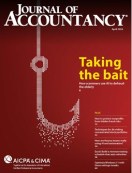
With the Baby Boomer generation hitting retirement age, personal financial planning has become an increasingly important service for many accounting firms. But practitioners are dealing with plenty of changes, including the implementation of new tax laws and the landmark rollout of new standards. The JofA assembled a team of industry
Advertisement
TOPICS
Tax
Salary was partially reasonable
Relying on standards set by the Ninth Circuit, the Tax Court found that a sole shareholder’s compensation from a wholly owned corporation for the year in question was partially deductible as reasonable compensation. The deductible compensation included catch-up payments for prior years’ services. Arthur Astor was the president and CFO
Basis reporting for debt instruments and options is phased in
In final regulations (T.D. 9616), the IRS is phasing in basis reporting requirements under Sec. 6045(g) for debt instruments and options. The IRS took the action in response to comments about the complexity of complying with these rules and to give brokers ample time to develop and implement reporting systems.
Voluntary Classification Settlement Program
Determining proper classification of workers, either as independent contractors or employees, can be a subjective challenge for employers. The determination of whether a worker is an employee or an independent contractor is based on the facts and circumstances surrounding the individual’s work for the employer. Generally, the more the employer
Requesting a first-time abatement penalty waiver
The IRS’s first-time abatement (FTA) penalty waiver, although introduced 12 years ago, remains little known and often unrequested by qualifying taxpayers. It allows a first-time noncompliant taxpayer to request abatement of certain penalties for a single tax period. Individual taxpayers may request an FTA of a failure-to-file or failure-to-pay penalty.
Proposed rules address minimum value of health coverage for premium tax credits
The IRS issued proposed regulations for determining whether an eligible employer-sponsored health plan provides minimum value for purposes of the Sec. 36B health insurance premium tax credit (REG-125398-12). Individuals do not receive the credit if they are eligible for affordable coverage under an eligible employer-sponsored plan that provides minimum value.
Highlights of tax research
With tax reform in the news, it is helpful to understand the origins of some popular and long-lived tax incentives, such as the favorable tax treatment of people over 65 and tax incentives that encourage people to save. As the economy takes fitful steps to recover, insight into the efficacy
GAO: Foreign account “quiet disclosures” may be much higher than detected
More than 10,000 taxpayers showed signs of having avoided offshore penalties by making “quiet disclosures” of foreign bank accounts for tax years 2003 through 2008, the U.S. Government Accountability Office (GAO) reported, a period for which the IRS has detected several hundred quiet disclosures. Filing data also suggest many more
IRS issues guidance on minimum essential health coverage, shared-responsibility penalty
In anticipation of the full implementation of health care reform next year, on Wednesday the IRS issued two notices. The first notice defines minimum essential coverage under certain government health plans and other coverage designated as minimum essential coverage for purposes of the Sec. 36B premium tax credit (Notice 2013-41).
Supreme Court strikes down Defense of Marriage Act in estate tax case
The Supreme Court on Wednesday, in a 5–4 decision written by Justice Anthony Kennedy, ruled that the Defense of Marriage Act (DOMA), P.L. 104-199, is unconstitutional because it violates the Fifth Amendment’s Due Process Clause by denying equal protection to same-sex couples who are lawfully married in their states (Windsor,
Interim IRS chief issues initial report on Sec. 501(c)(4) controversy
On Monday, acting IRS commissioner Daniel Werfel issued his report, Charting a Path Forward at the IRS: Initial Assessment and Plan of Action, on the plans to reform the IRS to avoid inappropriate targeting of taxpayers applying for Sec. 501(c)(4) social welfare organization status. In the first section of the
15 policies for sound not-for-profit governance
CPAs nodded their heads in sympathy as stories of governance mistakes were told during a session at the AICPA Not-for-Profit Industry Conference in Washington on Thursday. One organization accepted a gift of a cattle ranch that had nothing to do with its mission, creating huge administrative headaches. Another organization did
IRS controversy could cause tax-exempt processing slowdown
CPAs need to be prepared for a slowdown in certain work handled by the IRS Exempt Organizations Division in the wake of the recent controversy involving the processing of certain applications for tax exemption under Sec. 501(c)(4), the division’s former head said Thursday. “Probably the whole system is frozen in
AICPA recommends changes to net investment income tax
Jeffrey Porter, chair of the AICPA’s Tax Executive Committee, submitted comments to the IRS on behalf of the AICPA on Monday, recommending many changes to the proposed regulations on the new net investment income tax. Starting in 2013, Sec. 1411(a)(1) imposes a tax equal to 3.8% of the lesser of
Oral surgeon cannot deduct expenses for traveling between home and job
The Tax Court upheld IRS-assessed deficiencies caused by the disallowance of a number of travel expenses an oral surgeon deducted on his Schedules C, Profit or Loss From Business, for 2008 and 2009, and its imposition of a negligence penalty under Sec. 6662(a) (Bigdeli, T.C. Memo. 2013-148). Javad Bigdeli lived
Proposed PFP services standards available for public comment
The AICPA released an exposure draft of a Proposed Statement on Standards in Personal Financial Planning Services on Tuesday as part of an initiative that’s expected to help boost the profile of CPA personal financial planning (PFP) practitioners. The proposal outlines members’ responsibilities in PFP engagements. These responsibilities include: General
Indoor tanning tax final regulations issued
On Monday, the IRS issued final regulations on the 10% excise tax that has been in effect for amounts paid for indoor tanning services since July 1, 2010 (T.D. 9621). The regulations, which apply to amounts paid on or after June 11, 2013, finalize proposed rules issued in 2010 when
How have CPAs responded to regulatory overload?
Andrew Barbe, CPA, CGMA, wishes he had more time to devote to strategic planning and development as vice president for accounting and senior controller of NorTex Midstream Partners LLC, a natural gas midstream service company. But as the senior manager in charge of finance, accounting, treasury, tax, human resources, information
TIGTA criticizes the IRS on conference overspending
In the latest in a series of bad news days for the IRS, the Treasury Inspector General for Tax Administration (TIGTA) issued a report Tuesday on the IRS’s wasteful spending on conferences (TIGTA, Review of the August 2010 Small Business/Self-Employed Division’s Conference in Anaheim, California, Rep’t No. 2013-10-037). TIGTA focused
Partner cannot avoid valuation penalty by conceding on other grounds
In a big win for the IRS, the Tax Court refused to grant partial summary judgment to a partner who had conceded his tax shelter case on grounds other than valuation in an attempt to avoid the 40% gross valuation misstatement penalty under Sec. 6662(a). This has been a common
Features




FROM THIS MONTH'S ISSUE

4 ways solo practitioners can stand out
Five years ago, a grieving Angel Zhen started his own CPA firm with no clients and no revenue. Today, he has 300 clients, $600,000 in revenue and 12 weeks of annual vacation. In this JofA article, he shares how he set up his firm and how you could do the same.
From The Tax Adviser
April 30, 2026
Current developments in taxation of individuals: Part 2
April 30, 2026