When it pays to move HSA funds — and how to do it
Health savings account funds are portable, giving clients options beyond their employer’s chosen provider.
Over 60% of all health savings accounts (HSAs) are employer-affiliated, which leads to the common misconception that the employer controls these accounts. Most clients don’t realize that HSAs are portable, and often, reasons exist to move them.
The providers that most employers choose for HSAs are more likely to charge monthly maintenance fees and pay lower-than-market interest rates compared to products available to individuals. Additionally, the investment options offered may be limited to certain funds or management companies.
As more clients realize the wealth-building power of the HSA by accumulating assets in their accounts for tax-free investment growth, the importance of helping them avoid unnecessary fees and choose the best investment mix for their HSA is growing. See “How an HSA Can Be Viewed as a Flexible Tax-Favored Investment,” The Tax Adviser, April 1, 2022.
For clients who tend to spend down HSA dollars within a year or two of contribution, staying with the provider chosen by their employer likely makes sense. However, for clients who wish to accumulate assets for future large expenses or, ideally, to invest for retirement, avoiding these fees is easier than many people are aware.
Here’s what CPAs need to know to help clients avoid pitfalls and optimize the growth of their HSA assets.
Clients can maintain more than one HSA
Clients can transfer funds from their employer-provided HSA to an outside provider of their choice even if they are still participating in the HSA-eligible plan through their workplace. If a client is still actively contributing to their account via payroll, they should keep their original account open and make a plan to roll existing funds to their preferred provider on a periodic basis. For them to receive contributions from their employer, the employer-sponsored account must remain open.
While HSA contributions can be made outside payroll, participants may wish to continue doing so via payroll, as those contributions are made before FICA payroll taxes are assessed, in addition to income taxes. Contributions made to HSAs outside payroll reduce only federal income tax and, where applicable, state income tax (California and New Jersey do not allow income tax deductions for HSA contributions).
Annual limits apply to HSA contributions for all accounts, similar to IRA contribution limits, and having more than one HSA does not allow for greater contributions.
Best practices for rolling HSA funds from one provider to another
If a client is no longer employed at the company providing their HSA, rolling those funds to a new provider as soon as administratively possible can avoid maintenance fees, as mentioned above. Many providers will charge a transfer or account closure fee, which may be unavoidable. Utilizing the trustee-to-trustee rollover process is the most seamless way for clients to move funds from an account they are no longer using, as there are fewer opportunities for error and misreporting for tax purposes. However, using this method typically incurs a fee ranging from $25 to $50.
These fees can add up if clients roll over funds from their employer-sponsored HSA to their individual HSA regularly. As an alternative, these clients can use the indirect rollover method to avoid unnecessary fees but must exercise extreme diligence because missteps could lead to unintended tax consequences. Either way, performing the transfer no more than once every 12 months is advisable, to avoid paying excessive transfer fees and to stay within the rules of an indirect rollover.
Using an indirect rollover to transfer funds to an individual HSA
The HSA indirect rollover rules are similar to the rules for retirement accounts, with the major difference being that there is no mandatory tax withholding when an account holder requests a full distribution of their account. The following table compares trustee-to-trustee transfers to indirect HSA rollovers.
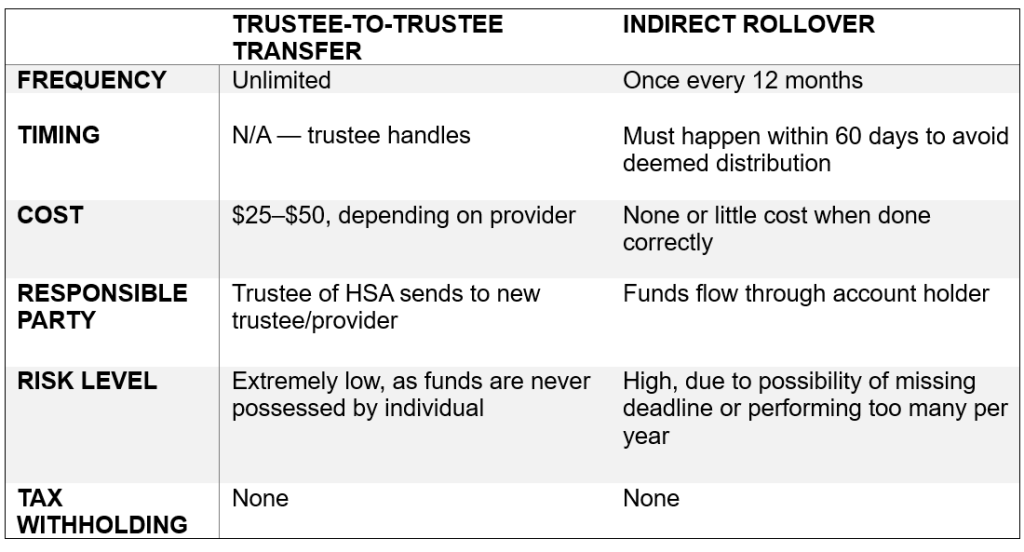
To perform an indirect rollover from one HSA to another, the account owner should request a distribution of their full account value directly to them. It’s not necessary to note that the reason for the request is to perform a rollover; in fact, doing so may prompt the employer-chosen provider to charge an account closing fee and close the account, negating the purpose of performing the indirect rollover. Remember that the primary purpose of performing an indirect rollover is to avoid fees.
Many providers will allow direct deposit, while others may send a check in the mail. Upon receipt of the funds, the client should immediately send them for deposit to their individual HSA, being sure to note that the deposit is a rollover and not a new contribution. Some providers will allow this to be done electronically, while others require a physical check along with a completed deposit form. The deposit form must be completed correctly to avoid potential miscoding and unintended tax consequences.
When performing an indirect rollover is not worth it
While trustee-to-trustee transfer fees can eat into the benefit of moving the funds to a different provider, performing indirect rollovers is fraught with potential pitfalls. Missing the 60-day window to deposit the funds at the new provider can lead to the funds’ being distributed outright, losing their ability to grow tax-free and potentially leading to taxation. Performing the maneuver too often during the 12-month window can also lead to an unintended distribution. There is also the chance that rollovers may be miscoded by the receiving provider as new contributions, leading to ineligible contributions and a potential headache at tax time.
Indirect rollovers also leave a paper trail that could lead to complications, especially if the client’s tax preparer isn’t aware of the transaction. They may also cause challenges if the IRS audits a client’s HSA usage. When an indirect rollover is initiated, the original provider issues a Form 1099-SA, Distributions From an HSA, Archer MSA, or Medicare Advantage MSA, showing the funds leaving the account.
The corresponding Form 5498-SA, HSA, Archer MSA, or Medicare Advantage MSA Information, showing that the funds were deposited via rollover is not available until after the April tax deadline. This can make it a challenge for tax preparers to confirm that the rollover was performed correctly for taxpayers who don’t extend their filing deadline. Since Form 5498-SA is typically not available until May 15, taxpayers who do not extend their filing deadline may have indirect rollovers incorrectly reported as distributions, which can lead to unnecessary inquiries from the IRS or potential additional tax that they don’t owe. Clients performing indirect HSA rollovers may wish to extend their tax filing deadline to ensure that everything is reported accurately to avoid added headaches with tax reporting.
Timing of HSA rollovers when maintaining the employer-provided account
For most clients, HSA funding happens throughout the calendar year via payroll deductions. In this case, the best practice is likely to initiate a trustee-to-trustee transfer once a year at year end. If the client is sufficiently organized and willing to risk the potential pitfalls of an indirect rollover, one way to avoid violating the 12-month rule is to use a memorable date such as a birthday or anniversary to make their request.
With HSAs growing in usage and asset value, more clients will be looking to their CPA financial planner for support with this valuable tool. Reminding clients that HSAs are portable and offering support with moving funds to a provider with lower fees and better investment options is one way to provide great value to clients.
— Kelley C. Long, CPA/PFS, CFP®, is an author and personal finance coach in Arizona. To comment on this article or to suggest an idea for another article, contact Dave Strausfeld at David.Strausfeld@aicpa-cima.com.