Liquidation accounting: When a going concern dissolves
Drawing from lessons learned in a real-life dissolution, a former CFO shares what CPAs need to know about applying FASB ASC 205-30.

When a business sells everything to settle obligations with creditors and distributes leftover cash to shareholders and other claimants because it is about to end operations, the financial statement preparation must shift from a going concern basis to a liquidation basis.
Liquidations can become imminent for businesses in any industry, and they usually happen under tough conditions. For CPAs, the accounting transition they trigger requires careful judgment, coordination, and disciplined financial reporting that no longer measures earnings and cash flow but focuses on converting assets to cash or other liquid assets and settling obligations with creditors in anticipation of the entity ceasing all activities.
That transition arrived for me when I was a CFO and a member of the board of directors of a U.S. financial services firm. The firm remained solvent and liquid, but insolvency proceedings involving affiliated entities abroad created significant uncertainty around continued operations within the broader group structure. After strategic alternatives, including a potential sale process, were evaluated, the board approved an orderly liquidation plan. I was responsible for preparing liquidation-basis financial statements under FASB ASC 205-30, Presentation of Financial Statements — Liquidation Basis of Accounting.
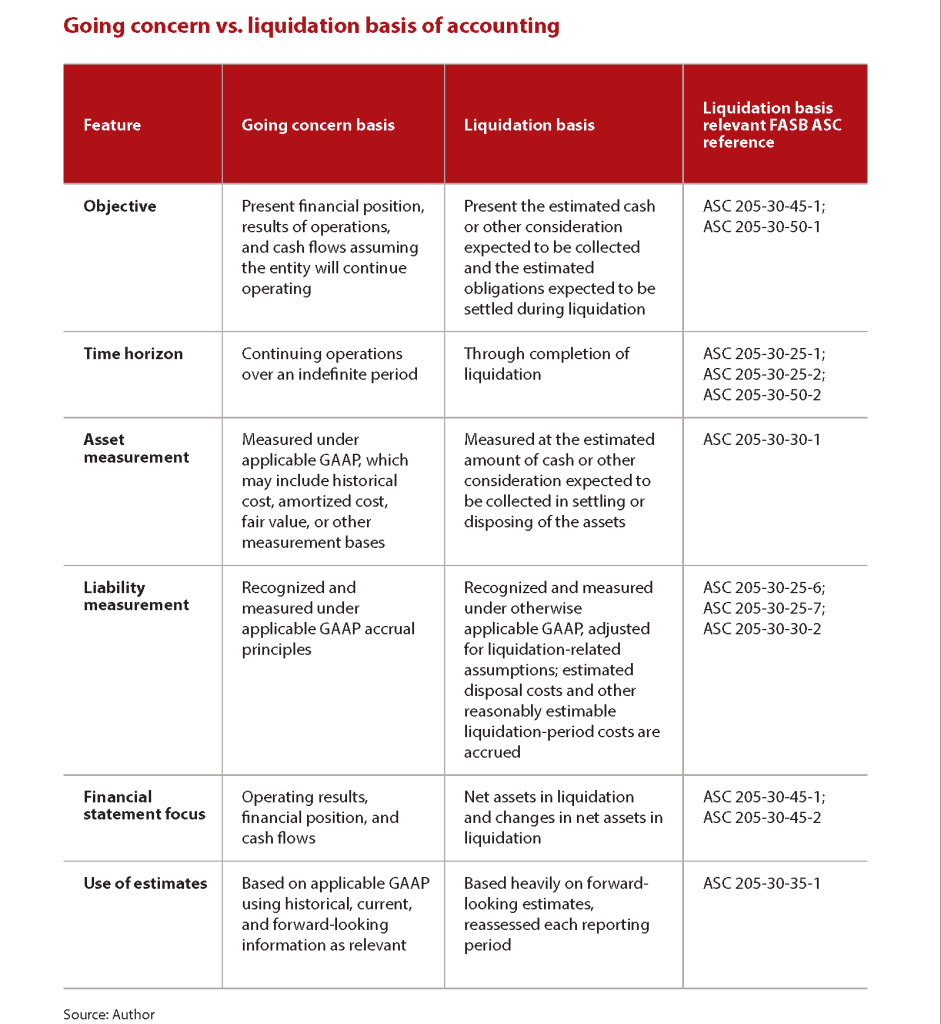
Once it was determined that liquidation was imminent by the board approving the liquidation plan, the company was required to adopt the liquidation basis of accounting. (See the table, “Going Concern vs. Liquidation Basis of Accounting,” below.) Monthly financial reporting shifted from measuring operating performance to estimating realizable asset values and the obligations remaining to be settled. The financial statements became a forward-looking road map for how the firm would convert assets to cash and discharge its liabilities.
RECOGNIZING IMMINENCE
Under FASB ASC 205-30-25-1, an entity is required to apply the liquidation basis of accounting when liquidation “is imminent, unless the liquidation follows a plan for liquidation that was specified in the entity’s governing documents at the entity’s inception.” The guidance does not permit this as an accounting policy election; once the criteria that liquidation is imminent are met, the entity must transition from the going concern basis to the liquidation basis. FASB ASC 205-30-25-2 defines liquidation as imminent when either of the following occurs:
- A plan for liquidation has been approved by the person or persons with the authority to make such a plan effective, and the likelihood is remote that any of the following will occur:
- Execution of the plan will be blocked by other parties (for example, those with shareholder rights).
- The entity will return from liquidation.
- A plan for liquidation is imposed by other forces (for example, involuntary bankruptcy), and the likelihood is remote that the entity will return from liquidation.
It is also important to distinguish liquidation from bankruptcy. While some bankruptcy proceedings result in liquidation, others are structured to allow for reorganization and continued operations. Conversely, liquidation may occur outside of formal bankruptcy through a voluntary dissolution approved by management or the board.
In my company’s case, insolvency proceedings involving the firm’s foreign parent and affiliates created the circumstances that led management and the board to evaluate strategic alternatives. The foreign insolvency administrator allowed management to explore selling the business in whole or in part and other strategic alternatives. When no viable transaction could be completed, the board approved an orderly dissolution. That decision, made in coordination with the insolvency administrator, marked the point at which the firm’s purpose shifted from operating to realizing assets and settling obligations.
RECASTING THE BALANCE SHEET
Under FASB ASC 205-30-30-1, assets are measured at the estimated amount of cash or other consideration expected to be collected in settling or disposing of those assets during liquidation. In some circumstances fair value may approximate this amount, but the guidance does not presume that fair value is appropriate for all assets.
Categories of assets were settled or disposed of in the following manners:
- Marketable securities: Highly liquid government securities were sold shortly after the reporting date, so liquidation–basis values reflected expected sale proceeds.
- Receivables from affiliates: Balances with affiliated entities in insolvency were measured based on expected recoveries under foreign insolvency proceedings, using information from administrators and legal counsel.
- Prepaid expenses: Prepaid items were written off unless contractually refundable, as only amounts expected to be recovered in cash or other consideration are recognized.
- Fixed assets: Furniture, fixtures, and leasehold improvements were not marketed for sale and were assigned no liquidation value because expected proceeds were lower than disposal costs. In accordance with FASB ASC 205–30–25–6, estimated disposal costs were accrued and presented separately from the related assets.
- Deposits and restricted cash: Cash held by third parties was recorded at the amount expected to be recovered. The related uncertainties and timing of recovery were described in the financial statement disclosures.
Estimating the costs of closure
FASB ASC 205-30-25-7 requires an entity to accrue costs and income expected to be incurred or earned through the end of the liquidation if and when they can be reasonably estimated.
Management developed a comprehensive cost model covering severance and payroll, lease and facilities obligations, vendor and professional services, and post-liquidation activities such as record retention and tax compliance. A critical part of this process involved close coordination with U.S. legal counsel. Counsel advised the board and officers on fiduciary duties, dissolution mechanics, and potential exposures, while finance translated those legal risks into accounting estimates that complied with U.S. GAAP.
Post-liquidation legal reserves were especially judgmental. They included not only known legal fees but also contingencies for unforeseen claims and administrative matters that could arise after operations ceased. Legal input had to be used to determine estimates that met FASB ASC 205-30’s recognition and measurement requirements rather than to simply reflect worst-case legal scenarios.
These estimates were reassessed and updated at each reporting date, consistent with the remeasurement requirements of FASB ASC 205-30-35-1.
Where professional judgment was most tested
The areas requiring the greatest professional judgment were estimating legal and administrative obligations and determining the expected recovery of receivables from affiliates undergoing insolvency proceedings. Estimates of legal fees, potential claims, and administrative matters changed as new legal, tax, and administrative information emerged, leading to extensive dialogue between management, external auditors, and legal counsel.
Recoveries from foreign affiliates were particularly complex in this case because several related entities were simultaneously undergoing insolvency proceedings. Once those proceedings began, intercompany receivables had to be evaluated based on expected recoveries through the applicable insolvency proceedings, similar to other creditor claims subject to legal priority rules.
These two areas underscored how liquidation-basis accounting differs from normal financial reporting. The focus is not on past performance but on recoverability and projection.
DISCLOSURE
FASB ASC 205-30-50-2 requires entities applying the liquidation basis of accounting to, at a minimum, provide detailed disclosures describing the circumstances leading to liquidation and the way liquidation-basis amounts are determined. Specifically, the standard requires disclosure of the facts and circumstances leading to liquidation, the entity’s plan for liquidation, the methods and assumptions used to measure assets and liabilities, and the expected timing of the liquidation process. Entities must also disclose any subsequent changes to their methods and assumptions that could affect the amounts reported.
Liquidation-basis financial statements rely heavily on forward-looking estimates. Users therefore need transparency around how those estimates were developed and what could cause them to change.
In this case, the financial statement notes described the events that made liquidation imminent, including the insolvency proceedings affecting affiliated entities and the board’s decision to approve an orderly dissolution. The disclosures explained the expected timeline and the key assumptions underlying asset realizations and liability settlements.
Because liquidation outcomes can vary depending on legal proceedings, market conditions, and other external factors, the notes also described the significant uncertainties that could affect recoveries from affiliates and the ultimate costs of completing the liquidation. These disclosures helped users interpret the liquidation-basis measurements presented in the financial statements. In addition, FASB ASC 205-30-50-2 requires disclosure of assets, other items intended for sale that were not previously recognized as assets, and liabilities and the expected manner and timing of their disposition or settlement during liquidation.
In practice, these disclosures provide users with critical context for understanding not only the reported amounts but also the degree of uncertainty inherent in liquidation-basis financial statements.
NAVIGATING THE EXTERNAL AUDIT
The audit focus shifted from historical performance to the reliability of management’s forward-looking estimates. Auditors relied on third-party confirmations and other audit evidence to support the existence and valuation of assets and reviewed insolvency correspondence and claims documentation related to affiliate receivables. They also evaluated the methods, assumptions, and supporting evidence underlying management’s liquidation-related estimates and accruals, including whether developments occurring after the reporting date provided additional evidence about expected asset recoveries or obligations.
Because of their inherent subjectivity, reserves received heightened scrutiny. Relatively small changes in assumptions could materially affect remaining net assets in liquidation. Management therefore had to demonstrate that estimates were grounded in evidence and supported by professional judgment. This required management to explain the basis for significant assumptions, provide the evidence supporting them, and reconcile changes in estimates from one reporting period to the next.
The audit process consequently became more iterative. As legal proceedings advanced and new information emerged, management updated its estimates, and the auditors evaluated whether the revisions were reasonable and consistent with the available evidence. This required more frequent and detailed interaction among management, the auditors, and legal counsel.
At times, the dialogue became somewhat adversarial because legal counsel and the auditors held different views regarding certain legal exposures and the resulting accounting estimates. Management remained responsible for the estimates and had to evaluate both perspectives against the applicable accounting requirements and available evidence. Although the discussions could be difficult, the differences were ultimately resolved through further analysis, supporting documentation, and professional judgment.
The auditors also evaluated the approval and timing of the liquidation plan itself, including the point at which liquidation became imminent under FASB ASC 205-30 and whether the liquidation basis had been applied prospectively from the appropriate date.
In addition, a significant audit focus involved assessing whether management had reasonably identified and estimated all material obligations expected to arise through the completion of the liquidation process, including contingent obligations and administrative costs, such as record retention, tax compliance, and other matters continuing after operating activities ceased.
LESSONS LEARNED
The experience of dissolving a company under the liquidation basis of accounting taught me the following:
- Treat the trigger date as a hard accounting cutoff: Under FASB ASC 205–30–45–2, the liquidation basis of accounting shall be applied prospectively from the day that liquidation becomes imminent.
- Build a living liquidation model, not a one–time estimate: Liquidation–basis financials must be remeasured each reporting period as legal, tax, and operational facts evolve.
- Post–liquidation reserves deserve the most scrutiny: These reserves drive reported net assets and must be supported by legal, tax, historical, and other relevant evidence (as necessary).
- Recoveries from affiliates may need to be evaluated like external claims: Once insolvency proceedings begin, intercompany balances may need to be assessed based on expected recoveries through those proceedings.
- Disclosures are the credibility engine: Under FASB ASC 205–30–50, transparent explanation of assumptions is critical to understanding the numbers.
- Strong controls protect everyone in the endgame: As cash is distributed and obligations are settled, disciplined approval, documentation, and review are critical.
ENDING WITH DISCIPLINE AND TRANSPARENCY
The liquidation basis of accounting is not merely a technical requirement. It is a framework for concluding an organization’s financial life with discipline and transparency.
When applied properly, FASB ASC 205-30 provides a structured framework for reporting the expected realization of assets and settlement of obligations during liquidation. Liquidation, accounted for in accordance with FASB ASC 205-30, is not a collapse but an orderly conclusion built on judgment, governance, and integrity.
Having led a company through its dissolution, in addition to other phases of the business lifecycle, gave me a perspective I did not fully appreciate at the time. Experiencing how value is preserved, eroded, or recovered at the end of a business sharpened my ability to anticipate risk, evaluate liquidity, and focus on what matters in financial stewardship. For CPAs, liquidation accounting is not only a technical exercise but also a reminder that financial reporting plays a critical role in ensuring transparency and fairness during the final stage of an organization’s life cycle.
In that sense, liquidation accounting was not only the concluding chapter of one company, but an essential chapter in my own development as a financial professional.
About the author
Anthony Vinci, CPA, MBA, is a senior policy director working in financial services. Previously, he worked as an auditor at EY and as treasurer and CFO at securities brokerages on Wall Street. The views expressed in this article are his own and do not necessarily reflect the views or official position of his employer. To comment on this article or to suggest an idea for another
article, contact Jeff Drew at Jeff.Drew@aicpacima.com.
LEARNING RESOURCES
International Tax Transactions I
This course puts corporate reorganizations, liquidations, and stock acquisitions in an international context.
June 8–11
International Tax Transactions II
This course explores nonrecognition transaction rules and the impact of Sec. 367 on inbound and outbound transactions.
CPE SELF-STUDY
Corporate Formations, Reorganizations, Acquisitions, and Liquidations
This course provides a comprehensive review of the tax implications of corporate changes.
CPE SELF-STUDY
For more information or to make a purchase, go to aicpa-cima.com/cpe-learning or call 888-777-7077.
MEMBER RESOURCES
Articles
“Applying the Liquidation Basis of Accounting in EBPs,” Audit & Assurance Resources, Nov. 17, 2020
“Considerations When Valuing Distressed or Impaired Businesses FAQs,” FVS Resources, April 29, 2020
Website
FASB Financial Accounting & Reporting (JofA topic page)