- podcast
- NEWS
Tweak the message, prep for pushback, succeed in the boardroom
Sponsored by AICPA Member Insurance Programs
Tiffany Willis, a former Starbucks finance executive, spoke recently at the Future of Finance Summit, presenting real and challenging boardroom scenarios for the audience.
In a podcast interview, she expanded on those ideas, sharing practical advice for handling high-pressure moments, communicating with executives, and presenting financial insights effectively.
Willis explained why preparation, audience awareness, and composure are critical skills. She also discussed the leadership lessons behind her book, Own Your Narrative, and the importance of authenticity in building successful teams.
What you’ll learn from this episode:
- Why the “meeting before the meeting” can minimize surprises in the boardroom.
- How to tailor financial insights and data presentations for different audiences.
- Ways to maintain composure and credibility when your work is challenged.
- How finance leaders can bridge gaps between organizational goals and financial realities.
- Why she emphasizes authenticity.
- Why Willis said she’s “still developing” as a leader.
Play the episode below or read the edited transcript:
— To comment on this episode or to suggest an idea for another episode, contact Neil Amato at Neil.Amato@aicpa-cima.com.
Transcript
Neil Amato: Hey, listeners, welcome back to the Journal of Accountancy podcast. Tiffany Willis is a former Starbucks finance executive. She’s a must-follow on LinkedIn, an author, and a speaker at the Future of Finance Summit, where we’re recording some late summer episodes. You’ll hear a conversation with Tiffany right after this message from our sponsor.
[Sponsor message]
Amato: This is Neil Amato with the JofA. Four years ago, I was honored to have Tiffany Willis join our podcast. Now she’s back, recording with me in person in National Harbor, Md. Tiffany, thanks for making time to talk and be on the JofA podcast.
Tiffany Willis: Absolutely, Neil. Absolutely. When you call, I answer.
Amato: That is great, thank you. Your session just now introduced a variety of scenarios, ones that no doubt you probably have been faced with. And the attendees definitely were given some food for thought. So I want you to kind of react to some of those as if you’re hearing them the first time as I present them to you. So the first one is this. I love this: The CFO challenges your forecast in the boardroom. What do you do?
Willis: I think with the CFO challenging a forecast in the boardroom, you have to make sure that, first and foremost, you know all the puts and takes in your forecast, and then try and see where they’re challenging so that way you can dig into those aspects of the forecast.
But I think the bigger thing is not addressing it in the boardroom. It’s the proactive skills and the proactive activities that you could have implemented and actioned before the boardroom. So, one, making sure that they saw the draft of the forecast, walking them through it, right? We always call it the meeting before the meeting. This is a great idea, and it is a great way to implement and get everyone aligned before being in a big room with a big audience.
Have that meeting before the meeting with the CFO. Walk them through your draft. Tell them where the puts and takes are. See where they have concerns, where they want to dig, where they want to push. That way, you can address it there and/or be prepared in the boardroom when other questions come.
Amato: I love that you scooped me on my next question because it was going to be about the meeting before the meeting. You’ve said why that’s important. You also mentioned that if there’s perhaps a board meeting and you’re scheduled to give a presentation, you always tried to send that data two days in advance.
Willis: Yes.
Amato: Tell me about that thinking.
Willis: Yeah, so I feel when you have a meeting and there’s some context that you want to make sure that the meeting attendees know, it’s great to give them ample time to digest it. If you put it in front of them in the midst of the meeting, they’re just going to flip through the pages. They’re not really digesting the information. But if you send it a week before, it’s going to probably fall into the back of their inbox, right? And so then, by the time the meeting comes, they’re trying to find it a few minutes before.
I like to send it two days before. I feel two days before is within that really nice sound window. One day before, anything could pop up; they don’t get to it. Two days before, they typically can carve out some time to really just shuffle through the deck over their lunch or something of that nature. And so I always like to send it two days before, at the same time that our meeting will be. And so that way it is technically, officially, a nice little gentle reminder that our meeting’s coming up as well.
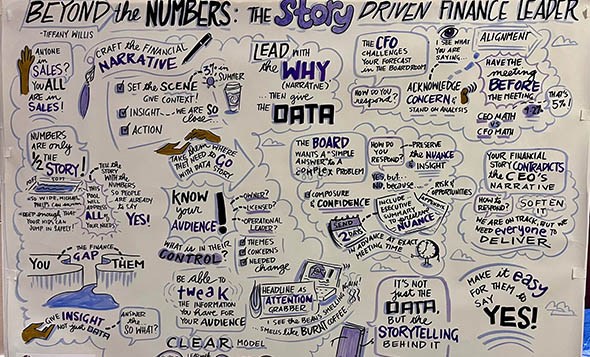
Amato: That’s great. It is the subtle reminder, “Oh yeah, I probably have to get prepared for this meeting or remember that it was on my calendar.” So this is not necessarily a scenario, but a concept that was captured by the visual artist.
Willis: Yes, I’ve never had that before. So I was so excited to see her do that.
Amato: Yeah, I took a picture of that. I may run it with the episode; who knows? But the concept: Be able to tweak the information for your audience. Now, that does not mean change the numbers. What does it mean?
Willis: Yeah, so different audience members are going to focus on different things, right? If you’re talking to your CFO, they’re looking at top-line revenue growth. They’re looking at margin. They’re looking at EPS. But if you’re talking to someone in sales, they may want to know about how many of the deals that were in the pipeline, how many closed, are actually included in the forecast number for revenue. And so different aspects of a forecast, different aspects of the numbers, are going to be important to some versus others.
If you think about it from an investor perspective, the CFO may want to know what the movement and the churn is in the investor roster. Your CEO may only want to know the top three, whereas the board may want to know, what are the themes you’re hearing from our investors, and not necessarily focused on the movement in the roster. So different individuals, different stakeholders, will have a focus on different elements of the business, and you have to be able to tweak and tell them that part of the story that is most aligned with their interests.
Amato: We talked earlier about the CFO challenging a forecast in the boardroom and how you react. But aside from how you answer that or how you prepare, how do you learn to stay composed when challenged?
Willis: I don’t know how you learn it. I think it’s almost like jumping in the deep end. When you’re in those scenarios, when you’re in those moments, you have to learn how to just hold your composure. And I think over time, when you’re in enough of those moments, you begin to get more comfortable with maintaining your composure and knowing how to just regulate your emotions and keep it very professional.
And I would say, as leaders, as we climb, there’s going to be differences of opinions in rooms. And there should be, because we shouldn’t have “think tank,” and we shouldn’t all be trying to come from the same perspective. And so just being comfortable with differences of opinions and pushbacks and people kind of nudging on your opinion and your recommendation should be expected. So you have to have that composure under pressure.
Amato: So one other scenario, and I’m paraphrasing here: The numbers in your data, your presentation, contradict the CEO’s narrative. What do you do?
Willis: Yeah, I think when the CEO has a narrative, usually it’s around growth. It’s around revenue, right? It’s around market share. And I think from a finance perspective, we have the numbers that are actually showing how we’re tracking. And the biggest thing to do to help bridge that gap is to help them understand where things are in the pipeline and if the opportunities will manifest, what that will look like. I definitely see, Mr. CEO, that our growth will be at that particular number by year end if these opportunities manifest. But hey, we need all of our sales professionals and our frontline workers to all be on board with delivering on this strategy for us to meet that number. But we also need the risks that are identified to be mitigated and managed.
And so we need the organization rallied around those as well. So I think when there’s a difference, our job as finance leaders is to bridge that gap by helping them understand for that number to be realistic and to manifest, here’s what it’s going to require.
Amato: That’s great. Thank you. I mentioned the word narrative in that scenario. Narrative is a key word. It’s part of the title of your book. It was the phrase that was a theme of our interview back in 2022. Now, the full title of your book: Own Your Narrative: A Journey Rooted in Resilience, Restored in Purpose. First, why did you decide to write the book, and what do you hope readers draw from it?
Willis: I decided to write the book really out of demand. I would always get booked for speaking engagements, and people would then say, “Can we also buy 50 copies of your book or 100 copies of your book? Hey, if you have books, you can bring them with you.” And I was doing speaking because I love to speak and love to just inspire, but never had it as a way of selling books. And so that was just not my focus. It wasn’t my priority. It wasn’t my goal.
But last year, I was speaking on Wall Street for Juneteenth, and an individual came up to me and wanted me to speak at their large conference of 3,000 individuals. And she goes through the roster of what they’re looking for in a keynote speaker. And she says, “Female, a person of color, you’re in finance.” And she keeps going through the list. And then she says, “Author.” And I said, “Well, I’m everything except an author.” And she says, “Oh, we need you to be an author because then we center the full year of meetings around our conference and our theme and the book.”
And so at that moment, I could not get booked for that speaking engagement. And I felt like there was going to be someone in that room that needed to be inspired, that is carrying a weight that’s invisible on their shoulders that no one knows about. And if some of my words could just uplift them, empower them to just keep putting one foot in front of the other, mission accomplished. And now I wouldn’t have that opportunity. And that’s when I said, “Never again will I be locked out of the door where I could have inspired someone.” And that’s what made me write the book.
Amato: Is there kind of a book tour continuing? Is it formal?
Willis: It’s a formal book tour. When I decided to write the book, it was in response to that kind of shutout of the demand, where people would always ask for it, and then ultimately not getting one particular speaking engagement because I didn’t have the book. And then I just said, you know, when I get booked for other speaking engagements, now I have it. And then if someone wants to book me and they want an author, I now have it.
Then the publisher said, “No, you got to market this book. This book is too good to just wait until your next speaking engagement.” And so I went into full marketing mode. Since May, I have been speaking all over. The response has been overwhelmingly positive. Within 90 days, we sold over 800 books, almost 900 books in 90 days, which my publisher said is unheard of for a noncelebrity, self-published memoir.
And it really has resonated, where people have described it as a leadership book disguised as a memoir. And so I’m really excited about how people are receiving it because it’s not only leadership lessons, but it helps people identify their own struggles, journey, and how to get through them.
Amato: So definitely some personal journey in there. And I’m going to close with this on the leadership side of it. How would you assess Tiffany Willis as a leader?
Willis: I’ve never assessed myself as a leader. I would say I am still growing into the best leader that I can be. But one of the staples of myself as a leader is being authentic. And that’s core to who I am as a leader, just being authentic and accepting people and my team for who they are and trying to find what brings out the best in them so that they can show up authentic. They can be their full selves.
I feel like when you spend energy trying to conceal or hide or bury aspects of yourself, that’s less energy that you’re able to use on bringing your best self to work. And so a key staple of my leadership is just being authentic and allowing other people to be authentic, but I’m still developing into the best leader that I can be.
Amato: Tiffany, thank you. We’ve hit just a few of the highlights, but it’s been an enjoyable time today. Thank you for being on the JofA podcast.
Willis: Thank you. Always a pleasure.