A recipe for sanctions: AI-hallucinated citations in tax
AI can speed tax research, but it can also invent cases. Your firm needs guardrails to avoid potential trouble.

Tax professionals are rapidly integrating the benefits of generative artificial intelligence (AI) into their workflow, but a recent Tax Court case, Clinco, T.C. Memo. 2026-16, shows how quickly things can go wrong.
In Clinco, the Tax Court provided a powerful message for tax professionals: Using AI requires rigorous due diligence. “Hallucinated” legal authorities can cause a taxpayer’s case to collapse “like an overmixed soufflé,” Judge Mark V. Holmes wrote in his opinion, using a playful cooking metaphor because the matter concerned a restaurant owner.
The decision provides a cautionary example for both tax attorneys and accountants navigating the growing use of AI in legal research and drafting.
The case involved the 2015 tax return of Peter L. Clinco, an attorney and entrepreneur who co-owned and operated MedCafe Westwood, a restaurant and bar near the University of California at Los Angeles. The IRS audited the return and determined through a bank-deposit analysis that MedCafe’s gross receipts were underreported on Clinco’s Schedule C, Profit or Loss From Business (Sole Proprietorship), for the restaurant by more than $2.2 million and that Clinco was not entitled to $56,798 in depreciation deductions for two rental properties due to a lack of substantiation. He challenged the IRS’s determinations in Tax Court, but the court upheld them. An unusual aspect of the opinion involved Holmes’s faulting of Clinco’s attorney for submitting briefs citing nonexistent cases that Holmes said appeared to have been hallucinated by generative AI.
THE ‘APPARITIONS’ IN THE BRIEFING
Among other things, Clinco challenged the validity of a notice of deficiency because it lacked a manual “wet” signature. His attorney cited four cases in support of this argument — three of which the court described as likely “hallucinations generated by a large language model AI.”
The three cases the court said appeared to have been hallucinations were:
- Cacchillo, 130 T.C. 132 (2008): The taxpayer’s counsel claimed this case held that an improperly signed notice of deficiency ousted the court of jurisdiction. In reality, the case does not exist. Page 132 in volume 130 of Tax Court Reports is within Porter, 130 T.C. 115 (2008), and discusses the standard of review for innocent–spouse relief.
- Miller, 57 T.C. 440 (1971): This citation allegedly clarified formal signature requirements, but page 440 of volume 57 of Tax Court Reports is within Winfield Manufacturing Co. v. Renegotiation Board, 57 T.C. 439 (1971), a case with no mention of deficiency notices.
- Tefel, 118 T.C. 324 (2002): The court described this as nonexistent, noting that the cited page actually refers to Hillman, 118 T.C. 323 (2002), a case regarding S corporation management fees.
Even though the IRS pointed out these errors in an answering brief, the taxpayer’s counsel failed to correct the record and even repeated one of the fictitious citations in a subsequent table of authorities.
A ‘RECIPE FOR SANCTIONS’
Holmes did not mince words in the Clinco opinion, describing the taxpayer’s attorney’s briefing on this issue as a “bouillabaisse of case names, reporter citations, and legal propositions” that suggested “something cooked up by AI.” While the court stopped short of formal sanctions, it issued a severe warning to the tax bar about the importance of exercising due diligence when using AI in tax research. As Holmes stated in his opinion, “Submitting a brief with fictitious caselaw is a recipe for sanctions.” The admonition applies to accountants too, as will be discussed.
Holmes noted that an attorney submitting a brief with citations to nonexistent cases in a federal district court is a clear violation of Rule 11(b) of the Federal Rules of Civil Procedure. Under Rule 11(b), an attorney or unrepresented party certifies that, to the best of the person’s knowledge, after a reasonable inquiry, the claims, defenses, and other legal contentions in a filing are warranted by existing law or by a nonfrivolous argument for extending, modifying, or reversing existing law or for establishing new law. The Tax Court lacks an equivalent to Rule 11 apart from Tax Court Rule 33(b), which governs pleadings (filings that formally set forth claims or defenses). The judge observed, however, that under Tax Court Rule 201(a), lawyers who appear before the court are bound by the American Bar Association’s Model Rules of Professional Conduct, which prohibit knowingly making false statements of law and require the correction of prior false statements (see Model Rule 3.3(a)(1)).
AI IN TAX RESEARCH AND DRAFTING
The issues raised in Clinco arise in a broader environment where AI is increasingly used in legal research and drafting. AI tools are quickly becoming embedded in the workflow of tax professionals, both attorneys and accountants. Large language models can quickly summarize legal concepts, generate outlines for memoranda, and suggest potential authorities addressing a research question. For practitioners, these tools can provide valuable help in research or drafting.
However, AI operates differently from traditional tax research platforms such as Checkpoint, Bloomberg Tax, or CCH. AI models are trained on large collections of text and generate responses by predicting likely language patterns. Although the resulting explanations may appear persuasive and authoritative, the model might cite authorities that do not actually exist or invent pertinent details.
This type of error is one of the most widely discussed risks associated with AI: hallucinations, as noted in Clinco. Hallucinations occur when AI generates any output that sounds plausible yet is fabricated or incorrect. While a citation and related text description often appear credible, practitioners who rely on AI-generated citations without verification may inadvertently cite nonexistent authorities.
The professional risk is significant, particularly if a hallucinated citation appears in a client research memorandum, an advisory letter, or a filing submitted to a court. Clients who are paying for professional tax advice are also likely to be unforgiving if the work product contains fabricated authorities, creating reputational and potential malpractice risks for the practitioner.
JUDICIAL SCRUTINY OF AI-GENERATED LEGAL AUTHORITIES
As Holmes noted in Clinco, “such apparitions have made frequent appearances in legal briefing in recent years” and are “unacceptable.” These include nontax cases. For instance, in Flycatcher Corp. v. Affable Avenue LLC, No. 1:24-cv-09429 (S.D.N.Y. 2/5/26), a business dispute, the court entered a default judgment against the defendant and permitted the plaintiff to seek attorneys’ fees after defense counsel submitted a brief containing numerous false citations and repeated similar errors in subsequent filings. The court emphasized that counsel’s continued reliance on unverified, AI-generated authorities violated basic professional obligations. See also Wadsworth v. Walmart Inc., No. 2:23-cv-00118-KHR (D. Wyo. 2/24/25); Fivehouse v. U.S. Department of Defense, No. 2:25-cv-00041-M (E.D.N.C. 3/2/26); and Mata v. Avianca, Inc., 678 F. Supp. 3d 443 (S.D.N.Y. 2023).
In response to growing concerns about fabricated citations, some judges have issued standing orders addressing the use of AI in litigation. Several courts now require attorneys to certify that any AI-generated research included in a filing has been independently verified against authoritative legal sources.
Clinco appears to be the first Tax Court case to address potential AI hallucinations.
CIRCULAR 230, SSTSs, AND PROFESSIONAL RESPONSIBILITY FOR AI-ASSISTED TAX RESEARCH
Risks of AI errors go beyond judicial rebuke for hallucinated legal authorities. They may, for example, cause practitioners to file incorrect returns and taxing authorities to erroneously process them. They may also compromise taxpayer confidentiality and data security. For a comprehensive assessment, see “A Risk Framework for AI Use in Tax Administration and Preparation,” by former IRS Commissioner Danny Werfel in the August issue of The Tax Adviser.
They may also implicate practitioners’ fitness and ability to practice before the IRS under Treasury Circular 230, Regulations Governing Practice Before the Internal Revenue Service (31 C.F.R. Part 10). Tax professionals’ misuse of, or incorrect reliance on, AI could conceivably result in a finding under Circular 230 of unethical or incompetent conduct, complete with an investigation by the IRS Office of Professional Responsibility and assertion of penalties, including censure, suspension, or disbarment. (For a summary of relevant Circular 230 provisions, see the chart “Circular 230 Considerations for AI-Assisted Research,” below.)
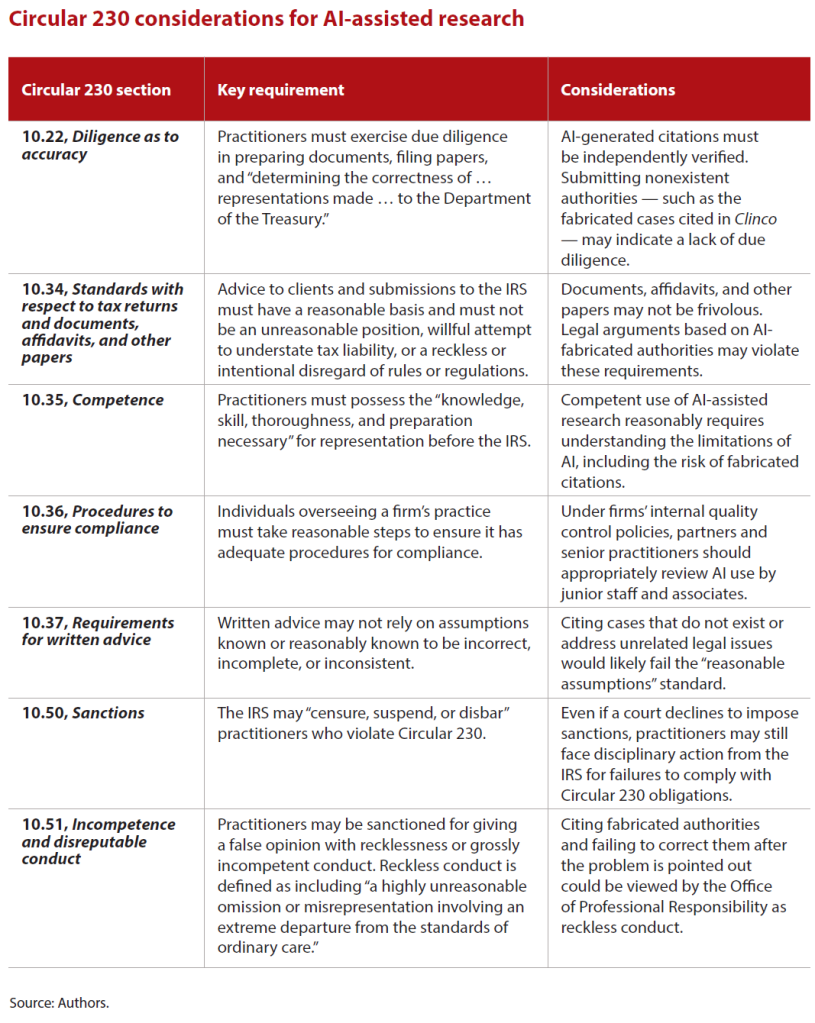
Since the drafting of this article, the IRS Office of Professional Responsibility released “Introductory Guidelines for Responsible AI Use in Federal Tax Practice,” which applies many of the same Circular 230 duties discussed below to AI-assisted tax practice. This guidance reinforces the central point of this section — AI may assist tax research and drafting, but it does not replace the practitioner’s independent responsibility to verify facts, authorities, citations, calculations, and client data safeguards before relying on or submitting AI-assisted research.
Additionally, AICPA members’ irresponsible use of AI may carry professional consequences under the AICPA Statements on Standards for Tax Services (SSTSs). SSTS Section 1.4, Reliance on Tools, prescribes standards when relying on tools in providing tax services, supplementing rules in the AICPA Code of Professional Conduct. AICPA members and CPAs licensed in states that incorporate the SSTSs into their professional rules of conduct may reasonably rely on tools in providing tax services but are not thereby absolved of professional responsibility (SSTS ¶1.4.4). When using AI or any other tool, they must exercise appropriate professional care and judgment (SSTS ¶1.4.3). Individuals may use AI or other tools to enhance or improve their understanding of a tax issue but not to supplant their professional judgment (SSTS ¶1.4.8). They remain responsible for the resulting work product (SSTS ¶1.4.7). AI may assist with drafting, but both Circular 230 and SSTS Section 1.4 make clear that the responsibility for the accuracy of tax authorities remains with the practitioner.
PRACTICAL RISK MANAGEMENT FOR TAX PRACTITIONERS
The lesson from Clinco is not that practitioners should avoid AI altogether. Rather, while AI can be a useful drafting and research tool, the case illustrates that professional judgment and due diligence remain vital. Practitioners who incorporate AI into their work should implement clear safeguards to reduce the risk of inaccurate legal authority appearing in client work or court filings.
Firm AI use policies
Firms should establish written policies governing how AI may be used in tax research and drafting workflows (see the sidebar “Firm Policies for Responsible AI Use in Tax Practice” at the end of this article and the July JofA article “Drafting an AI Policy That Actually Works“). These policies should define permitted and prohibited uses, identify which specific AI tools can be used, require human review of all AI-assisted work products, and outline documentation procedures for verifying research authorities. Training is equally important. Practitioners and staff should understand both the benefits and limitations of AI, including the risk of fabricated citations.
Litigation safeguards
When AI is used in litigation-related work, additional safeguards may be warranted. Firms may adopt checklists for briefs requiring attorneys to confirm that all cited authorities have been independently verified. Some firms maintain citation verification logs or require a second reviewer to cross-check legal authorities before filing.
Disclosure considerations
Practitioners are also beginning to evaluate whether and when the use of AI should be disclosed. While no universal rule currently requires disclosure in most tax matters, some courts have begun requiring certifications that filings were reviewed by a human attorney (see Mata). Monitoring emerging expectations will be important as standards continue to evolve.
Carefully framed research prompts
Practitioners should remember that AI output is only as reliable as the instructions and information provided to the system. Poorly framed prompts or vague research questions can increase the likelihood of inaccurate output. Providing clear search parameters and carefully reviewing the results remains essential (see “9 Tips to Write More Effective AI Prompts,” JofA, May 5, 2026).
A CAUTIONARY REMINDER
Ultimately, Clinco serves as a cautionary reminder that new technology does not diminish the professional obligations of tax practitioners. Circular 230, the SSTSs, and court rules place responsibility for errors squarely on the practitioner. AI may assist with drafting and research, but the duty to verify the tax law and the consequences of failing to do so remain with the tax practitioner.
Firm policies for responsible AI use in tax practice
The IRS Office of Professional Responsibility’s recent AI guidance underscores that responsible AI use is not only an individual practitioner issue but also a firm-governance issue requiring policies, training, supervision, secure data protocols, and documentation. Accordingly, firms should consider including the following elements in their AI policy:
- Define permitted and prohibited uses of AI, including restrictions on uploading taxpayer or other sensitive client information to unsecured platforms;
- Require practitioners to treat AI-generated text as a draft, not a final work product;
- Require human verification of all cited authorities, factual statements, calculations, and legal conclusions;
- Establish secure AI data-handling protocols, access controls, and procedures for addressing breaches or AI-generated errors;
- Provide training on AI limitations, including hallucination of authorities, bias, confidentiality risks, and appropriate use of AI tools;
- Vet third-party AI tools before use, including reviewing security, confidentiality, and data-use terms;
- Establish supervisory review procedures; and
- Maintain documentation of AI use, review, and citation verification.
The firm’s policy should apply to all AI-assisted work products, including memoranda, client advice, and submissions to the IRS or courts.
About the authors
Kaitlin Newkirk, CPA, MST, M.Acc., is an assistant professor in the Williams College of Business at Xavier University in Cincinnati. Sarah Webber, CPA, J.D., LL.M., is an associate professor in the School of Business Administration at the University of Dayton in Dayton, Ohio. To comment on this article or to suggest an idea for another article, contact Jeff Drew at Jeff.Drew@aicpa-cima.com.
LEARNING RESOURCES
Discover the premier benefits of Tax Section membership to keep pace with tax changes and meet market and client demands. Benefits include 16 free CPE hours, the Annual Tax Compliance Kit, a weekly e-newsletter, and The Tax Adviser.
SECTION
Practical AI Techniques for CPAs Serving Not-for-Profits
Discover how AI is transforming not-for-profit accounting. This session equips CPAs with insights to streamline processes, enhance data analysis, and improve decision-making for greater impact.
webcast
For more information or to make a purchase, go to aicpa-cima.com/cpe-learning or call 888-777-7077.
MEMBER RESOURCES
Engage365 tax communities
Engage 365 is an AICPA members-only community where tax practitioners connect, share resources, and exchange real-world insights. Tax professionals can join two communities tailored to their practice area — Corporate and International Tax and Individual and Small Business Tax — making it easy to connect with peers and exchange perspectives and practical guidance.
Article
“AI Risks CPAs Should Know,” JofA, Feb. 1, 2026
Live, monthly roundtable sessions
Podcast episode
Tax Section Odyssey: Unlocking the Future of Tax Research With AI
Website