- podcast
- NEWS
Accounting’s future: Embrace change and build on trust
Sponsored by AICPA Member Insurance Programs
Finance leaders can become consumed by today’s challenges, but long-term thinking is essential to staying competitive and relevant.
In this episode of the Journal of Accountancy podcast, hear from former AICPA chair Okorie Ramsey, CPA, CGMA, on how the Rise2040 initiative identifies key forces shaping the profession, why embracing change is critical, and how trust can remain a powerful advantage for CPAs.
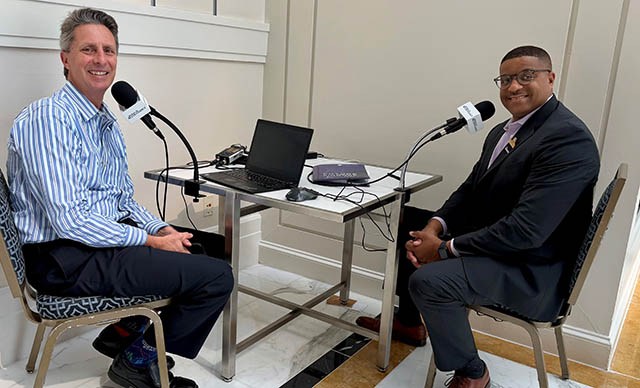
Ramsey, speaking from the Future of Finance Summit in National Harbor, Md., also discussed the purpose of the AICPA Foundation and why he enjoys being part of the Future of Finance Leadership Advisory Group.
What you’ll learn from this episode:
- A framing of the Rise2040 initiative and how it can help finance leaders think beyond this week’s task list.
- Ramsey’s comment on Rise2040 including the statement from accountants that “our biggest threat is us.”
- Why embracing change is a critical skill for the profession.
- The reason trust is particularly important now in Ramsey’s mind.
- His focus areas as vice president of the AICPA Foundation.
Play the episode below or read the edited transcript:
— To comment on this episode or to suggest an idea for another episode, contact Neil Amato at Neil.Amato@aicpa-cima.com.
Transcript
Neil Amato: Okorie Ramsey is the 110th chair of the AICPA, and he’s the guest on the next episode of the Journal of Accountancy podcast. You’ll hear that episode right after this brief sponsor message.
[Sponsor message]
Amato: Welcome back to the show. This is Neil Amato with the JofA. Again, I said he’s the 110th chair of the AICPA. He’s also vice president of Sarbanes-Oxley, or SOX, at Kaiser Permanente. Okorie, you’re a repeat guest. We’re glad to have you back on the JofA podcast.
Okorie Ramsey: Thank you, Neil. It’s a pleasure to be on the JofA podcast and to spend time with you. I’m really excited for our conversation today.
Amato: That’s great. We’re recording at the Future of Finance Summit in National Harbor, Md., some late summer recordings for airing later in the year.
One thing I want to talk about first is Rise2040. I think our listeners are familiar with Rise2040 right now, but one thing that I think you underscored well in a Future of Finance Summit session is it’s many things. and we’ll get to those many things a little bit later.
But when people hear 2040, they can get overwhelmed a bit. What to you are the concepts of Rise2040 that finance leaders can start applying right now?
Ramsey: Absolutely, Neil. And just to frame it a little bit, because I know we’re going to talk a little bit more about Rise2040 and some of the core components of it, but this is a process. It’s a review that I would say that we do every 15 years or so, to relook at the profession and where we’re going.
And so we’ve done this now over 30 years, where during two 15year periods, we will say, what do we think about where the profession is going? And we have a lot of input around that, which I know we’ll talk about as well. But I just wanted to frame what 2040 is for folks to understand that this is really about us really looking at our profession holistically and where do we think we are now, but also where we’re going.
And then be able to take a look back and say, hey, did we achieve the things that we intended or are there things that we missed the boat on? And how do we think about that as we go forward? So when I think about what are the concepts that people can really apply today, I think about three different areas. The first being embracing change, because change is the one thing in the world that is constant. And so we’re always going to be evolving, always changing, and there are always going to be some risk and some opportunities that come with that. So how do we make sure that we are thinking thoughtfully about that?
The second is learning through the value that we hold as a trusted profession. So we talk often about being trusted advisers or being a trusted profession, and now we have a campaign that the organization is behind, the AICPA and CIMA. That campaign is around trust as part of a really a stakeholder for who we are as professionals. And that’s something that we should honor and that we should appreciate, but also take advantage of because as a trusted profession, that gives us some credibility that we don’t have to start from the beginning. We’re starting with that already in place, and it’s really a matter of building.
The third thing would be the drivers that come out of Rise2040. So, there are five drivers: data and technology, quality and sustainability, talent and workforce, trust and assurance, and then global shifts in society. And so as we think about those drivers, the things that we need to think about as it relates to those are what are the hard trends? What are the soft trends? What are problems that we have associated with that? And then also what are the opportunities?
So we shouldn’t be looking at it only as one side, being that while there’s a lot of issues that are coming up that impact the profession, but what opportunities does that create for us to really drive business forward, being advocates for the work that we need to do in our companies and in our organizations. So there’s a lot really to unpack in the report that can be applied today.
Amato: You mentioned embracing change. You mentioned change is probably the main constant. Finance leaders, it seems like they’re dealing with so much change right now. Do they even have time to think about 10 or 15 years down the road when they’re struggling to think about next week?
Ramsey: That’s a great question, and it’s a very important point. I do believe that in today’s environment we have to be able to straddle between current challenges that we’re looking at today, but also focusing on what’s on the horizon. Because if we’re not focused on what is to come, then we want to be prepared when we get there. So we have to be forward thinking about that.
Just to give an example, my board recently has approved our 10-year economic plan for Kaiser Permanente. If we don’t have a plan and a vision for what we want to achieve in those 10 years, then we won’t get there. So we have to be thinking about what are the things that are important for our organization to sustain the growth that we need to be a major player in the healthcare space. And I think as other organizations, also need to be thinking about their strategic plan, their operating plans, their economic plans for how they want to grow. And again, it’s not going to be perfect. But at the same time, if you don’t have a plan, where are you going?
Amato: So let’s go back to Rise, which was the subject of your opening presentation at Future of Finance. I liked this idea as I hadn’t really seen it before, that it’s “a conversation, a method, and a platform.” Tell me more about each of those three aspects of Rise2040.
Ramsey: When we say that Rise 2040 is a conversation, this really dates back to, I want to say 2010, when we first started looking at the profession and where we thought we would be going. And so I believe Paul Stahlin was the chair at the time, and we did a look at that time as to where do we believe the profession was going, and we did that for what would we be in 15 years. That brings us from 2010 to 2025.
In 2025, we started the discussion around what do we believe we’ll be in 2040? And, hence rise 2040. And so now we’re looking at, again, 15 years in the future, where do we think what will be the priorities, what will be some of the challenges, and how do we get in front of that today? And again, be able to look back at things that we were concerned about and focused on back in 2025, did they come up? Did they occur as we thought that they would when we were looking in 2040? So, we’ll see.
But in addition to that, it’s about it being a dialogue, about what experiences are we seeing as practitioners. So it’s not something that is happening to us or that is being written about us, it’s being created for us, by us. So that would be the conversation.
In terms of the method, we utilized a method that is anchored in the work of a global futurist. His name is Daniel Burrus. And Daniel Burrus has this anticipatory framework that allows for us to have common language around the way that we think about the future. So, the fact that we are having this conversation and we’re utilizing the same language everywhere that we are — it’s amazing. We did this analysis in 95 future forums to think about where are we going. We had over 6,000 members of the profession who were actually involved in the analysis to really help create this output. Because I don’t even like to call it a report because it’s much more than that. And then the third piece would be the platform. So again, not just a report, really a way for us to look at, every 15 years, where do we think we’re going? It’s not a check-the-box exercise with a report that we just put on the shelf, but really a way for us to take insights and turn them into action.
Amato: One concept or one statement unearthed out of Rise2040 is the kind of inward looking statement, “Our biggest threat is us.” If you let that sit for a moment, tell me what comes to mind when you think about those words.
Ramsey: You know, Neil, for me, that was actually quite powerful because I viewed it as being quite self-reflective as a profession, that we had a lot of individuals who were involved in this. Over 6,000 voices are being heard through this work. And to consistently hear that we are the thing that can stand in our way from making the advancements that we believe we need — wow, that’s something that it seems simple, but at the same time, sometimes it’s hard to look in the mirror and say, “Oh, the problem is me.” So I think that it’s great that we can understand that and that we understand also that we can’t be resistant to change.
And that’s why I kind of started out with being open to embracing change because it is constant. So how do we make sure that as we come together, that as we think about the future, that we are not being in the way and that we’re embracing that, yes, change is hard and that some of the things may be difficult to do, but that it’s important for us to really stay in the fight and make our way through.
Amato: You mentioned the word “trust” earlier on — CPA Trust, an initiative announced earlier this year. Why to you is that concept of trust so important today?
Ramsey: I believe that trust is very important today, especially in an age of disinformation. People really feel a void of trust in leaders. They feel a void of trust in what they thought was accurate information. And what I view it is as a profession, we are trusted. And so when people are looking for something to fill that void of where can I get accurate information, people who I believe have the best interest of me and what’s happening in our economies, that we’re built on a very trusted foundation. We are trusted advisers. We support businesses and economies in achieving what they need to sustain our future.
And I believe that that’s why it’s so important that we build off of that and that we also not take that for granted. Because ultimately, if you do take that for granted and let’s say that we see some bad actors within our profession taking the lead, wow. I mean, what damage that could do broadly to our overall profession. We really don’t want that. So reinforcing the importance of the role that we play as trusted advisers and how important trust is in our profession, I think it’s important element of the work that we do.
Amato: Tell me some about the AICPA Foundation. What is it and what is your role with it?
Ramsey: Well, I’m very glad that you asked, and I’m very excited about the work that I will be doing here for the next few years with the foundation. So just as a backstop, the foundation was established in 1922, and the foundation’s primary purpose is to fund innovative programs and initiatives that bolster the accounting profession and also encourage students of all backgrounds, honestly, to become CPAs.
So that’s really the foundation of why we do this, right, in terms of the AICPA Foundation. Now, what my work will entail is I currently serve as vice president of the foundation. Tracy Golden is past chair as well. She is currently serving as president of the foundation. So I’m really watching and seeing what are the areas that we currently focus on in terms of growing our corpus for the future of the profession. How do we make sure that we have the scholarships and the resources available to support young people who are inspired by the profession, who want to be a part of it, but don’t necessarily always have the financial means to do that.
And so how we grow that number, different corporations are interested in helping us to build that corpus so that we have more dollars available for scholarships but also helping to tell our story. We need to be able to tell our story better than anyone about all the great things that you can do within this profession. And so the more that we have people who will come forward and who will share their experiences, but also those who are willing to give, we can really make a very vast impact. So I’m really excited about this. I have a lot of great ideas coming behind Tracy as, ideally, the next president of the foundation and seeing how we can continue to grow our numbers.
Amato: That’s great. As I said, we’re recording at the Future of Finance Summit. Why do you like being part of this Future of Finance group?
Ramsey: Neil, I really enjoy being a part of the Future of Finance group because it’s really a community that we have built of professionals who are in business and industry. My background is largely now business and industry. It’s interesting to say that I spent the first 15 years of my career in public accounting between three firms. And I’ve now spent 18 years within Kaiser Permanente. And so I am deeply rooted in business and industry.
And even as a past chair, and when I was chair, that was really the foundation of I wanted to see more of the areas of focus that we have in the Future of Finance work that Tom Hood’s leading. It’s again a very important aspect of our membership, being public accounting and all those in advisory work. But this is a community of people who are in industry, who are working with different corporations, who are making vast contributions to their respective organizations dealing with the day-to-day, whether it’s closing the books for the financial statements, whether it’s thinking about strategy, whether it’s thinking about how are we going to do things like SOX and internal audit.
You have a very broad cross-section of operational leaders who are in place that you can really engage with about the different challenges that you’re all facing and can leverage that community for day-to-day issues and challenges that you might be facing because you’re dealing with people who are experiencing in their own organizations the very same things that you’re dealing with. So having that community is amazing. The Future of Finance Leadership Advisory Group was started back in 2020 with having the first Future of Finance event actually in 2021. And so to be now six years into this and to have a summit where every year we continue to grow that population of professionals who join us, it’s just been wonderful to be a part of that. And so that’s what keeps me coming back.
Amato: Okorie Ramsey, thank you for being back on the JofA podcast.
Ramsey: Awesome to be here with you, Neil. Thank you for the opportunity, and I look forward to more opportunities to engage with you in the future.