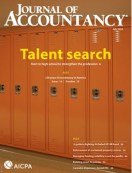
CPA firms trying to attract and retain top talent should emphasize career growth opportunities, salary and paid time off while maintaining an open-door policy that makes management accessible. That summarizes the key findings of the AICPA’s Private Companies Practice Section (PCPS) 2011 Top Talent Survey, which aims to help PCPS
Advertisement
TOPICS
Management accounting
High-Potential CPAs, the BIG Picture
Editor’s note: Also read “The Lowdown on High Potentials” in the December 2011 issue of the JofA. With the 2011 edition of its Top Talent Survey, the AICPA’s Private Companies Practice Section took a look for the first time at high-potential CPAs working in the business, industry and government (BIG)
Planned Job Cuts Dip Slightly in November, Challenger Says
The pace of U.S. job-cut announcements slowed slightly in November, but the 11-month total for 2011 exceeds the 12-month total from 2010, global outplacement firm Challenger, Gray & Christmas announced Wednesday. Planned job cuts unveiled by U.S.-based employers in November decreased 13% from the same month in 2010, when employers
Revised Revenue Recognition Proposal Unveiled
FASB on Monday released a revised exposure draft on the financial reporting requirements for recognizing revenue from contracts with customers. The proposed standard, which was released for public comment jointly with the International Accounting Standards Board (IASB), makes a number of changes to a joint ED issued in June 2010
Business Basics in Brazil
Brazil is a nation rapidly on the rise. In 2010, the country’s economy grew 7.5%, making it the seventh-largest in the world, according to the World Bank. In 2011, Brazil’s GDP is expected to grow 4.5%, slower than last year but still a healthy pace. And growth over the next
AICPA, CIMA Gearing Up for Jan. 31 CGMA Launch
The AICPA and the Chartered Institute of Management Accountants (CIMA) have set Jan. 31 as the launch date for their new joint credential, the Chartered Global Management Accountant (CGMA). “What we’re creating is a very significant global community,” Charles Tilley, CIMA’s chief executive, told members of AICPA’s governing council Monday.
Economist Predicts Moderate Growth
The economy is not sliding back into recession, but GDP will only expand at an annual rate of 2% to 2.5% until the housing market recovers, according to Martin Regalia, senior vice president–economic and tax policy for the U.S. Chamber of Commerce. Speaking Tuesday to the AICPA governing Council in
Intergovernmental Financial Dependency: Why It Matters
Current economic conditions, including job losses, illiquid credit markets, an ailing construction industry and reduced consumer spending, have combined to increase risk and uncertainty not only across all private industries, but also in the public sector, including local governments, states and, perhaps most importantly, the federal government. AICPA Statement of
Act Public Before Going Public
After several years of increasing numbers of U.S. companies making initial public stock offerings, starting in late summer 2011, some companies postponed going public as economic and market conditions grew turbulent and uncertain. But even a holding pattern might have some advantages if companies use that time to better prepare
Planning for Uncertainty
With national debt crises in both Europe and the United States, a shaky recovery from the deepest recession since World War II and volatile currency markets, it’s not surprising that recent research conducted by the Beyond Budgeting Round Table found that more than two-thirds of corporate budgets are irrelevant before
PCAOB, Norway Reach Accord on Auditor Inspections
The PCAOB on Wednesday said it entered into a cooperative agreement with the Financial Supervisory Authority (FSA) of Norway for the oversight of audit work performed by public accounting firms that practice in the two regulators’ respective jurisdictions. The PCAOB had been blocked from inspections in Norway since 2008, the
International Committee Releases Draft Framework for Integrated Reporting
The International Integrated Reporting Committee (IIRC) calls for a new approach to corporate reporting in a discussion paper released Monday. The paper, Towards Integrated Reporting: Communicating Value in the 21st Century, discusses the rationale for integrated reporting, offers initial proposals for the development of an international integrated reporting framework, and
Economic Optimism Slumps, Execs Anticipate Double-Dip Recession
Economic optimism dropped to a two-and-a-half year low as more than 60% of CPA financial executives thought it was likely the U.S. would experience a double-dip recession, according to results released Wednesday from the AICPA Business & Industry Economic Outlook Survey Q3 2011. Optimism for the U.S. economy significantly dropped
Highlights of Corporate Governance Research
Several corporate governance developments have occurred in the wake of the high-profile scandals of the past decade. Some of these developments are motivated by legislation such as the Sarbanes-Oxley Act of 2002 (SOX). Others are best practices enhancements intended to shore up investor confidence. Academic research has monitored these developments.
Auditing
The PCAOB adopted a temporary rule to establish an interim inspection program for registered public accounting firms’ audits of securities brokers and dealers as permitted by the Dodd-Frank Wall Street Reform and Consumer Protection Act. The board adopted without material change a proposed temporary rule (tinyurl.com/6x47nh5) issued Dec. 14, 2010.
Survey Shows Hiring Plans Rising for Accountants, Other Professionals
Twelve percent of CFOs interviewed for the quarterly Robert Half Professional Employment Report said they planned to hire professional-level accounting and finance staff in the fourth quarter of 2011, while 7% foresaw cutbacks. CFOs were increasingly optimistic about the hiring outlook, according to the report. The net 5% of financial
FDIC: Insurance Fund Back in the Black as Bank Profits Rise 38%
The improved health of the nation’s banks boosted the Deposit Insurance Fund (DIF) into a positive balance ($3.9 billion) for the first time in two years, according to the FDIC’s Quarterly Banking Profile for the quarter ending June 30. The report also said profits at insured institutions rose to $28.8
Presentation of Patient Service Revenue Changed for Health Care Entities
FASB issued an Accounting Standards Update (ASU) containing amendments that require health care entities to change the presentation of their statement of operations by reclassifying the provision for bad debts associated with patient service revenue from an operating expense to a deduction from patient service revenue (net of contractual allowances
Asset-Based Financing Basics: Step-by-Step Examples
Editor’s note: Also read “Asset-Based Financing Basics,” by Robert A. Modansky, CPA/CFF, and Jerome P. Massimino, CPA, in the August 2011 issue of the JofA. Example 1: GAAP Treatment of Acceleration Clauses and Lockboxes The following is a summary of the provisions of FASB Accounting Standards Codification (ASC) Subtopic
Asset-Based Financing Basics
Once considered financing of last resort, asset-based lending and factoring have become popular choices for companies that do not have the credit rating or track record to qualify for more traditional types of financing. In general terms, asset-based lending is any kind of borrowing secured by an asset of the
Features





FROM THIS MONTH'S ISSUE

Right-sizing risk management
Sole practitioner or small firm? Risk management doesn’t have to be “one size fits all.” Learn how to help protect your practice without adding unnecessary admin time.
From The Tax Adviser
July 31, 2026
Current developments in S corporations
July 31, 2026