
Skip to content
AICPA-CIMA
  • AICPA & CIMA:
  • Home
  • Engage 365 Communities
  • CPE & Learning
  • My Account
Journal of Accountancy
  • TECH & AI
    • All articles
    • Artificial Intelligence (AI)
    • Microsoft Excel
    • Information Security & Privacy

    Latest Stories

    • Improve your Windows 11 productivity using Microsoft PowerToys
    • 4 Excel features that make reviewing large spreadsheets easier
    • Accounting ethics in the age of AI

  • TAX
    • All articles
    • Corporations
    • Employee benefits
    • Individuals
    • IRS procedure

    Latest Stories

    • Congress approves funding bill that maintains IRS budget
    • Sixth Circuit holds home-distilling ban is constitutional
    • TIGTA: IRS unable to prevent $213 million in improper EITC payments to individuals with nonwork SSNs
  • PRACTICE MANAGEMENT
    • All articles
    • Diversity, equity & inclusion
    • Human capital
    • Firm operations
    • Practice growth & client service

    Latest Stories

    • Congress approves funding bill that maintains IRS budget
    • Confidence in U.S. economy rises despite inflation concerns
    • FASB proposes several incremental improvements to GAAP
  • FINANCIAL REPORTING
    • All articles
    • FASB reporting
    • IFRS
    • Private company reporting
    • SEC compliance and reporting

    Latest Stories

    • SEC proposal aims to clarify securities rules for crypto assets
    • SEC eyes e-delivery as the default over paper
    • SEC shares 3 goals in proposed 2026–2030 strategic plan
  • AUDIT
    • All articles
    • Attestation
    • Audit
    • Compilation and review
    • Peer review
    • Quality Management

    Latest Stories

    • New AICPA guidance on stablecoins, mining revenue, current auditing standards
    • ASB approves standard on auditors’ responsibilities relating to fraud
    • SAS 149 is coming: What audit teams need to know
  • MANAGEMENT ACCOUNTING
    • All articles
    • Business planning
    • Human resources
    • Risk management
    • Strategy

    Latest Stories

    • Confidence in U.S. economy rises despite inflation concerns
    • Data governance: How finance builds trust in the numbers
    • Are finance leaders moving too fast on agentic AI?
  • Home
  • News
  • Magazine
  • Podcast
  • Topics
Advertisement
  1. newsletter
  2. Cpa Insider
CPA INSIDER

The Medicare Part D coverage gap is ending

Take this opportunity to review your clients’ Medicare elections.

By James Sullivan, CPA/PFS
October 15, 2018

Please note: This item is from our archives and was published in 2018. It is provided for historical reference. The content may be out of date and links may no longer function.

Related

October 1, 2018

Don’t let the Medicare Annual Enrollment Period pass you by

August 6, 2018

What the future of medical diagnostics could mean for CPAs

August 1, 2018

Advising chronically or terminally ill clients

TOPICS

  • Personal Financial Planning
    • Retirement Planning

Medicare is a complex system with many moving parts, and clients often find it difficult to make sense of it all. CPAs can perform an important service by understanding Medicare and helping clients make better decisions regarding their coverage. In particular, CPAs may want to revisit their clients’ Medicare elections, particularly now that Part D changes are on the horizon.

Currently, in 2018 Medicare Part D beneficiaries who pay more than $3,750 a year on prescriptions but less than $5,000 are subject to what is known as the coverage gap, popularly called the “doughnut hole.” That’s set to change. In the past, while in the coverage gap the beneficiary paid more for drugs than while in the initial coverage limit. Recent legislation (the Bipartisan Budget Act of 2018, P.L. 115-123) will all but end the coverage gap a year earlier than scheduled.

As a refresher: In 2018, the coverage gap goes into effect for Part D beneficiaries who pay more than $3,750 a year on prescriptions. At that point, beneficiaries enter the “doughnut hole”: a tier on which, in 2018, they must pay 35% of the cost of brand-name drugs and 44% of the cost of generic drugs. If their spending reaches the catastrophic coverage level of $5,000, though, they exit the “doughnut hole” and pay no more than the $3.35 for a generic drug and $8.35 for a brand-name drug or, if greater, 5% of either type of drug’s cost for the remainder of the year.

However, starting in 2019, beneficiaries in the “doughnut hole” will pay 25% of the cost of brand-name or 37% of the cost of generic prescriptions until they reach the catastrophic coverage level — effectively closing the “doughnut hole” for brand-name drugs. In 2020, beneficiaries in the “doughnut hole” will only pay 25% of the cost of generic drugs as well. 

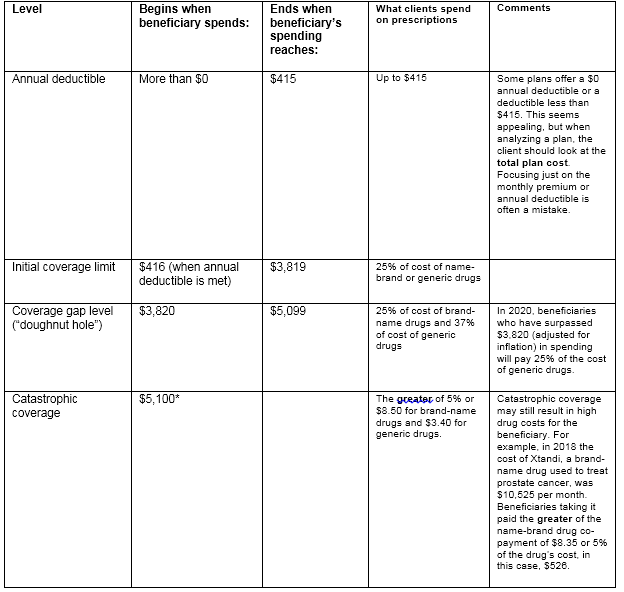
To summarize, in 2019 and going forward there will be four coverage levels (see chart):

  1. The first level of coverage is the annual deductible. In 2019 this will be $415. A beneficiary will need to pay this amount before coverage kicks in.
  2. The second level is the initial coverage limit. It begins after the beneficiary has reached the annual deductible. At this level, a beneficiary will pay 25% of the cost of brand-name or generic drugs.
  3. The third level, or the coverage gap level, begins when a beneficiary reaches $3,820* of gross drug cost. At this level, the cost sharing will be 25% for brand-name drugs and 37% for generic drugs.
  4. The fourth level, or catastrophic coverage, begins when a beneficiary’s total drug costs for the year reach $5,100*. At this level a beneficiary will pay the greater of 5% of the cost of the drug or $3.40 for generic drugs and $8.50 for brand-name drugs. 

*The term includes the cost of co-payments and co-insurance for drug costs and the cost of the drug to the plan including discounts. Thus a $50 discount provided by the drug manufacturer to the plan and the plan beneficiary would be added to the drug cost and applied to the out-of-pocket spending limit.
Coverage Levels

Assisting your clients with their Medicare Part D coverage issues sends a message that your concern goes beyond the financial to helping your client make better decisions regarding their health care coverage. The upcoming changes to Part D present an excellent opportunity to do so.

Advertisement

In The Adviser’s Guide to Retirement and Elder Planning: Financing Retirement Healthcare (available to PFP Section members and PFS credential holders), author Jim Sullivan provides a complete understanding of the options facing retirees as they pay for healthcare in the early and later years of retirement. Timelines, planning tips, and client questions all make this a very readable guide.

James Sullivan, CPA/PFS, is a financial planner in Wheaton, Ill. He specializes in working with clients, and the families of clients, suffering from chronic illness. To comment on this article or to suggest an idea for another article, contact Courtney Vien, a JofA senior editor, at Courtney.Vien@aicpa.cima.com.


Advertisement

latest news

September 3, 2026

Congress approves funding bill that maintains IRS budget

September 3, 2026

Confidence in U.S. economy rises despite inflation concerns

September 2, 2026

FASB proposes several incremental improvements to GAAP

August 31, 2026

IRS enforcement activity fell despite record tax collections, TIGTA says

August 28, 2026

Why many Americans don’t retire on their own terms

Advertisement

Most Read

4 Social Security rules that surprise clients — and some advisers
4 Medicare rules that surprise clients — and some advisers
Real-life ways small firms use AI
IRS updates overtime deduction FAQs, adds reporting details
Final rule will eliminate BOI reporting for US entities
Advertisement

Podcast

August 27, 2026

Finance’s chemistry lesson: The guardian-to-catalyst transformation

August 20, 2026

An innovative state society CEO and her view of accounting’s future

August 13, 2026

AI gets the headlines, but it’s not the whole story for finance leaders

Features

How CPAs can expand from tax into personal financial planning

How CPAs can expand from tax into personal financial planning

A recipe for sanctions: AI-hallucinated citations in tax

A recipe for sanctions: AI-hallucinated citations in tax

2026 tax software survey

2026 tax software survey

A CPA playbook to help prevent disaster fraud

A CPA playbook to help prevent disaster fraud

Strategic planning for tax advisory

Strategic planning for tax advisory

SPONSORED REPORT

Agentic accounting has arrived: What’s hype and what’s real?

Artificial intelligence (AI) is moving beyond chatbots and into accounting workflows. A new generation of agentic AI tools can plan, execute, and adapt as they complete tasks, raising expectations for what automation can do inside firms and finance departments. What can agentic AI realistically do today and what challenges are there in its implementation? Find out in this Journal of Accountancy sponsored report.

From The Tax Adviser

August 31, 2026

What today’s clients expect from their CPA and how firms are responding

August 31, 2026

2026 tax software survey

August 31, 2026

A risk framework for AI use in tax administration and preparation

July 31, 2026

Current developments in S corporations

MAGAZINE

September 2026

September 2026

September 2026
August 2026

August 2026

August 2026
July 2026

July 2026

July 2026
June 2026

June 2026

June 2026
May 2026

May 2026

May 2026
April 2026

April 2026

April 2026
March 2026

March 2026

March 2026
February 2026

February 2026

February 2026
January 2026

January 2026

January 2026
December 2025

December 2025

December 2025
November 2025

November 2025

November 2025
October 2025

October 2025

October 2025
view all

View All

http://JofA_Default_Mag_cover_small_official_blue

PUSH NOTIFICATIONS

Learn about important news

This quick guide walks you through the process of enabling and troubleshooting push notifications from the JofA on your computer or phone.

CPA LETTER DAILY EMAIL

CPA Letter Logo

Subscribe to the daily CPA Letter

Stay on top of the biggest news affecting the profession every business day. Follow this link to your marketing preferences on aicpa-cima.com to subscribe. If you don't already have an aicpa-cima.com account, create one for free and then navigate to your marketing preferences.

Connect

  • X Logo JofA on X
  • facebook JofA on Facebook

HOME

  • News
  • Monthly issues
  • Podcast
  • A&A Focus
  • PFP Digest
  • Academic Update
  • Topics
  • RSS feed rss feed
  • Site map

ABOUT

  • Contact us
  • Advertise
  • Submit an article
  • Editorial calendar
  • Privacy policy
  • Terms & conditions

SUBSCRIBE

  • Academic Update
  • CPE Express

AICPA & CIMA SITES

  • AICPA-CIMA.com
  • Global Engagement Center
  • Financial Management (FM)
  • The Tax Adviser
  • AICPA Insights
  • Global Career Hub
AICPA & CIMA

© 2026 Association of International Certified Professional Accountants. All rights reserved.

Reliable. Resourceful. Respected.












