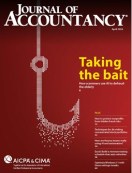
Authors’ Note This article is based on Managing Opportunities and Risks , a Management Accounting Guideline written by Tamara Bekefi, Marc J. Epstein and Kristi Yuthas and published by the AICPA, the Society of Management Accountants of Canada and the Chartered Institute of Management Accountants. AICPA members can download all
Advertisement
TOPICS
Management accounting
More Perspectives on Audit Committees and ERM
We are offering additional commentary on the article titled “Rising Expectations: Audit Committee Oversight of Enterprise Risk Management” (April 08, page 44). I am an internal audit director and part-time NYU faculty member running an ERM consulting business in New Jersey, together with another practitioner and colleague in New York.
Executive Pay Growth Outpaces Revenue
EMPLOYEE BENEFITS In the year from February 2007 to February 2008, total overall executive compensation, including salary, bonuses, stock options, pension and other compensation, in domestic publicly traded companies increased 20.5%, according to a new study, while revenues increased just 2.8%. The study was conducted by ERI Economic Research
Post-Transaction Adjustments
More and more, global companies are discovering that year-end adjustments to intercompany transfer pricing can improve the accuracy of their transfer pricing tax reporting and, potentially, help prevent overpaying taxes by millions of dollars. However, increasing scrutiny by tax authorities in the United States and other key countries makes it
Rising Expectations
Recent events such as the massive trading losses at Societe Generale, the subprime lending crisis and product recalls associated with Mattel’s international toy manufacturing operations continue to shock financial markets and negatively impact shareholder value. These events have also fostered rising expectations for boards of directors to exert greater oversight
Focus on Compliance
On average, compliance spending is outpacing growth of net income at the nation’s largest financial and thrift institutions. A Deloitte Center for Banking Solutions survey found that compliance spending as a percentage of net income rose to 3.69% in 2006 from 2.83% in 2002. Respondents also recognized that compliance is
Communication Is Key
Catherine Allen et al.’s article (“Navigating the Crossroads of Control and Independence ,” Dec. 07, page 42) was an excellent article clarifying the guidance in Statement on Auditing Standards (SAS) no. 112 as it applies to private company auditors’ responsibilities of communicating internal control matters. Page 46 of the article
Take Your New Team to the Top
EXECUTIVE SUMMARY Vision. Start with a clear vision of a finance team that is involved in the business and engaged in key management decisions. Stakeholders. Identify and engage key stakeholders right away. Conduct structured interviews to identify what is most important to your internal clients. Current Organization. Immediately
Implementing Enterprise Risk Management
Managing risk is imperative for successful leadership in today’s business world. Leaders must develop processes like enterprise risk management (ERM) to improve their ability to manage risks effectively. ERM cuts across an organization’s silos to identify and manage a spectrum of risks. Consider these ERM action items: Resolve to
Highlights
The SEC’s Committee on Improvements to Financial Reporting voted in January to support a slate of preliminary recommendations designed to make the information presented by U.S. public companies more useful to investors while reducing the complexity of the financial reporting system. The preliminary proposals included a call for
Allocating Value Among Different Classes of Equity
EXECUTIVE SUMMARY It is essential for board members, executive officers, CFOs, auditors and private equity investors to comprehend option-pricing models used to determine the per-share values of common and preferred shares. The AICPA Practice Aid, Valuation of Privately-Held-Company Equity Securities Issued as Compensation , describes three methods
From the Defense: How to Combat a Deepening Insolvency Claim
In 2007, I represented Grant Thornton in its challenge of a deepening insolvency claim in Minnesota. The decision by the Minnesota Court of Appeals in the case—Julia A. Christians, Trustee for the Bankruptcy Estate of Technimar Industries Inc. v. Grant Thornton LLP—could provide useful lessons for accounting firms. Technimar planned
High Court Bars Secondary Liability in Securities Case
The U.S. Supreme Court ruled in a major securities fraud case that secondary parties—essentially aiders and abettors—can’t be held liable when the companies they work with mislead investors. Stoneridge Investment Partners LLC v. Scientific-Atlanta Inc., et al., docket no. 06-43, threatened to expand the reach of investor lawsuits beyond parties
Vendor Management Tips
Selecting the right vendors and properly managing vendor relationships can help protect your company from damages and long-term losses. As more work is outsourced to specialized vendors, companies face greater exposure to fraud, security breaches and the possibility of financial losses. When companies outsource, they are still responsible
Boards Driving Enterprise Risk Management
More than half (55%) of risk, audit and finance executives said their corporate boards are leading ERM (enterprise risk management) programs, up from 49% in 2004, according to a report from The Conference Board. One-third of participants serving a core business function—legal, CFO, CEO or corporate board member—considered ERM to
Capture and Share Firm Expertise
BUSINESS TIPSIn a recent CCH survey, accounting firms associated several benefits with having formal knowledge management programs, such as an increase in efficiency (76%), productivity (63%) and revenue (62%) and an improvement in client service (69%). These firms were also more likely to follow other management best practices, including: Using
Mastering the Payment Card Industry Standard
EXECUTIVE SUMMARY Becoming familiar with the Payment Card Industry Data Security Standard is a prerequisite to understanding the regulatory environment in which many businesses that accept credit and debit cards operate. PCI dovetails with a CPA’s core competencies in attest work, risk management, internal audit support and fraud
Risk Assessment Standards in Action
Eight standards rolled out in 2006 by the Auditing Standards Board are sparking a cultural shift for auditors. The standards—Statement on Auditing Standards nos. 104–111—are designed to enhance auditors’ responses to audit risk and materiality and encourage them to focus on areas with the greatest risk of
Audit Committees Should Lead by Example
The authors of “ Eight Habits of Highly Effective Audit Committees” (Sept. 07, page 46) have identified relevant recommendations. However, these recommendations are for an audit committee that is a new body in the governance of a company or one in a company where formerly the audit committee merely listened
Make Direct Marketing Pay Off
EXECUTIVE SUMMARY Direct marketing has become a popular and successful form of CPA firm marketing with the following potential benefits: The process encourages you to define a very specific target audience of prospects most likely to buy your services. The format enables you to develop a specific message
Features





FROM THIS MONTH'S ISSUE

Right-sizing risk management
Sole practitioner or small firm? Risk management doesn’t have to be “one size fits all.” Learn how to help protect your practice without adding unnecessary admin time.
From The Tax Adviser
July 31, 2026
Current developments in S corporations
July 31, 2026