Choosing among Trump accounts, 529 plans, and other child savings options
Parents saving for a child’s future have a long list of options, and it's easy to get overwhelmed.
Sometimes having many options can make it hard to choose. Parents leading hectic lives may get stuck on the question “Which savings choice is best?” and never get around to opening a 529 plan account, Trump account, custodial Roth IRA, or other account for their child.
“We have a lot of choices,” said Larry Pon, CPA/PFS, CFP, of Redwood City, Calif., who pointed out that the savings options have different pros and cons and are not mutually exclusive. “It’s like a buffet, right?”
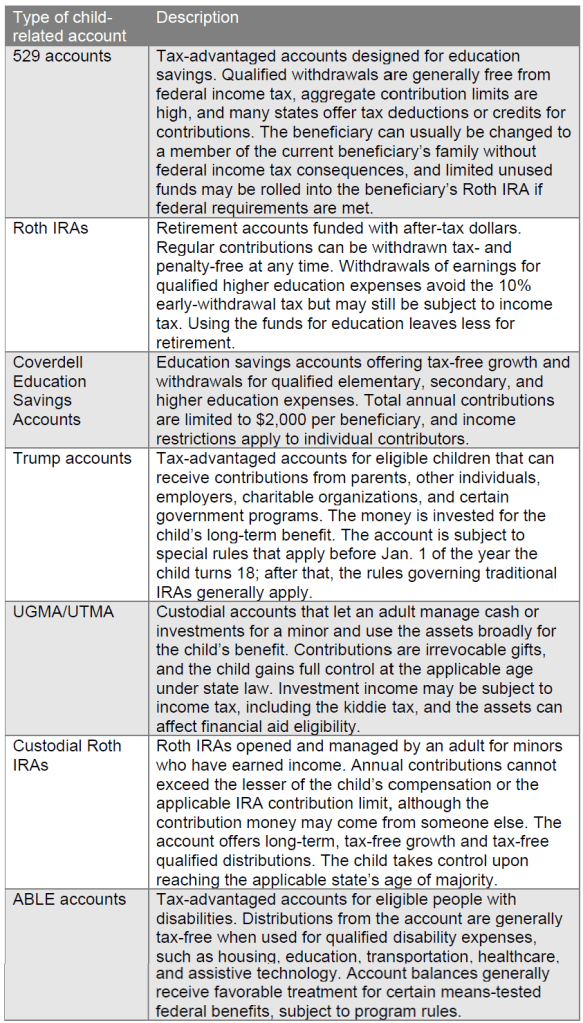
This article compares various types of child-related accounts. A chart summarizing them appears at the end.
Clients need to remember that the biggest mistake may be not doing anything at all.
Options for education savings
Pon, who has given seminars on child-related accounts, said 529 plans are usually the best option to save for educational expenses.
Although some parents instead use their Roth IRA to accumulate money for their children’s education, and this can be reasonable, “I think from a mathematical standpoint, the 529 makes more sense,” he said.
Benefits of 529 plans: Pon highlighted that 529 plan accounts have specific advantages over Roth IRAs, including much higher contribution limits and, in many states, a tax deduction or credit for contributions to the account.
Another key advantage of a 529 plan account is that its funds can be withdrawn tax- and penalty-free if used for qualified educational expenses. Although distributions from a Roth used for qualified educational expenses generally are not subject to the Sec. 72(t) 10% additional tax on early withdrawals, the earnings portion of the withdrawn funds is usually subject to income tax at ordinary rates if the account owner is under age 59½. See generally “Which Is Best for College Savings: 529 Plan or Roth IRA?” Saving for College, Jan. 1, 2026.
Leftover funds: A potential disadvantage of 529 plans, Pon said, is that the parent might end up with leftover funds in the 529 plan account if, for instance, the child doesn’t go to college.
Although trapped funds could lead to withdrawal penalties, several rules mitigate this risk. First, leftover balances in a child’s 529 plan account can be distributed and rolled over within 60 days to the 529 plan account of a family member (as defined in Sec. 529(e)(2)). Second, funds in a 529 plan account can be used for qualified expenses for vocational training at an eligible educational institution. Third, up to a lifetime limit of $35,000 per beneficiary in unused funds in a 529 plan account can be rolled into a Roth IRA for the child, if the 529 account has been maintained for at least 15 years, subject to certain additional conditions and limitations.
Broader picture: Parents need to consider wider factors too. “It’s acceptable to use a Roth IRA to pay for college,” said Ryan Firth, CPA/PFS, CFP, CCFC, founder of Mercer Street Personal Financial Services in Houston. “It’s just that then you’re taking money out of your retirement and you’re moving it over to this education bucket,” which could interfere with saving enough for retirement. See “3 Ways to Balance Saving for Education and Retirement,” JofA, Dec. 1, 2024.
One approach to consider, Firth said, might be to open a 529 account “and then if the 529 isn’t sufficient and the parents really want to dig into their retirement, they can make up the shortfall with the Roth IRA.”
Coverdell education savings accounts: Both Pon and Firth take a generally negative view of Sec. 530 Coverdell education savings accounts (ESAs), noting that these savings vehicles have a low annual contribution cap of $2,000 per designated beneficiary. Also, the maximum amount an individual can contribute phases out based on the individual’s modified adjusted gross income. Coverdell ESAs are “kind of limited compared to a 529,” Firth said. Pon pointed out that it can be difficult to find financial institutions willing to open Coverdell ESAs anymore.
Options for general savings
Saving for children’s other needs can be addressed by Sec. 530A Trump accounts, which aim to give them a head start on long-term savings.
Trump accounts function like “an IRA for kids,” Firth said. Speaking broadly, contributions to a Trump account are generally subject to an aggregate annual limit of $5,000 (indexed for inflation beginning in 2028) during the account’s growth period, which begins when the account is established and ends on Dec. 31 of the year the beneficiary turns 17. During this period, the account can receive contributions from parents, other individuals, employers, charitable organizations, and certain government programs.
Beginning Jan. 1 of the calendar year the beneficiary turns 18, most of the special Trump account rules end and the account is generally treated as a traditional IRA. At this point, the beneficiary may wish to consider converting some or all the account to a Roth IRA in years when their other income is low. Then, when ready, the beneficiary could, for instance, use funds from the Roth IRA for a down payment on a first home, subject to the applicable rules governing taxation of Roth IRA distributions. (See “3 Strategic Uses for Roth IRAs Beyond Retirement,” JofA, Aug. 2, 2022). Or the beneficiary can keep the funds in the Roth IRA for longer-term goals, including retirement.
Could the beneficiary use the money for higher education? “Yes, you can use it for education,” Pon said, but “I think the power of the Trump account is for retirement.”
Custodial accounts: Other options for gifting funds to children are UGMA (Uniform Gifts to Minors Act) and UTMA (Uniform Transfers to Minors Act) accounts. These custodial accounts, the assets of which must be used for the benefit of the child, lack the tax advantages of Trump accounts but offer greater flexibility in investments and use of the funds. Like Trump accounts, “at the age of majority, the money is generally the child’s to control,” which is a “big caveat,” Pon observed. Also, kiddie tax issues can arise.
With any child-related account, one factor to consider is whether opening one would affect the child’s eligibility for student financial aid, Firth and Pon said. The rules differ from one type of account to another.
Additional types of accounts
Two other savings vehicles should be mentioned. One, a Sec. 408A custodial Roth IRA, can benefit children who have income from summer or part-time jobs. A child can contribute to a custodial Roth IRA opened by a parent on the child’s behalf. The contribution, which may not exceed the lesser of the child’s compensation for the year or the annual IRA contribution limit, doesn’t necessarily have to come from the child’s own money. For example, if the child earns $3,000 from a summer job, a parent or grandparent could contribute $3,000 to the child’s Roth IRA (see “The Ins and Outs of Roth IRAs for Children,” JofA, Oct. 11, 2022). Custodial Roth IRAs offer long-term, tax-free growth and tax-free qualified distributions.
Lastly, to provide for the needs of a child with a disability, consider using a Sec. 529A Achieving a Better Life Experience (ABLE) account. Another option is a special-needs trust.
Pon and Firth emphasized that the advice of a CPA financial planner will depend on the client and their specific situation. “Our job is to tell them what’s available to them, what are the pros and cons, and what the consequences are,” Pon said. “And every family is different. Every family’s kid is different.”
— Dave Strausfeld, J.D., is a JofA senior editor. To comment on this article or to suggest an idea for another article, contact him at David.Strausfeld@aicpa-cima.com.