
Skip to content
AICPA-CIMA
  • AICPA & CIMA:
  • Home
  • Engage 365 Communities
  • CPE & Learning
  • My Account
Journal of Accountancy
  • TECH & AI
    • All articles
    • Artificial Intelligence (AI)
    • Microsoft Excel
    • Information Security & Privacy

    Latest Stories

    • AICPA seeks IRS clarity on AI guidelines, CPA fees
    • Improve your Windows 11 productivity using Microsoft PowerToys
    • 4 Excel features that make reviewing large spreadsheets easier

  • TAX
    • All articles
    • Corporations
    • Employee benefits
    • Individuals
    • IRS procedure

    Latest Stories

    • AICPA seeks IRS clarity on AI guidelines, CPA fees
    • Congress approves funding bill that maintains IRS budget
    • Sixth Circuit holds home-distilling ban is constitutional
  • PRACTICE MANAGEMENT
    • All articles
    • Diversity, equity & inclusion
    • Human capital
    • Firm operations
    • Practice growth & client service

    Latest Stories

    • FASB updates investment company fair value reporting standard
    • PCAOB finalizes simplified quality control amendments
    • Risk response often doesn’t match the threat or the opportunity
  • FINANCIAL REPORTING
    • All articles
    • FASB reporting
    • IFRS
    • Private company reporting
    • SEC compliance and reporting

    Latest Stories

    • SEC proposal aims to clarify securities rules for crypto assets
    • SEC eyes e-delivery as the default over paper
    • SEC shares 3 goals in proposed 2026–2030 strategic plan
  • AUDIT
    • All articles
    • Attestation
    • Audit
    • Compilation and review
    • Peer review
    • Quality Management

    Latest Stories

    • PCAOB finalizes simplified quality control amendments
    • New AICPA guidance on stablecoins, mining revenue, current auditing standards
    • ASB approves standard on auditors’ responsibilities relating to fraud
  • MANAGEMENT ACCOUNTING
    • All articles
    • Business planning
    • Human resources
    • Risk management
    • Strategy

    Latest Stories

    • Risk response often doesn’t match the threat or the opportunity
    • Confidence in U.S. economy rises despite inflation concerns
    • Data governance: How finance builds trust in the numbers
  • Home
  • News
  • Magazine
  • Podcast
  • Topics
Advertisement
  1. newsletter
  2. Extra Credit
Extra Credit Cover

An online pivot can be an opportunity

A faculty member reconfigured her finance class in the wake of the COVID-19 crisis to teach soft skills.

By Rebeka Mazzone, CPA, CGMA
April 14, 2020

Please note: This item is from our archives and was published in 2020. It is provided for historical reference. The content may be out of date and links may no longer function.

Related

February 11, 2020

Get started teaching blockchain

February 11, 2020

Mental health concerns on campus: What faculty can do

TOPICS

  • COVID-19
    • Remote Working
  • Accounting Education

If you have never taught online, it can be intimidating, especially when you do not have much time to practice and plan. However, if you are open to the opportunity, teaching online can foster the skills our students need most.

We constantly hear that we need to teach our future finance professionals critical thinking, communication, and creative problem-solving skills. So, when, as an adjunct professor, I was told that I was allowed to alter the delivery and content of my finance capstone course when transitioning it to an online class amid the pandemic, I immediately acknowledged it as an amazing opportunity to rethink how I deliver the curriculum to better approach those types of skills.

Below, I’ll explain how I adapted my class and assignments to work online. I acknowledge that I am better prepared for this change than many faculty members, as I was facilitating webinars 15 years ago, but I’ll share advice that can work for anyone teaching online. (I also want to give a shoutout to campus technology staff and the higher-education community for all of the resources and support brought to bear almost overnight.)

A revised assignment grounded in the current situation

We spent the first online class discussing risk management. This is normally the last class of the semester, but I think it sets the tone for where we are right now. We talked about the concepts underlying COSO’s enterprise risk management framework and the importance of looking broadly at an organization, but also looking deeply into the varying risks associated with each division.

We then spent time talking about the upside of risk. I showed students that, yes, there is an upside! If you understand your risk and manage it well, you can differentiate yourself from your competitors, build deeper and more trusting relationships with customers, and even support social good, as the distilleries making hand sanitizers or auto manufacturers making ventilators are doing during this pandemic.

I then gave them the assignment. I divided the class into four groups and asked each group to select an industry. From there, each student within the group was asked to select a professional role based on their career interest. Their goal is to research their industry and identify potential significant risks within the next four to eight weeks of the pandemic but also to consider the longer term horizon of residual risk of a recession. Then, they will give a presentation to the “CEO” and “Board” (roles played by me and the rest of the class) on what those risks are, and more importantly, from their “professional” perspective, tell us what they would do to minimize those risks or leverage them to create opportunity.
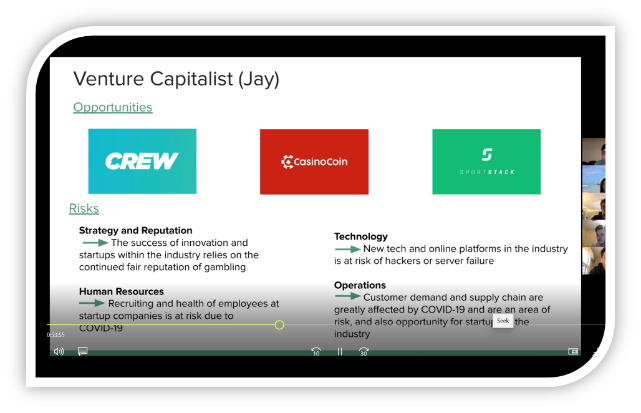
One group of students proposes opportunities for investing in the online gaming industry.

Fostering critical thinking skills

This exercise will prioritize critical thinking and problem-solving over memorization. Instead of requiring students to memorize formulas, I’ll ask them to focus on the underlying components and concepts behind the formulas. Committing formulas to memory is a very narrow skill and does not teach students how to think critically or solve problems that they have never seen before — skills that are becoming more and more critical with the emergence of globalization and technology.

Advertisement

I also want students to learn not just what was defined in the course syllabus, but also to help them take on the perspective of a CFO, an investment analyst, a venture capitalist, or another role during a major world crisis that is financially impacting every industry. When I surveyed the students at the beginning of the semester, I learned that these were their career aspirations, so why not let them practice?

Helping students adjust to learning online

I was surprised at how many of my students, who grew up with smartphones in their hands, were concerned about how they were going to learn online. Online learning is new to them, and I needed to find ways to alleviate their concern and engage them so they would be open and willing to participate in this new approach. I needed to host a video tutorial for my class on the use of Zoom and its breakout rooms feature. (This feature allows me to send my teams into separate video meetings simultaneously and then have them return to the main classroom at the end of an exercise.) I also used the tutorial as an opportunity to connect with students on a more personal level by showing them my home office, my dog, and even a brief appearance from my college-aged daughter.

This class has unexpectedly turned out to be a way to teach students online communication skills. It’s helping them learn how to host effective team meetings with remote teams, growing the online communication skills that they will need to use in a global economy, such as:

  • The importance of having effective visuals to support your talking points;
  • Using your physical presence on video as a way of keeping the audience engaged;
  • Limiting your talking to 6–10 minutes, then engaging the audience with a poll, exercise, or question;
  • And the one we dread the most, being comfortable with silence. When someone asks a question in an in-person class, the response time is much quicker because the students can see one another’s body language. On a videoconference this silence can be deafening.     

Creative problem-solving and building effective teams

My plans for the class include weaving in some skills on management of team dynamics and problem-solving using design thinking. Traditionally, accountants are taught rules and how to fine-tune our skills to apply those rules to every situation — in essence, how to get to the right answer as quickly as possible. But today, we are faced with new challenges that will not have predefined “rules” we can apply to every situation. As students continue to delve deeper into our COVID-19 case study over the next few weeks, they will be challenged to look at the disruptions in their chosen industry and propose solutions.

I am excited to see how this all plays out. I want my students to emerge from this semester with deeper problem-solving and critical thinking skills, and most importantly, I want them to be the type of finance professionals who approach a problem as an opportunity — a challenge to be solved. I would love to hear thoughts from my friends out there!  Please share ideas.

— Rebeka Mazzone, CPA, CGMA, is an adjunct faculty member at Providence College in Providence, R.I., and a strategic finance consultant at FuturED Finance, a consulting firm partnering with CFOs to help college and universities leverage financial management capacity to drive innovation. To comment on this article or to suggest an idea for another article, contact senior editor Courtney Vien at Courtney.Vien@aicpa-cima.com.


Advertisement
Advertisement

latest news

September 10, 2026

FASB updates investment company fair value reporting standard

September 9, 2026

PCAOB finalizes simplified quality control amendments

September 9, 2026

Risk response often doesn’t match the threat or the opportunity

September 8, 2026

AICPA seeks IRS clarity on AI guidelines, CPA fees

September 3, 2026

CFO hires increasing; average age of hires decreasing

Advertisement

Most Read

4 Medicare rules that surprise clients — and some advisers
4 Social Security rules that surprise clients — and some advisers
Real-life ways small firms use AI
Final rule will eliminate BOI reporting for US entities
No joke: Comedian CPA adding more to Tax Return Pizza Tracker menu
Advertisement

Podcast

September 10, 2026

What boards don’t know can hurt them

September 3, 2026

Looking to 2027: Economic sentiment, hiring plans, inflation concerns

August 27, 2026

Finance’s chemistry lesson: The guardian-to-catalyst transformation

Features

How CPAs can expand from tax into personal financial planning

How CPAs can expand from tax into personal financial planning

A recipe for sanctions: AI-hallucinated citations in tax

A recipe for sanctions: AI-hallucinated citations in tax

2026 tax software survey

2026 tax software survey

A CPA playbook to help prevent disaster fraud

A CPA playbook to help prevent disaster fraud

Strategic planning for tax advisory

Strategic planning for tax advisory

SPONSORED REPORT

Agentic accounting has arrived: What’s hype and what’s real?

Artificial intelligence (AI) is moving beyond chatbots and into accounting workflows. A new generation of agentic AI tools can plan, execute, and adapt as they complete tasks, raising expectations for what automation can do inside firms and finance departments. What can agentic AI realistically do today and what challenges are there in its implementation? Find out in this Journal of Accountancy sponsored report.

From The Tax Adviser

August 31, 2026

What today’s clients expect from their CPA and how firms are responding

August 31, 2026

2026 tax software survey

August 31, 2026

A risk framework for AI use in tax administration and preparation

July 31, 2026

Current developments in S corporations

MAGAZINE

September 2026

September 2026

September 2026
August 2026

August 2026

August 2026
July 2026

July 2026

July 2026
June 2026

June 2026

June 2026
May 2026

May 2026

May 2026
April 2026

April 2026

April 2026
March 2026

March 2026

March 2026
February 2026

February 2026

February 2026
January 2026

January 2026

January 2026
December 2025

December 2025

December 2025
November 2025

November 2025

November 2025
October 2025

October 2025

October 2025
view all

View All

http://JofA_Default_Mag_cover_small_official_blue

PUSH NOTIFICATIONS

Learn about important news

This quick guide walks you through the process of enabling and troubleshooting push notifications from the JofA on your computer or phone.

CPA LETTER DAILY EMAIL

CPA Letter Logo

Subscribe to the daily CPA Letter

Stay on top of the biggest news affecting the profession every business day. Follow this link to your marketing preferences on aicpa-cima.com to subscribe. If you don't already have an aicpa-cima.com account, create one for free and then navigate to your marketing preferences.

Connect

  • X Logo JofA on X
  • facebook JofA on Facebook

HOME

  • News
  • Monthly issues
  • Podcast
  • A&A Focus
  • PFP Digest
  • Academic Update
  • Topics
  • RSS feed rss feed
  • Site map

ABOUT

  • Contact us
  • Advertise
  • Submit an article
  • Editorial calendar
  • Privacy policy
  • Terms & conditions

SUBSCRIBE

  • Academic Update
  • CPE Express

AICPA & CIMA SITES

  • AICPA-CIMA.com
  • Global Engagement Center
  • Financial Management (FM)
  • The Tax Adviser
  • AICPA Insights
  • Global Career Hub
AICPA & CIMA

© 2026 Association of International Certified Professional Accountants. All rights reserved.

Reliable. Resourceful. Respected.












