How to help students who are ‘Biased Jumpers’
Show students the importance of weighing other viewpoints.
Editor’s note: This is the third in a series of articles to help you explore student thinking, and how critical thinking is taught and learned, to better enable you to help your students thrive in today’s complex business and accounting environment. See the first article for an overview of critical thinking and the three most common patterns of thinking exhibited by college students, and the second for an in-depth look at the “Confused Fact-Finder” pattern.
Most students I have taught — in both undergraduate and masters-level accounting courses — have demonstrated the “Biased Jumper” pattern of thinking. My experience is consistent with cognitive development research in higher education. At this stage of development, students jump to a conclusion and then defend their position with personal biases and logic. Accordingly, I refer to this pattern of thinking as the “Biased Jumper” stage.
Biased Jumper thinking and how to recognize it
How can you recognize students who are operating at the Biased Jumper level of thinking? Below are common signs.
The student:
- Jumps to a conclusion
- Stacks up reasons and evidence quantitatively to support own view and ignores or inappropriately discounts contrary information
- Equates unsupported personal opinion with other forms of evidence
- Insists that all opinions are equally valid, but discounts other viable opinions
- Views experts as being opinionated or as trying to subject others to their personal beliefs
Source: Wolcott, S.K. (January 26, 2006). Steps for Better Thinking Performance Patterns. Available at WolcottLynch.com. Based in part on information from Reflective Judgment Scoring Manual With Examples (1985/1996) by K.S. Kitchener and P.M. King. Grounded in dynamic skill theory (Fischer and Bidell, 1998; Fischer and Pruyne, 2002).
Because Biased Jumpers believe it is sufficient to simply stack up arguments to support their opinion — and because they believe that everyone acts the same way — they are highly resistant to more fully or objectively analyzing other viewpoints. These students are overconfident, believe it would be a waste of time to explore other viewpoints, and may become defensive if challenged or confronted with conflicting evidence.
How to help Biased Jumpers develop
Because students’ beliefs about knowledge drive their critical thinking approaches, our challenge as faculty members is to alter their underlying beliefs about how the world works. The most effective approach is to help these students move to the next-higher pattern of thinking, which I’ve nicknamed the “Perpetual Analyzer.” In this stage, students delay reaching a conclusion until they have fully and objectively analyzed multiple perspectives and evidence.
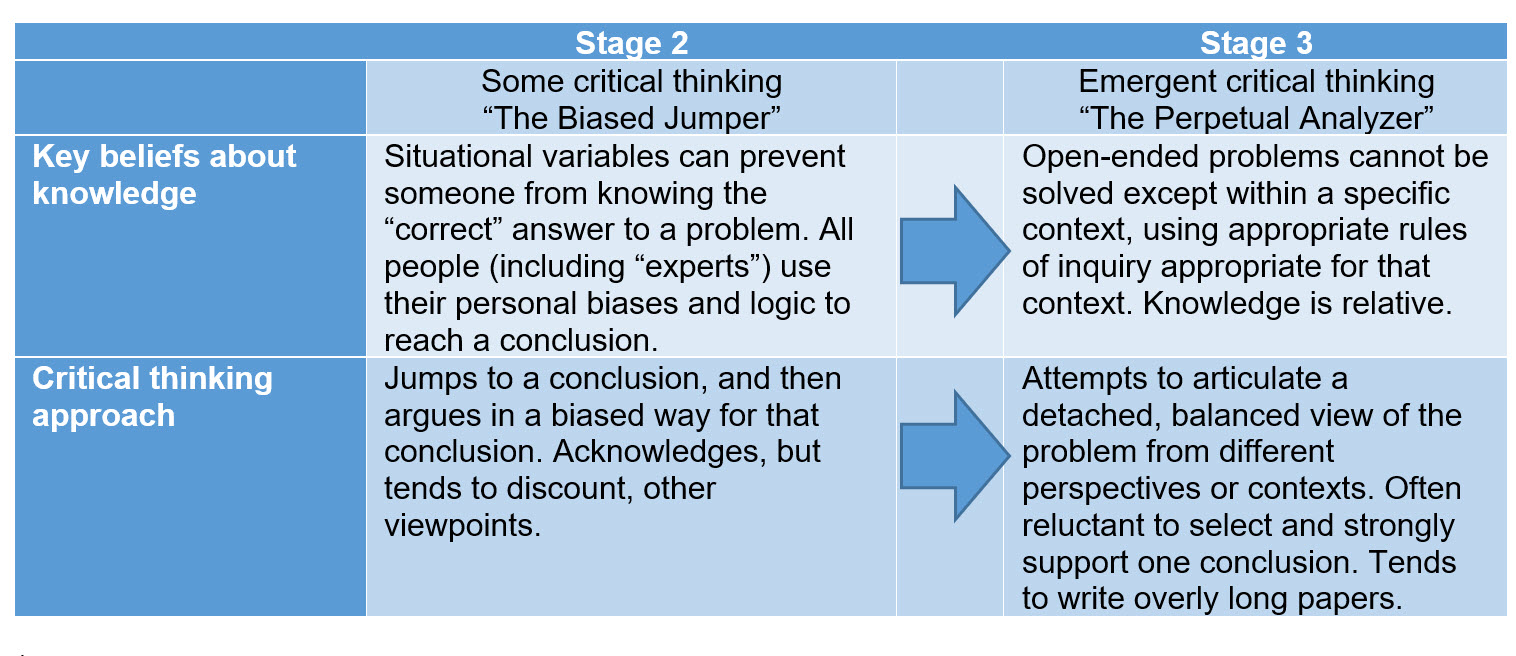
(Note: These patterns are based on Stages 4 and 5 in the reflective judgment model developed by P.M. King and K.S. Kitchener. For details, see my freely available Faculty Handbook: Steps for Better Thinking. For a copy, send an email to swolcott@WolcottLynch.com.)
Teaching/learning recommendations
To move to the next stage, Biased Jumpers need to learn that good critical thinking means delaying conclusions until after they have objectively and thoroughly explored relevant information, including other viewpoints. Specifically, they must learn how to break down problems, to appreciate the need for multiple perspectives, to control for their own biases, and to qualitatively evaluate evidence and arguments. Here are some classroom activities that can foster each of these tasks:
- Identify and control their own biases. Classroom discussions can help students recognize and learn to control their biases. Although undergraduate Biased Jumpers acknowledge the existence of other viewpoints, they are often surprised during class discussions to learn that multiple viewpoints exist within the classroom. Faculty can take advantage of student differences by conducting classroom discussions about the effects of preferences and preconceived notions when interpreting and using information. (Note: Students might be more willing to acknowledge and discuss “preferences” than “biases.”) You can also give students readings to help them learn about common biases and their negative impact on decision-making. Additionally, have students brainstorm ideas for identifying and controlling personal biases.
- Provide arguments for and against alternatives. Students are usually taught to begin an essay with an introduction and thesis statement, and to begin a business memo with a statement of the problem and their conclusion. While this is a good way to organize and present the results of critical thinking, many students mistakenly believe that they must first choose their conclusion before analyzing information. They will probably also resist what they see as “wasting” their time exploring information that disagrees with their opinion. Thus, it is essential to require students to demonstrate more thorough analysis. One approach is to ask students to complete a table describing the pros and cons (or strengths and weaknesses, or costs and benefits) for each potentially viable alternative. Students might complete the table as homework, and then expand their tables during small-group and/or whole-class discussions. To increase student motivation to address both pros and cons, ensure that grading criteria require a balanced set of arguments.
- Qualitatively evaluate evidence. Although Biased Jumpers recognize the existence of uncertainties, they often ignore those uncertainties when evaluating information. They tend to regard individual pieces of information in terms of whether it supports or does not support a viewpoint, and they ignore the quality of that information. To help students qualitatively evaluate information you can ask them to use a rating scale to evaluate the degree to which individual pieces of evidence support an argument as a homework task, and then reach an agreement on their rating with other students during small-group or whole-class discussions. You can also ask students to explain why some arguments/evidence are stronger than others.
- Identify and analyze assumptions. Biased Jumpers often use assumptions, but they often fail to identify them or to evaluate their reasonableness. One way to help students is to ask them to define and explain the purpose of assumptions. Then help them learn to identify and apply criteria for evaluating the quality of assumptions. Note that it will be easier for students to initially identify and evaluate assumptions used by others. Then you can ask them to focus on their own assumptions.
- Organize information into meaningful categories. As students develop stronger analysis skills, they will begin to consider a wider and richer set of information and have greater difficulty deciding how to organize it. You can help students improve both their analysis and organization skills by having them use concept mapping techniques. Consider having your students practice different methods for organizing information. Use of a critical thinking model can also help students organize their overall work into a statement of the problem, analyses, and conclusions.
Look for the next article in this series — which will address the “Perpetual Analyzer” stage of critical thinking — for more critical thinking teaching and learning ideas.
Susan Wolcott, CPA, CMA, Ph.D., is a founder of WolcottLynch, which conducts research and develops educational resources for critical thinking development. She has taught accounting courses at seven universities and is currently a visiting professor at the Indian School of Business. To comment on this article or to suggest an idea for another article, contact senior editor Courtney Vien at Courtney.Vien@aicpa-cima.com.