Maximizing the impact of guest speakers on campus
A University of Montana experiment found that accounting students who heard from guest speakers, live or recorded, showed more interest in the profession. Learn what students said, who benefited most, and how faculty and professionals can make classroom visits count.
Research and professional groups have long suggested that incorporating guest speakers into introductory accounting courses is effective in fostering interest among undergraduate students in pursuing an accounting career. But are the logistical challenges of booking guest speakers worth the effort?
A recent controlled experiment we conducted at the University of Montana examined how guest speakers affected students’ interest in accounting. We found that guest speakers can increase interest in the accounting major, whether students hear from them live or watch recordings. Also, prerecorded presentations can broaden access to practitioners beyond those visiting campus for recruiting events or those who live nearby.
The research also provides insights into misconceptions that guest speakers help to change. We integrated these findings with previously unpublished data and our personal experiences to recommend best practices for faculty and professionals who want to use guest speakers effectively.
The impact of guest speakers
At the University of Montana, all business majors complete a sophomore-level “Principles of Managerial Accounting” course. In spring 2023, the same faculty member taught three sections of this course. One section had no speakers, a second had eight live speakers, and a third had recorded videos of the same eight speakers.
We measured students’ interest in the accounting major on a seven-point scale from 7 = strongly interested to 1 = strongly disinterested. Students responded near the beginning of the 16-week semester (week two, before speakers) and at the end (week 15, after speakers).
The speakers were university alumni working in seven different states and in Europe. They had three to 15 years (average 7.5) of experience in audit, tax, advisory, and corporate accounting. One speaker was a doctoral student. The talks averaged about 15 minutes, and each speaker answered the same questions.
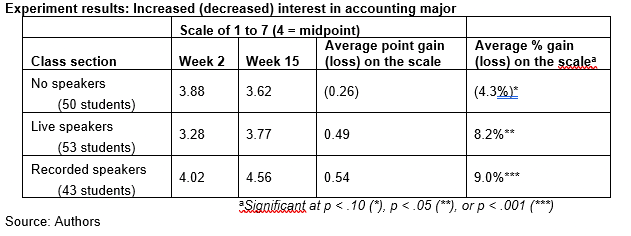
Students who listened to live speakers or watched recorded talks showed a significantly increased interest in the accounting major over the course of the semester. Students’ interest in the major increased on average 0.49 points if they heard from live guest speakers and 0.54 if they viewed recorded speakers. Those who did not hear from guest speakers displayed a small decline in interest over the same period. (See the table, “Experiment Results: Increased (Decreased) Interest in Accounting Major.”)
Changing students’ perception
High school and new college students often have a negative perception of the accounting profession and do not understand the career opportunities in the field. (For more information, see “How Students View the Accounting Profession,” JofA, June 1, 2023.)
This is likely due to students having little to no understanding of the nature of accounting work and how interesting it can be.
In the controlled study, we explored whether the guest speakers affected preconceived notions about the profession by asking students to respond to open-ended questions about their experiences. One question was: “What (if anything) changed your perceptions about the accounting profession by viewing the guest speakers?” Students could list as many items as they wished. The students’ most common response was that the speakers made them aware of how many career options are available with an accounting degree (representing 31% of total items shared in responses), followed by discovering that accounting work is more interesting and less monotonous than they thought (18%). Students also frequently mentioned they were surprised by how often accountants travel (8%) and how much they genuinely seem to enjoy their work (8%).
“I was under the impression for most of my undergrad that accounting was a you-put-your-head-down-and-grind-on-the-computer kind of job, so having professionals come to speak with us students broke that notion for me,” said Luca Bella Schwartz, who participated in the experiment. “We spoke with someone from a Big Four firm during one of my classes. I remember him explaining how complex and interesting his work was and that he felt devoted to his clients. I’m somebody who needs that social aspect, so getting to hear his day-to-day life and where he felt that he was making an impact with his work really helped me want to pursue accounting.”
Schwartz has completed internships in audit and assurance and tax since graduating in 2025 with a bachelor’s degree in accounting and business management and considers herself an early-career accountant.
Kaitlynn Martin, who graduated from the University of Montana in 2025 with a bachelor’s degree in accounting, observed the influence of guest speakers on her career choices. The Navy veteran switched majors from wildlife biology to accounting and interacted with guest speakers through panels and career week sessions.
“Being able to talk to [guest speakers] and hear about their experiences, and seeing the different career paths, gave me comfort and confidence in my future after graduating,” Martin said. Guest speakers even helped her choose where to start her career as an accountant.
“I had a feeling I wanted to do audit, but talking with the panels helped me gauge the personalities of each department and gave me a really good idea of what companies I wanted to apply to,” she said.
In January 2026, Martin joined Eide Bailly LLP in Boise, Idaho, as a full-time assurance associate.
The impact of guest speakers on recruitment initiatives
Previously unpublished data from our research suggests that guest speakers have an even greater effect on the interest in accounting among racial-minority and first-generation students, even though the guest speakers in the experiment did not include any racial minorities or reveal if they had been first-generation students.
This data shows that 26% of racial-minority students increased two or more points on the seven-point scale toward interest in the major, compared to 14% of non-racial-minority students. A modest number of first-generation students had outsized gains as well, with 17% increasing two or more points in interest, compared to 13% of other students.
Advice for faculty
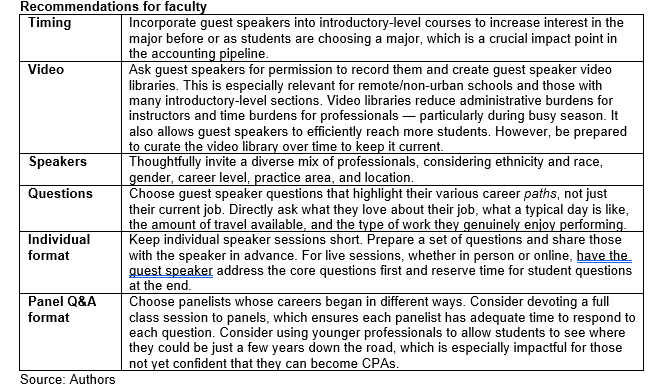
Based on our research findings and experience, we recommend the following approaches for using guest speakers to build students’ interest in accounting. (See chart, “Recommendations for Faculty.”)
Speakers with the biggest impact
At the end of the semester, the students who heard guest speakers (live or recorded) were asked to identify their favorite and least favorite speakers and to explain why they chose these speakers.
According to previously unpublished data, one student wrote about the speaker with the highest ratings that “she sounded the most passionate about her job and her job sounded fun.” Another student wrote that “she advocated for a more creative and different lifestyle in accounting.”
The two lowest-rated speakers appeared to be rated lower because of the length of their sessions and their low energy levels. Describing one of them, a student wrote that the speaker “didn’t really seem to be happy” and “went on for a long time” (23 minutes). Describing the other one, a student wrote that the speaker was “lacking in the energetic department and made it sound like they didn’t care for their career and how boring accounting can be.”
This aligns with our experience with guest speakers in the classroom: Genuine enthusiasm is key, and speakers who convey why they love their job are well received. The following recommendations for guest speakers are based on student feedback and our own observations:
- Preparation: Reflect in advance on what you like about being an accounting professional, your career path so far, missteps, and wins. That will help you answer authentically and succinctly. Consider asking the faculty member if they have questions you can think about in advance.
- Demeanor: Bring energy to the discussion and make eye contact. Treat students as future colleagues, not clients, and keep answers concise. Let your personality come through, have fun, and enjoy the conversation.
- Transparency: While positivity is key, anticipate students asking about what you do not like about your job, mistakes you have made, or things you would do differently. Showing vulnerability and honesty resonates with students. Emphasize the importance of a growth mindset or what you learned from those situations.
- Relatability: Come prepared with one or two brief stories about your experience that illustrate how interesting your job is or that your days are not monotonous. Talk about your own experiences, not just about your current firm. Students know right away if it is a recruiting pitch.
- Audience: Know your audience. If it is largely students 18 to 20 years old, they will not have the same mindset as older students who have returned to school after gaining life or work experience. Ask the faculty member to describe the students before you arrive so you can relate experiences most relevant to them.
- Availability: Offer students your email or business card and/or invite them to connect with you on LinkedIn, if you have the time to respond to them. Students may be apprehensive about following up with you without that personal invitation.
Finally, professionals should engage with faculty in the classroom outside of the recruiting cycle, as faculty can be bombarded with requests for classroom visits and your voice may be diluted during these times.
— Leah Diehl, CPA, Ph.D., is an assistant professor of accounting and the AgWest faculty fellow at the University of Montana – College of Business in Missoula, Mont. Terri Herron, CPA, Ph.D., is on the boards of NASBA and the NASBA Center for the Public Trust and is a member of the Montana Board of Public Accountants. Allen Lloyd is executive director at the Montana Society of CPAs. To comment on this article or to suggest an idea for another article, contact Jeff Drew at Jeff.Drew@aicpa-cima.com.