


Data storytelling: A valuable and exciting skill to introduce to students
Help students prepare for careers using and communicating big data.
As big data use gains prevalence, it becomes increasingly important to communicate information in ways that are easily understood by internal and external stakeholders. Accounting students learn how to gather and analyze data, but data storytelling can help them take that information and use graphics and narratives to give it context and meaning.
Kimberly Church, Ph.D., has taught a variety of undergraduate and graduate courses and has incorporated data storytelling into all of them. “Whatever class it is dictates the type of data used, but the ability to use data to tell a story transcends all courses,” said Church, who is director of the school of accountancy at Missouri State University, Springfield-Branson.
Students who are familiar with and skilled in storytelling will be more valuable in the workplace. It is also a skill set that can excite and inspire them in the classroom. How can accounting faculty members incorporate storytelling into their courses? Here are some ways to introduce it to students:
Tackle the anxiety. “When you talk about storytelling, students clam up at first because they think it’s harder than it is,” said Alicja Foksińska, an instructor at the University of Alabama at Birmingham, and lead IT auditor at Protective Life. To solve that problem, her students’ first assignment is simply to tell one of their favorite stories, whether it’s from their own lives or from another source, like a Harry Potter book. She then encourages them to think about how their favorite movies or songs tell stories. Taking it to the next step, she uses information from everyday sources, such as a water bill, to show how it can tell a very clear story about, for example, how usage goes up at certain times a year when lawns are being watered or drops when someone is on vacation. “Storytelling is not a big scary concept anymore,” she said.
Once they’ve become comfortable with telling a story, she asks students to choose a data set and use it to build a dashboard with a program such as Tableau or Power BI. The storyboard must illustrate three key takeaways that might be useful in decision-making. The ultimate questions for the students are what story the dashboard would tell others and why it would be meaningful.
Foksińska reminds students that the dashboard may be seen by a wide spectrum of people, and the student won’t always be there to explain the charts. “This forces them to create a clear and concise message, visualized by clean charts that drive the message — the key takeaways — home,” she said.
Define what makes a story. Church cautions students that data alone, and even a flashy dashboard, doesn’t necessarily tell a story. “It’s not as simple as picking two points and making a trend line,” she said. Before getting started, she and her students evaluate visualizations on other websites to determine how they tell their stories and which approaches are most successful.
Weaving a story can begin with some simple data based on everyday topics, such as the shopping behavior of mall customers, according to Saravanan Muthaiyah, Ph.D., CGMA, professor of information technology, Multimedia University, Cyberjaya, Malaysia. The students then use cluster analysis to draw conclusions about customer satisfaction and loyalty. Muthaiyah incorporates data from case studies based on actual situations that he has worked on in his consulting practice because it can bring the material alive for students, he said. Linking the data to a real situation with an actual impact makes it easier to engage students because it is not a hypothetical exercise but genuinely meaningful, he said.
Connect to student experiences. Another option is to assign projects that revolve around businesses that are part of students’ lives. For example, in Church’s managerial accounting classes, she has paired local bike share data with weather information to create models to predict bike usage and determine how many will be required on any given day. “It’s a way to learn about managing the bike share company’s assets,” she said. In intermediate accounting classes, students have used GPS data on the bikes to consider whether it’s necessary to accelerate impairment on certain bikes based on their usage.
The Topeka Metro Bike data is available on the University of Arkansas Walton College of Business site. The enterprise datasets website is free for academic use.
Students of Pam Schmidt, Ph.D., an accounting faculty member at Washburn University, have actually presented to the City of Topeka stakeholders with their projects using the bike share data, and their work has informed actual resource decisions made by the city. “It was pretty exciting for her students to watch class projects come to life in the city around them,” Church said. It enabled Generation Z students to see how using accounting analytics can help them become purpose driven in their local communities.
Because learning how to gain access to data is important for auditors, especially when benchmarking, Foksińska encourages students to explore new areas each week. In one course, a student created a dashboard on the debt that students take on to attend different schools in the state of Alabama. “They can be very creative,” she said. Classes are not required to stick to financial data, because accountants are increasingly working with nonfinancial data. In a travel module, for example, her students created stories using data on attendance at Disney theme parks, Southwest Airlines flights and temperatures in Bali.
The students post a link to their Tableau Public profile for the class to view, providing feedback that helps them make revisions before they turn in a final. Submissions include information on which audience the students meant the data for. Students have been hired because they linked their Tableau Public profiles to their LinkedIn profiles, allowing prospective employers to see how well they can tell a story. “It was a win-win for the students as they used their school projects to land a job,” Foksińska said.
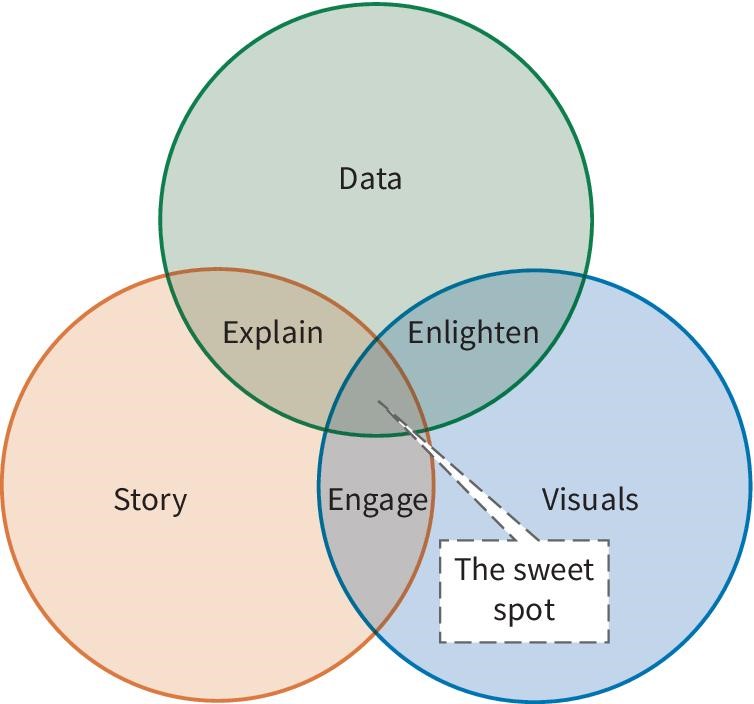
Get the building blocks in order. Foksińska believes that data and analysis come first, to prevent adjusting the data to fit a hypothesized story. Once analysis of the data is complete, students determine what stories the data can tell and create visuals that convey them. She uses a diagram to illustrate how the elements of data storytelling fit together (see chart below).
Make use of available resources. Students can also learn from YouTube videos (such as this example) and social media groups related to data storytelling. “Our job has become easier because of the resources available,” said Muthaiyah, who noted that Python resources and tutorials are useful to students without programming or statistical backgrounds.
Data storytelling is also valuable in accounting frameworks such as the Integrated Reporting Framework or the ESG Reporting Framework, both of which require data storytelling technique to showcase a company’s value to the ecosystem in which it operates. (See the Association’s 2021 integrated report here.)
Set the stage for storytelling
Church urges faculty members to be bold when jumping into data analytics and storytelling. Gen Z members are digital natives, so faculty members may question how much they can add to students’ knowledge. However, faculty can give students the foundation they need, then allow them the freedom to explore storytelling.
— Anita Dennis is a freelance writer based in New Jersey. To comment on this article or to suggest an idea for another article, contact Courtney Vien at Courtney.Vien@aicpa-cima.com.

















