The South Carolina Department of Revenue is providing affected taxpayers a year of credit monitoring after a hacker stole information including 3.6 million Social Security numbers and 387,000 credit and debit card numbers from its computer systems. State revenue officials announced Friday that the S.C. Division of Information Technology learned
Advertisement
NEWS
IASB creating forum; FASB extends private company comment deadline
The International Accounting Standards Board (IASB) is proposing the creation of a 12-member forum of national standard setters and regional bodies. In an Invitation to Comment (ITC) issued Thursday, the IASB proposed that the Americas, Asia-Oceania and Europe each should get three automatic seats on the forum, which will provide
IRS delays Oct. 31 deadlines for taxpayers and preparers affected by Hurricane Sandy
On Wednesday, the IRS announced it is granting taxpayers and tax preparers affected by Hurricane Sandy until Nov. 7 to file returns and accompanying payments normally due on Oct. 31 (IR-2012-82).The relief applies to taxpayers and tax preparers in an area affected by Hurricane Sandy or otherwise affected by the
TPA developed on supplementary information that accompanies interim financial information
Developed by the AICPA Accounting and Auditing Technical Hotline, Technical Question and Answer (TPA) 9170.02 has been issued to provide nonauthoritative guidance regarding whether the auditor, when performing an interim review in accordance with AU section 722, Interim Financial Information (AICPA, Professional Standards), is required to report on supplementary information
COSO shows how to put risk assessment into practice
The Committee of Sponsoring Organizations of the Treadway Commission (COSO) on Friday released a thought paper, Risk Assessment in Practice, designed to help organizations find the optimal risk-taking zone, which the paper refers to as the “sweet spot.” “Risk assessment is all about measuring and prioritizing risks so that risk
Fiscal worries to persist regardless of who wins election
The “fiscal cliff” and long-term government deficit issues are weighing heavily on the minds of finance professionals, and they do not expect business conditions to improve regardless of the results of the Nov. 6 presidential election. Three-fourths of 949 executives who responded to a survey at the annual conference of
FATCA prop. regs. amended to extend various deadlines
The IRS is delaying various FATCA-related deadlines because it has received feedback that complying with the original deadlines and other requirements is proving to be impractical for some taxpayers (Announcement 2012-42). The announced changes modify the 388-page proposed regulations issued in February related to the Foreign Account Tax Compliance Act
Health care technical practice aids discuss insurance claims, recoveries
The AICPA Health Care Expert Panel has developed a series of technical practice aids related to the implementation of a 2010 FASB Accounting Standards Update (ASU) on insurance. Technical Questions and Answers (TPA) 6400.49 to 6400.52 provide nonauthoritative guidance on the implementation of ASU No. 2010-24, Health Care Entities (Topic
Guidance issued on reporting pursuant to the Global Investment Performance Standards
Issued under the authority of the AICPA Auditing Standards Board, Statement of Position 12-1, Reporting Pursuant to the Global Investment Performance Standards, supersedes SOP 06-1 of the same title and paragraphs 11.37–.42 of chapter 11, “Independent Auditor’s Reports and Client Representations,” of the AICPA Audit and Accounting Guide Investment Companies
Framework for SMEs emphasizes relevance, historical costs
As David Morgan revealed some of the specific principles that will be contained in the proposed Financial Reporting Framework for Small and Medium-Sized Entities, one common theme emerged. “We don’t get into a lot of things that we don’t consider relevant,” Morgan told the audience Monday at the AICPA fall
IFRS Foundation report says SEC’s concerns can be overcome
Three months ago, the SEC staff had its say on IFRS. Now the IFRS Foundation is providing its own analysis. The IFRS Foundation on Tuesday released a detailed, 84-page response to the SEC’s exhaustive, 127-page report on IFRS, which was released in July. The SEC’s report outlined concerns it had
U.S. leadership position among accounting bodies at stake if progress toward IFRS, convergence stalls, Melancon warns
The U.S. must keep pushing for convergence of U.S. GAAP and international standards, AICPA President and CEO Barry Melancon urged in a speech Monday. Melancon, addressing the AICPA governing Council, raised concerns that support is waning for convergence of international standards and U.S. GAAP, with talk of comparability rather than
Private Company Council chair favors holistic approach over differential standards for public, private companies
The chairman of the new Private Company Council envisions trying to change FASB standards for all users before attempting to create exceptions or modifications to standards for private companies. The chairman, Billy Atkinson, said during an AICPA fall Council presentation Monday that he would favor differential standards for private companies
New Private Company Council’s first meeting set for Dec. 6
The new Private Company Council (PCC) will hold its first public meeting Dec. 6 at the offices of the Financial Accounting Foundation (FAF) in Norwalk, Conn. Formed by FAF to work with FASB to develop modifications and exceptions to U.S. GAAP for private companies, the PCC will open its agenda
IRS announces inflation adjustments for 2013
On Thursday, the IRS released its annual revenue procedure making inflation adjustments to the gift tax annual exclusion and other items for tax years beginning in 2013 (Rev. Proc. 2012-41). The gift tax annual exclusion will increase from $13,000 to $14,000 in 2013 and the amount of foreign earned income
Diermeier replaces Brennan as chair of FAF board of trustees
Former CFA Institute President and CEO Jeffrey Diermeier has been elected chairman of the board of trustees of the Financial Accounting Foundation (FAF), succeeding John Brennan. Brennan, who is chairman emeritus of the investment management company The Vanguard Group, had led FAF’s board since February 2009. While stepping down from
New tool aids in evaluation of external auditors
With interactions between audit committees and external auditors a focus of a steady stream of news recently, a new tool has been developed to assist audit committees in annual evaluations of external auditors. The Center for Audit Quality (CAQ), which is affiliated with the AICPA, is one of seven organizations
TIGTA: IRS pays millions in unnecessary interest on NOL carrybacks
The Treasury Inspector General for Tax Administration (TIGTA) issued a report Monday in which it found that IRS delays in processing net operating loss (NOL) carrybacks result in the IRS’s paying millions of dollars in interest unnecessarily (TIGTA Rep’t No. 2012-40-111). According to TIGTA, the IRS pays these millions in
New Yorkers should act now to file protective refund claims for MTA tax
Time is running out for taxpayers who paid New York’s metropolitan commuter transportation mobility tax (MCTMT or MTA tax) when it was first imposed in 2009 to file protective refund claims in the wake of the tax’s being declared unconstitutional. On Aug. 22, 2012, the New York Supreme Court held
FASB moves forward with new model for financial instrument impairment
FASB’s new model for impairment of financial instruments is clearing hurdles as the board pursues a different path than its international counterpart on expected credit loss. The revised credit impairment model FASB is developing will be re-exposed separately from tentative proposals on the classification and measurement of financial instruments, according
Features




FROM THIS MONTH'S ISSUE
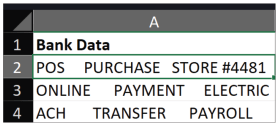
Clean data faster using Excel’s REGEX functions
Excel’s REGEX functions provide a simpler, flexible solution to text-cleaning tasks, reducing the need to combine multiple functions when cleaning imported data. This JofA Technology Q&A article shows the way with step-by-step instructions and a video walkthrough.
From The Tax Adviser
July 31, 2026
Current developments in S corporations
July 31, 2026