The work opportunity tax credit (WOTC) has been in existence for years; however, the Small Business and Work Opportunity Tax Act of 2007, P.L. 110-28 (SBWOTA), expanded the definition of some of the target groups, creating tax incentives that will affect more clients than originally expected. SBWOTA
Advertisement
TOPICS
Tax
Corporations and Partnerships to Tell More About Ownership
The IRS issued proposed revisions to Form 1120, U.S. Corporation Income Tax Return, and Form 1065, U.S. Return of Partnership Income , that would ask for more ownership information. Corporations would be required to identify individuals who own at least 50% of the voting power of all classes of the
Son of BOSS Goes Into Overtime
As a general rule, the statute of limitations on income tax returns is three years, extended to six years under section 6501 for a substantial omission of gross income. Courts in recent tax shelter litigation involving overstatement of basis have declined to apply the longer period. However, a recent district
IRS Issues FIN 48 Field Guide
The IRS Large and Mid-Size Business Division analyzed implications of FASB Interpretation no. 48, Accounting for Uncertainty in Income Taxes, in an industry directive and field examination guide. The summary and 10 questions and answers of LMSB-04-0507-045 cover some questions extensively discussed elsewhere, such as FIN 48 workpapers falling within
Car 54, Where Are You?
Police officers and firefighters who are permitted to drive their official vehicles home are exempt from the arrangement’s being considered a fringe benefit includable in income or subject to substantiation requirements of IRC § 274(d)(4), since the vehicles are considered unlikely to be used for personal purposes more than a
Taxpayer Suffers One-Two Punch on Stock’s Decline
The Court of Appeals for the Seventh Circuit rejected a taxpayer’s argument that margin loan financing of nonstatutory employee stock options rendered her exercise of the options not a taxable transfer within the meaning of IRC section 83. Under section 83, non-cash compensation, such as shares of stock, is taxable
Highlights
Japan and the International Accounting Standards Board (IASB) agreed to accelerate convergence between Japanese GAAP and International Financial Reporting Standards (IFRS). The two boards will seek to eliminate by 2008 major differences between Japanese GAAP and IFRS, with the remaining differences being removed on or before June 30,
TIGTA: IRS Passwords at Risk
Investigators posing as IRS computer help desk personnel were able to persuade 60% of Service employees they contacted to change their password to one the investigator suggested, a violation of IRS computer security rules. The findings by the Treasury Inspector General for Tax Administration (TIGTA) echoed those of a similar
“Unique” Trust Costs Exempted From Floor
The IRS and Treasury Department issued proposed regulation amendments intended to clarify how administrative expenses of estates and non-grantor trusts may be deducted. In general, such costs are considered miscellaneous itemized deductions subject to a minimum of 2% of adjusted gross income, similar to individual returns. IRC section 67(e)(1), however,
Cafeteria Plans Get Full-Menu Regs
The IRS updated, clarified and consolidated several previously issued proposed regulations concerning employee benefits under IRC section 125, better known as cafeteria plans. The new sections in REG-142695-05 clarify the definition of a cafeteria plan and guidance changes since the superseded regulations were published (the earliest in 1984) and include
Travel Deduction Gets Bumped
The Tax Court recently held that an airline mechanic could not deduct travel expenses while working in a city to which he was transferred by his employer, even though he hoped to return to his city of residence. The court concluded the mechanic was not “away from home” as required
Call in the Pros
Small businesses, payroll companies and tax professionals: The IRS wants to answer your calls. The Service is sponsoring free monthly phone forums—on the national and local levels—covering topics such as withholding requirements for foreign workers, powers-of-attorney, energy credits and identity theft prevention. The presentation is followed by a question-and-answer session.
Overlooked Medical Deductions Abound
While it is common knowledge that taxpayers may deduct qualified medical expenses for themselves and their dependent children, other opportunities to deduct medical expenses are not so widely known. One is the deduction of medical expenses that a taxpayer pays on behalf of others, such as elderly
“Reasonable Certainty” for a Theft Loss Deduction
The Internal Revenue Code often requires the calculation of amounts that are less than absolute but more than mere guesses. IRC § 165 allows taxpayers to deduct theft and other casualty losses but requires them to take reasonable action to recover those losses. If a claim for
NPO Compensation in the Spotlight
EXECUTIVE SUMMARY Intermediate sanctions impose a penalty tax on key employees of certain tax-exempt organizations who receive unreasonable compensation, and on managers who approve it knowingly. Intermediate sanction regulations provide a framework of appropriate policies and procedures regarding compensation for tax-exempt organizations. Intermediate sanction rules require organizations
The Word on IRD
Probably for the same reason people tend to put off making their wills, taxpayers often neglect to plan for the effects on their heirs of income they were entitled to receive but didn’t live long enough to see. So-called “income in respect to a decedent” (IRD) includes,
A Pink Slip and a Vest
In a revenue ruling, the IRS further standardized a benchmark it first proposed in 1991 for determining when a partial termination of a defined contribution retirement plan under IRC section 411(d)(3)(A) has occurred. The provision comes into play often when employers downsize, as in the scenario of the ruling, 2007-43,
AICPA Comments on Child Regs
The AICPA suggested modifications to proposed regulations concerning children claimed as dependents by parents who are separated or divorced. REG-149856-03, released in May, amends Treas. Reg. § 1.1152-4, which specifies support, custody and parental status requirements for children to qualify as dependents of parents who are divorced, separated or live
Users Grade Tax Software
A record number of CPAs responded to our fourth annual professional tax software survey in which we invited AICPA members to disclose, among other things, what tax-preparation software they use and how they evaluated various aspects of their products. In past years, only members of the Tax Section were included
Features




FROM THIS MONTH'S ISSUE
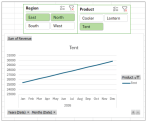
Create interactive dashboards with Excel PivotCharts and slicers
Leave the static spreadsheets behind. This JofA Technology Q&A article with video walkthrough provides a step-by-step guide for creating interactive dashboards in Excel that decision-makers can use.
From The Tax Adviser
January 31, 2026
Trust distributions in kind and the Sec. 643(e)(3) election
January 31, 2026
Effects of the OBBBA on higher education
December 31, 2025